Ramaphosa defends B-BBEE laws amid Musk's criticism


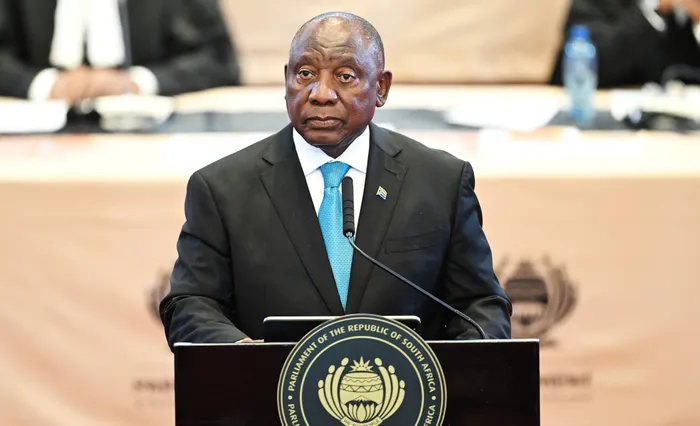
President Cyril Ramaphosa has pushed back against claims by Elon Musk that South Africa’s empowerment laws are “racist”, saying the policies are constitutional measures to address historical inequality.
Image: Phando Jikelo / Parliament of SA
President Cyril Ramaphosa has rejected Elon Musk's criticism of South Africa's Broad-Based Black Economic Empowerment (B-BBEE) laws, insisting that the policy is not racist, despite being labelled “extremely racist” by the billionaire.
Musk, who was born in South Africa, claimed his satellite internet service, Starlink, was denied a licence because he is not Black.
He described the regulations as “extremely racist” and a “shameful disgrace” to the legacy of Nelson Mandela, and called for sanctions against officials supporting B-BBEE.
However, the Independent Communications Authority of South Africa (ICASA) confirmed in March 2025 that Starlink had not formally applied for the required licences, despite raising concerns about the regulatory framework.
Under the Electronic Communications Act, aligned with B-BBEE policy, companies are required to have at least 30% equity ownership by historically disadvantaged individuals.
Musk also alleged that his company was offered opportunities to bypass the requirement by misrepresenting ownership, which he said he refused.
Speaking on the sidelines of the National Local Economic Development Summit 2026 in Boksburg, Ramaphosa said he paid little attention to Musk’s remarks.
“Our laws are not racist. They are empowerment laws meant to uplift people who were discriminated against,” he said.
Ramaphosa said that apartheid-era policies explicitly restricted Black South Africans’ rights, including where they could live and work.
He said current legislation is rooted in constitutional provisions aimed at redressing historical inequalities.
“What we are seeking to do is implement the constitutional imperative to correct the imbalances of the past,” he said.
He added that companies unable to meet equity ownership requirements can comply through “equity equivalent” programmes, such as investments in enterprise development, education and community initiatives.
Ramaphosa said hundreds of international firms, including Google, Amazon, Microsoft and General Electric, comply with South African regulations.
“Singling out our BEE laws is quite dishonest,” he said.
“These are empowering laws designed to benefit all South Africans, including women who were disadvantaged under previous systems.”
Meanwhile, tensions between South Africa and the US have intensified.
The situation follows renewed scrutiny of US-South Africa relations under President Donald Trump, who returned to office in January 2025.
His administration has criticised South Africa’s land reform policies and foreign relations with Russia, China and Iran, and threatened sanctions alongside a proposed US-South Africa Bilateral Relations Review Act of 2025.
The US has also imposed 30% tariffs on certain South African goods as part of its broader trade strategy.
Last week, the ANCs Fikile Mbalula said in August 2025 that ANC leaders were prepared to face sanctions rather than abandon policies aimed at economic transformation, including B-BBEE.