Riyaadh Kader: From paralysis at 13 to law graduate at UWC


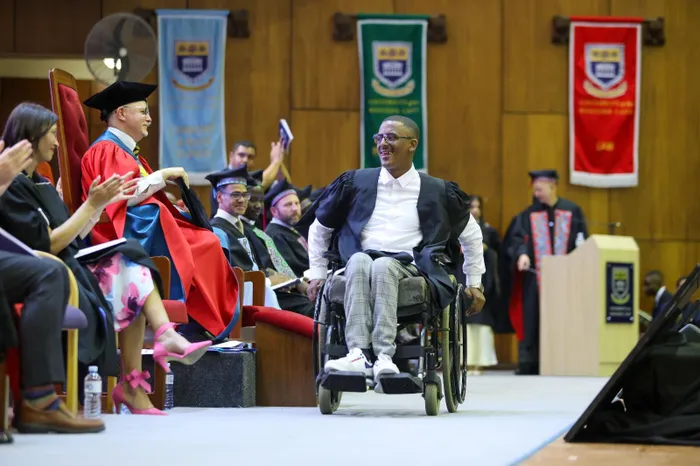
Riyaadh Kader arrives on stage in his wheelchair to receive his LLB at the University of the Western Cape graduation ceremony.
Image: Supplied/ UWC
At 13, Riyaadh Kader’s life changed in an instant.
A shooting in Hanover Park left him paralysed, forcing him to rebuild a future he had barely begun to imagine.
More than a decade later, he has done just that.
Now an LLB graduate of the University of the Western Cape (UWC), Kader’s journey is not only one of survival, but of purpose — a deliberate decision to turn hardship into something that could serve others.
“I am just a humble boy from the Cape Flats,” he said. “My journey started bitter, but it has been filled with so many meaningful moments.”
Growing up in a community where violence and inequality are part of daily life, Kader said his experience could have shaped him very differently.
Instead, it pushed him towards something bigger.
“I chose law because I want to serve society, to help people access justice and to contribute to equality and fairness,” he said.
For him, the degree is not just an academic milestone, but a step towards becoming part of a system he believes can improve lives.
“This was never just for me. It was for my community, for people who feel like hope is out of reach.”
That sense of purpose carried him through a journey that was anything but straightforward.
After matric, Kader applied to study LLB, making it his only choice. But when he arrived on campus to register, he was told his application had not been captured. With both law programmes already full, the possibility of studying further seemed to disappear overnight.
“I told myself if I don’t get into law, that’s the end of my studies,” he said.
It was only through the intervention of faculty members that he was eventually admitted into the five-year programme, a moment he still describes as life-changing.
“That was the start of a beautiful journey,” he said.
University life brought a new set of challenges. Living on campus meant adjusting to independence for the first time, while navigating an academic workload far more demanding than anything he had experienced before.
Accessibility was not always guaranteed. At times, reaching lecture venues proved difficult, but support from lecturers and the university’s Office for Students with Disabilities (OSwD) helped ensure he was not left behind.
“They made sure that I was not deprived in any way and went above and beyond,” he said.
The OSwD worked with faculty from Kader’s first year to ensure full access to academic spaces and facilitated suitable on-campus accommodation, helping him settle into university life.
He also became actively involved in the OSwD community, serving as a student assistant and building strong relationships with staff and fellow students.
“The OSwD team is immensely proud of Riyaadh’s achievements, which reflect his resilience and commitment to success,” said administrative assistant Craig Loubser.
Kader credits this support, along with his faith and resilience, for helping him endure moments that might have broken others.
“I internalised that this is all part of my journey, designed to benefit me and not disadvantage me,” he said.
His years of study were also marked by profound personal loss. During crucial exam periods, he lost both his brother and his grandmother, moments that tested not only his focus, but his strength.
Still, he returned.
“I reminded myself that I chose this path, and I was going to finish, no matter what,” he said.
Looking back, Kader said that while he did not find justice in his own case, it did not weaken his belief in the law or his desire to be part of it.
“I want to be on the forefront of fighting for justice for everyone,” he said.
For him, the law represents something larger than individual cases — a way to bring fairness and dignity to those who often feel excluded from it.
Now, as he prepares to graduate, the reality of what he has achieved is still sinking in.
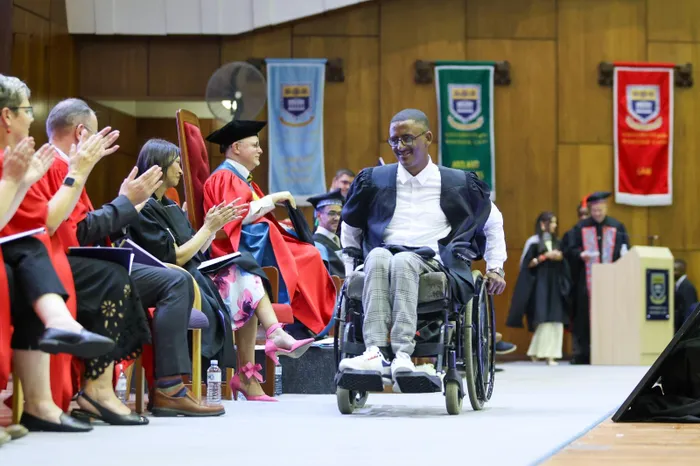
Applause fills the venue as Riyaadh Kader makes his way across the stage during his UWC graduation ceremony.
Image: Supplied/ UWC
“I don’t think I fully realise how big this is yet,” he said.
For his family, the moment carries even deeper meaning.
“I am the first graduate on my mother’s side. It’s something we never imagined, but it happened despite everything,” he said.
Spokesperson for UWC, Gasant Abarder, said Kader’s achievement reflects both personal determination and the impact of an inclusive academic environment.
“The University of the Western Cape is immensely proud of Riyaadh Kader’s remarkable achievement in graduating with his LLB. His journey is a powerful testament to triumph over adversity and the resilience of the human spirit,” Abarder said.
“At UWC, we are committed to being an inclusive university where students from all walks of life can pursue their dreams, no matter the obstacles they face.”
He added that Kader’s success is an inspiration beyond the university.
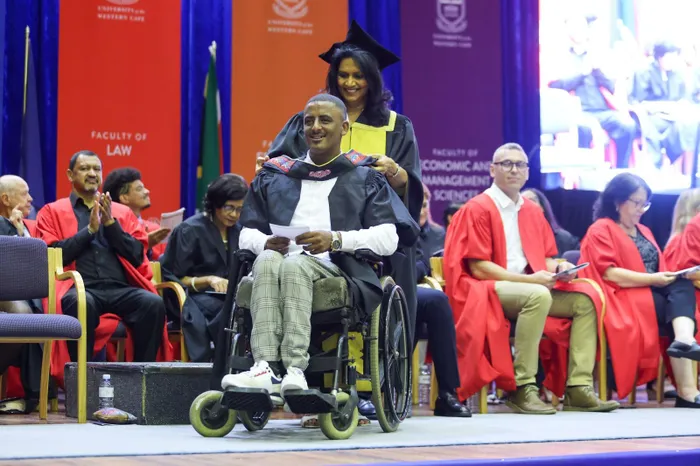
Riyaadh Kader receives his LLB at UWC, marking a major milestone in his journey after being paralysed at 13.
Image: Supplied/ UWC
“We celebrate Riyaadh’s accomplishment as an inspiration to his peers, his community, and to South Africa at large.”
For Kader, the journey is not over.
If anything, it is only beginning.
As he looks ahead, he is seeking an opportunity to complete his articles at a law firm, determined to turn his qualification into a tool for change.
“Being in a wheelchair and achieving this is not something you see every day, but it shows that anything is possible,” he said.
“After every difficulty, there is relief,” he added, referencing a verse from the Quran.
It is a message shaped by experience, but offered with hope.
“I just want to be of service and inspire the world,” he said.