Cape Town Muslim undertakers express concerns over High Court ruling on mortuary facility


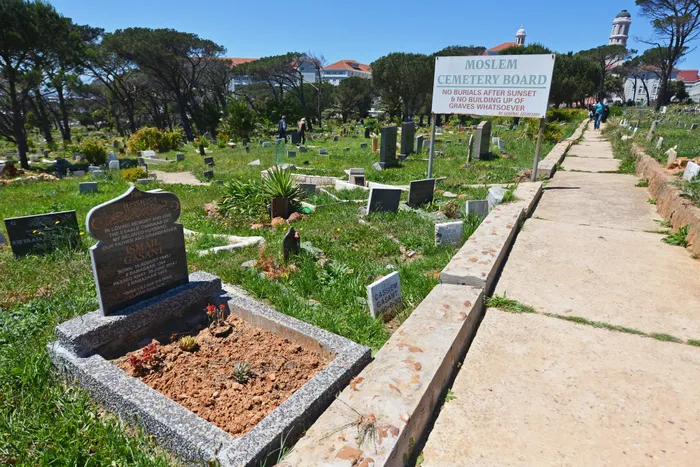
The planned storage facility at the Mowbray Cemetery has been halted by a high court order.
Image: Independent Newspapers Archive
Undertakers in Cape Town's Muslim community express their frustration following a High Court ruling that prevents the construction of a much-needed mortuary facility at Mowbray Cemetery.
The order, which was issued by Judge Gayaat Da Silva Salie, sitting at the Western Cape High Court, followed an application from Dr Tolgah Bassier, who challenged the conduct of the Muslim Cemetery Board that administers the cemetery.
In her judgment, Judge Da Silva Salie issued an order restraining the Board from constructing, completing, operating, or maintaining any mortuary facility on the cemetery property.
In a letter by the undertakers, the group said this order is disappointing and concerning, as this development is a significant loss of service infrastructure for the Muslim community and the burial sector.
The group consists of: Haroon Peters, Ameen Schroeder, Ebrahim Solomon, Yagyah Canfield, Faried Khan, Moulana Ebrahim Lee, Naeem Dadabhay, Redewaan Abrahams, Abdullah Salie, Yaseen George, Shamiel Herman, Mogamat Yusuf Evans, Imam Tasleem Abrahams, Igsaan Isaacs, and Muawiya Sofejan.
“As undertakers who work within the burial space on a daily basis, we find it deeply troubling that persons who are not involved in burial work, who are not undertakers, and who are not involved in the operational realities of death administration and burial logistics, have involved themselves in a matter of this nature to the extent that a facility intended to serve the community has been stopped,” the group said.
The group wanted to make the Muslim community aware that the mortuary storage was not a luxury but an essential part of the burial chain and was only meant to store the bodies of the deceased and not do post-mortems. It said this was a much-needed facility.
At present, the group said the community is heavily dependent on mortuaries that are not owned by the Muslim community. Daily, undertakers are compelled to make use of private mortuaries, many of which are owned by non-Muslims, and storage is paid for daily. This places continuous financial strain on burial services and ultimately on the community.
The undertakers further wanted to dispel the widespread misconception that the facility will be used for ordinary janazah processes.
“In most cases, burials take place without the need for storage. However, undertakers are frequently faced with circumstances where storage becomes absolutely critical,” the group said.
The undertakers said the halting of this facility has set burial services back in terms of infrastructure development and long-term planning.
The cemetery was acquired in 1886 specifically to provide a dedicated burial ground for members of the Muslim faith.
“The characterisation of the property as a waqf carries with it important legal consequences. Those who administer the cemetery do so not as owners, but as custodians or mutawallis (trustees), entrusted with preserving the property and ensuring that it is applied strictly in accordance with the purpose for which it was dedicated,” Judge Da Silva Salie noted.
She further added that any deviation from, or expansion beyond, the defined purpose of burial is inconsistent with that custodial role.