R95m programme aims to tackle gender-based violence in schools across South Africa


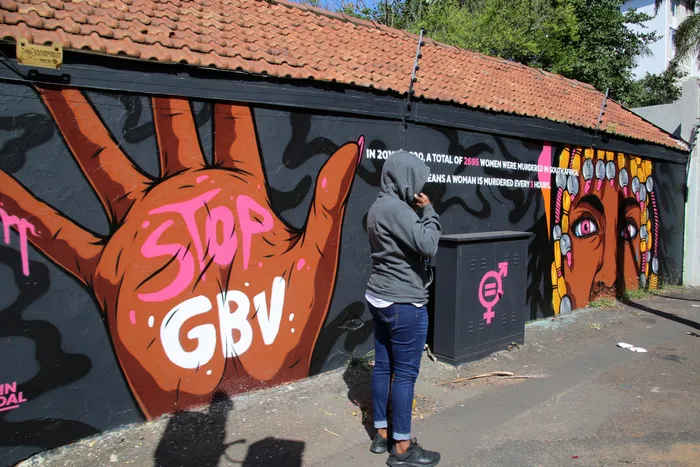
The Department of Basic Education is set to implement a new programme in 80 schools across four provinces, focusing on GBV prevention and support mechanisms for learners.
Image: Tumi Pakkies/ Independent Newspapers
The Department of Basic Education (DBE) is intensifying its efforts against gender-based violence (GBV) in schools with a R95 million (EUR 5 million) allocation from the European Union (EU).
The funding will support a programme targeting schools in 20 communities across KwaZulu-Natal, Gauteng, Mpumalanga, and Limpopo.
Education Minister Siviwe Gwarube detailed how the R95m will be allocated and what outcomes the department expects from the intervention, following a parliamentary question by the DA’s Ciska Jordaan.
Jordaan had also raised concern about the high crime incidents in schools as reported in the Quarter 3 (October - December 2025) crime statistics published in February.
“The programme is intended to strengthen prevention, referral, and support mechanisms in selected school communities, in alignment with South Africa’s broader policy and legislative framework on school safety, learner well-being, and the National Strategic Plan on Gender-Based Violence and Femicide,” Gwarube said.
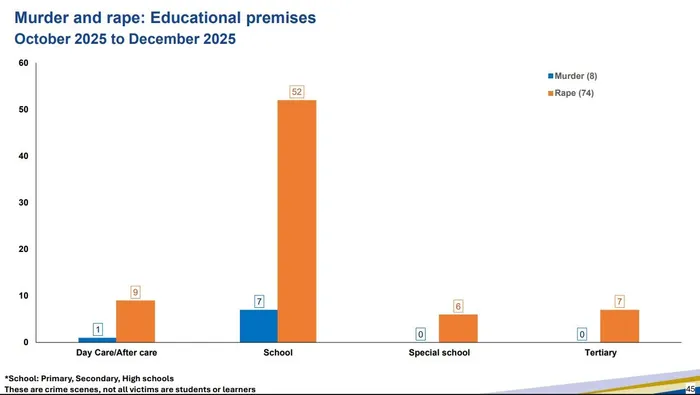
Statistics reveal the urgent need for intervention, with significant incidents of violence reported in educational settings across South Africa.
Image: SAPS
She noted that implementation will occur through two funding streams:
- EUR 3.5 million through a contribution agreement involving UN Children’s Fund (Unicef) and UN Educational, Scientific and Cultural Organisation (Unesco); and
- EUR 1.5 million through a grant to the Foundation for Human Rights.
“According to the information provided to the DBE, the intervention is expected to be implemented in 80 primary and secondary schools across 20 communities in the four provinces,” said Gwarube.
“The allocation is therefore directed at programme implementation, capacity-building, prevention initiatives, referral pathways, and support services for affected learners and school communities, rather than as a direct cash transfer to schools.”
Gwarube said the anticipated results are as follows:
- Improved access to prevention, protection, and psychosocial support services for learners in participating school communities;
- Stronger school- and community-level referral mechanisms for GBV cases;
- Increased awareness and prevention programmes aimed at reducing violence in and around schools; and
- Improved coordination among schools, communities, and relevant support services in the targeted areas.
She added that the department will be in a better position to report on the final measurable indicators and implementation targets once the planning process is complete.
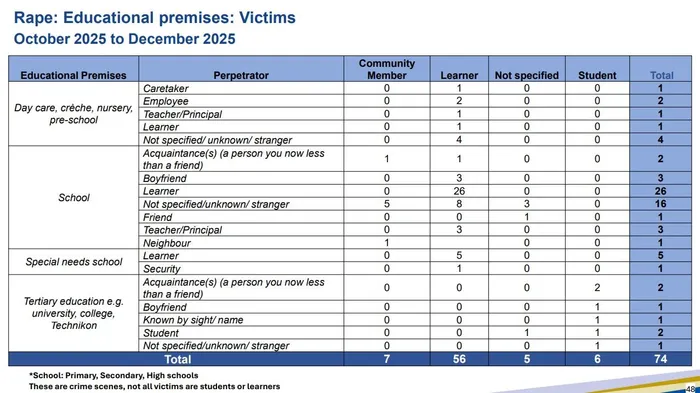
Quarter 3 crime statistics reveal that 74 rapes occurred at educational premises.
Image: SAPS
According to the Quarter 3 crime statistics, eight murders and 74 rapes occurred at educational premises (schools include primary, secondary, and high schools):
- Day care/after care (one murder, nine rapes)
- School (seven murders, 52 rapes)
- Special school (no murders, six rapes)
- Tertiary (no murders, seven rapes)
However, police said these are crime scenes, and not all victims are students or learners.
KZN registered the most rapes at educational premises with 16, followed by Gauteng with 13, Limpopo with seven, and Mpumalanga with five.