European tourists boost Cape Town's visitor numbers


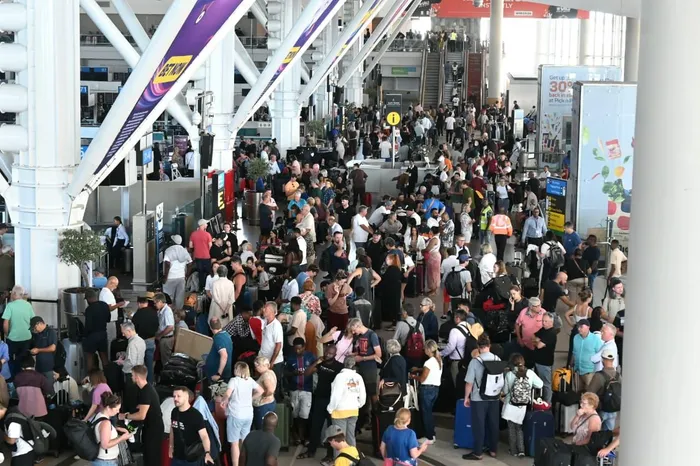
Thousands of passengers inside the terminals at the Cape Town International Airport.
Image: Ayanda Ndamane / Independent Media
Cape Town has continued to draw global travel interest, with recent figures released by StatsSA showing 121 612 visitors arriving at Cape Town International Airport during February 2026 alone.
According to StatsSAs International Tourism release for February 1-28, 2026, Europe accounted for 72.5% of all overseas tourists, with Cape Town accounting for 90 427 of 161 707 arrivals from that continent.
Economist Dawie Roodt said living standards in countries like China and India have also increased, and South Africa is seeing more tourists from those countries.
According to StatsSA, 3 792 travellers from Asia flew directly to Cape Town in February.
Roodt said global shifts in travel patterns are emerging.
"What I’ve picked up recently is that there are more and more other BRICS countries’ tourists coming to South Africa, like Russians, so it’s good for South Africa, from that point of view, to be part of BRICS but we certainly can and should market ourselves better in other parts of the world.
"What has been happening in recent years is that living standards in countries like China and India have increased quite nicely and we are getting more and more tourists from those countries so we are getting more visitors from other parts of the world, which is a good thing."
However, he warned that external factors could disrupt traditional markets.
“A potential risk is that, because of tensions in the Middle East, we could see European tourists not coming in the numbers that they used to,” he said.
“Diversifying for the ‘new rich’ countries is very important,” he said.
Most overseas tourists arrived in South Africa by air, with 94.6% using this mode of travel.
The StatsSA report noted that routine data collected by Department of Home Affairs immigration officers at the ports of entry into and out of South Africa shows that a total of 2 689 619 travellers (arrivals, departures and transits) passed through South African ports in February 2026.
These travellers were made up of 594 114 South African residents and 2 095 505 foreign travellers.
A further breakdown of the figures for South African residents indicates that there were 296 413 arrivals, 297 220 departures and 481 travellers in transit.
The corresponding volumes for foreign arrivals, departures and travellers in transit were 1 126 271, 935 359 and 33 875, respectively.
In February 2026, the distribution of overseas tourists was: Europe, 161 707 (72,5%); North America, 28 206 (12,6%); Asia, 15 804 (7,1%); Central and South America, 8 146 (3,7%); Australasia, 7 111 (3,2%) and Middle East, 2 004.
The United Kingdom and Germany were the leading European source markets, contributing 45 404 and 39 866 tourists to South Africa respectively, followed by the Netherlands and France.
Economist, Ulrich Joubert, said tourism inflows can contribute to supporting the rand.
“If you have more visitors coming into South Africa than leaving, it creates a net inflow of foreign currency, which should support the value of the rand,” he said.
Joubert said strong tourism performance could have a knock-on effect for households.
“A stronger rand helps keep the domestic price of fuel and other imports more stable, which in turn helps contain inflation.
“If inflation is contained and interest rates remain stable or decline, it helps households with housing loans, vehicle finance and other debt,” he said.
However, he warned that failing to fully capitalise on tourism growth could come at a cost.
“The potential in the tourism industry is being lost, and it could have a major impact on the value of the rand,” he said.
Cape Town’s tourism growth has been closely linked to air access, with the city connected to more than 30 global destinations and over 200 international flights a week.
Get your news on the go, click here to join the Cape Argus News WhatsApp channel.
Cape Argus