Eight-time TB survivor inspires hope in the fight against tuberculosis


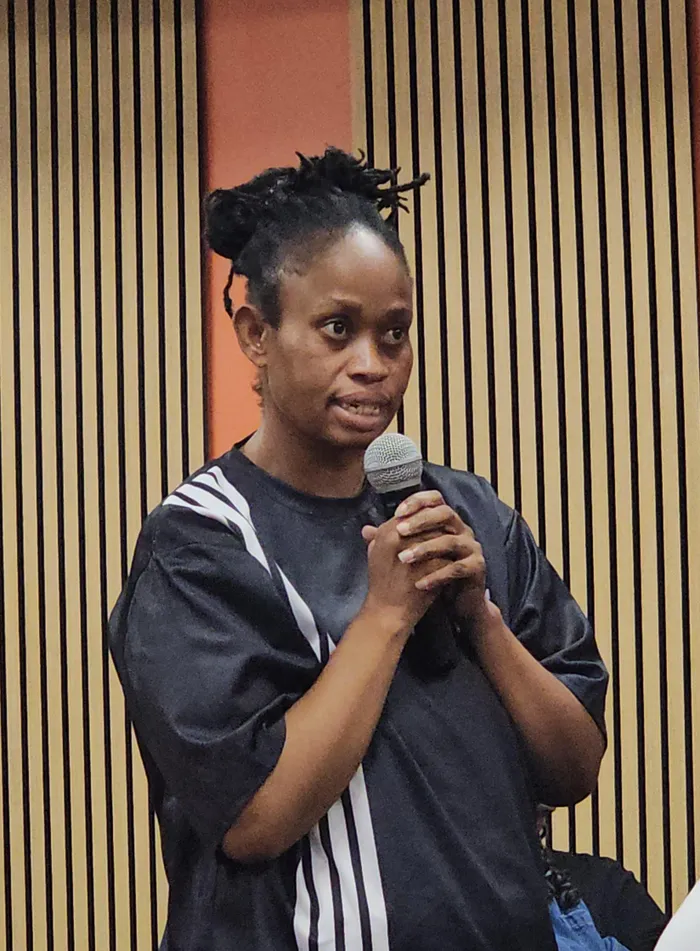
Mabongi Luthuli, an eight-time TB survivor, believes tuberculosis is fightable, inspiring hope even as thousands continue to battle this deadly disease each year.
Image: Screenshot of video by Karen Singh
World TB Day remains shadowed by a sobering reality where a person dies from tuberculosis every ten minutes.
This is despite having an advanced, evidence-based Tuberculosis (TB) programme.
Professor Rubeshan Perumal, head of the TB-HIV Treatment Research Programme at the Centre for the AIDS Programme of Research in South Africa (CAPRISA), points out that the mortality rate is “a frightening level... from a disease that is not only preventable but also curable.”
The fight against TB in South Africa is no longer defined by a lack of diagnostic tools or effective drugs; it is now a battle against the ‘last mile’ challenges, including poverty, systemic cracks, and the profound social burden carried by patients and their families.
Perumal was speaking at CAPRISA’s World TB Day Commemorative Panel discussion, in collaboration with the University of KwaZulu-Natal (UKZN) and the Africa Health Research Institute (AHRI) at the Nelson Mandela School of Medicine this week.
The human cost: Pills, poverty, and post-TB life
For ordinary South Africans, the struggle with TB is intensely personal. TB survivor from the District AIDS Council in eThekwini, Nkosikhona Mpungose, recalls the initial difficulty of treatment. “The pill is just too big for your throat. I’m not sure whether science will actually design something smaller and friendlier, but the pill is just not friendly for your mouth. It’s too big and tastes bitter.”
Dr Richard Lessells, Group Leader at KRISP, UKZN, highlights this critical disconnect between the lab and the living room. “These are the simple things that we often, as researchers and clinicians, pouring over data, we forget... the basic reality of the challenges of taking TB treatment for six months.”
Perumal stresses that survival is not the end of the story. “People who survive TB are scarred... and they live the rest of their lives with difficulty breathing, with uncomfortable symptoms of cough and fatigue.” This “post-TB lung disease” is a neglected area that needs “better ways of supporting people as they transition from our care for acute TB into long-term care after TB,” he says.
The socio-economic toll is crippling. Perumal notes that the destabilising event of TB in a home leads to what is termed a “catastrophic cost” for half of all affected families.
These are expenses that the health community often fails to account for: “The cost that will be incurred to improve the nutrition of the home and to travel to the clinics monthly... to stay for caregivers to stay away from work or school to take care of their loved one.”
Vikar Singh from the National Health Laboratory Service, an advocate for broader support, echoes similar sentiments, stating, “We need to open the discussion to other departments, such as social development... to find out what they are doing to support people living with TB.”
This includes ensuring patients are fed. “You see patients that actually don’t have food to eat when they have to take their TB treatment.”
Professor Kogie Naidoo, CAPRISA Deputy Director, drives home the severity of this poverty link, citing a trial in India where nutritional intervention in households reduced microbiologically positive TB by 48%. “A TB patient is a symptom of a family in distress,” she states.
The missing: Those undiagnosed and those who die
The National Department of Health (NDoH) has made significant strides, but a massive diagnostic gap persists. Dr Norbert Ndjeka, Chief Director of TB Control and Management for the NDoH, outlines the landscape: “389 people per 100,000 population. It translates to 249,000 people that we should be finding with TB every year. We find 64,000 less; our gap is 26%.”
Furthermore, 54,000 people die from TB annually in South Africa.
Ndjeka explains, “If you have a count of 249,000, you lose 54,000 because they’ve died. You lose 64,000 because you’ve not diagnosed them. Then you get the rest, you treat them.”
The people most likely to die are those “who really fall through the cracks,” says Dr Lessells. This includes patients with devastating forms of the disease like TB meningitis and disseminated TB, often linked to advanced or undiagnosed HIV.
Professor Mahomed Yunus Moosa, Chief Specialist and Head of Infectious Diseases at UKZN, sees these patients at the extreme end. “I’m the wrong person. I shouldn’t be seeing these patients. They should have been sorted out well before they even got the TB... For us, it is about diagnostics. We’ve improved diagnostics... but we’ve still got a hell of a lot to deal with TB.” He believes TB needs to be addressed at a “far higher level” than the clinic or hospital.
Mabongi Luthuli, an eight-time TB survivor, spoke about her struggle, describing her journey as “painful but fightable because I’m still alive.”
Although she continues to live and fight, she faces ongoing complications with her lungs.
“I was diagnosed with TB last year, in December, but I’m not captured. They lost my card three times. I’ve been getting the message from the National Health Laboratory Service (NHL) that I’m supposed to go to the clinic. So that means our data is not doing its job.”
The adherence dilemma: Beyond the pill box
Once diagnosed, the next hurdle is adherence. The debate about returning to Directly Observed Treatment (DOT) support — where a health worker or family member watches a patient take their pill — is back on the table.
Patrick Mdletshe, from the Treatment Action Campaign and head of CAPRISA’s Community Programme, argues, “I still argue that you don’t change what is actually working. I think somewhere, somehow, we need to go back to those basics. Because without a buddy or without someone that is giving you that support on a daily basis, then you get tired.”
Lessells acknowledges that the field moved away from DOT due to concerns that it was “paternalistic” or “punitive”.
However, he is now interested in revisiting the discussion to see “whether that’s working or whether we need to still find better ways to give that support”.
Perumal advocates for a nuanced, “differentiated service delivery” model for adherence. The vast majority of people do fine on their own, but there is a smaller group who need “constant support” and an even smaller group who need daily, in-person assistance. “It’s how do we identify those people who need this kind of intensified support?”
Other critical social issues undermine adherence. CAPRISA TAC member Nqobile Ngcongo believes that the stigma of TB being associated with poverty stops people from returning for care. “After you are told that you have TB, you won’t go back to the clinic because you don’t want them to say, I have TB because I’m poor.”
Professor Limakatso Lebina, Director of Science at Africa Health Research Institute (AHRI), stresses that TB must be treated as a “chronic disease” requiring intentional support. “We have not invested as much in TB management to say this is a chronic condition... You can’t just be high. You have TB. Here are your tablets. Go home and figure it out.”
She argues for post-test counselling, similar to HIV care, to build supportive structures around the patient.
Innovation and hope
Despite the immense challenges, the TB community remains focused on innovation. South Africa has been a world leader in adopting GeneXpert molecular testing and is now implementing newer technologies.
Ndjeka mentions introducing targeted next-generation sequencing to quickly detect resistance to new drugs and near point-of-care molecular tests to decentralise diagnostics.
In terms of treatment, the duration for drug-resistant TB (DR-TB) has been dramatically reduced from 24 months to six months for most patients, with treatment success rates now approaching 80%.
Ultimately, many experts agree that sustained progress requires a vaccine.
Naidoo highlights that, “the seminal papers that have come out over the last few years that have shown us how to effectively reduce TB incidents, we need a vaccine.”
Ndjeka is “pleased that UKZN has been the bedrock of clinical training... [and] that, for example, at CAPRISA there are four novel TB vaccine candidates that are being assessed.”
The final frontier, however, is not a drug or a diagnostic tool, but a societal shift. As Sazi Jali, Secretary of Civil Society in eThekwini, puts it, the messaging must change. “Who is the face of TB? Anyone can have TB, and I’m glad that they brought up the issue of adherence... I think the message needs to change. And also go back to what civil society is saying. We say that community leads.”
Have thoughts on this topic or other subjects you’d like us to explore? Want to share your experiences? Reach out to me at [email protected]