R823m SANDF deployment under scrutiny


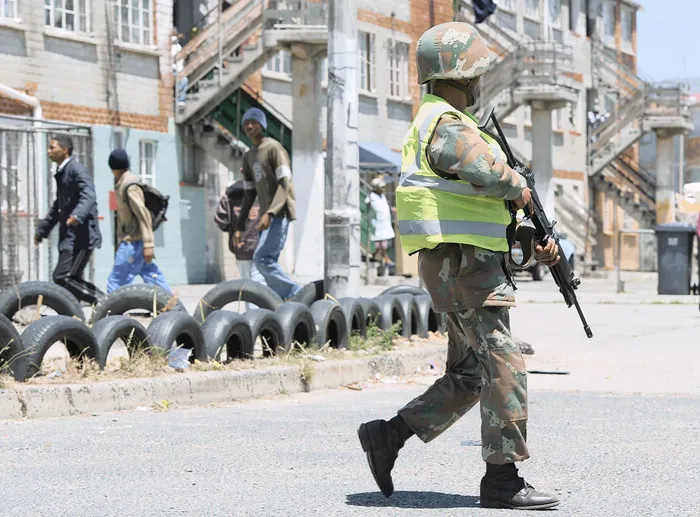
SANDF deployment under scrutiny as DA questions R823m cost and transparency amid Cape Flats crime concerns
Image: Henk Kruger Independent Newspapers
A Cape Town mother wept inconsolably, struggling to utter a single word, after both her sons — one after the other — were shot and killed at the weekend.
The brutal deaths of her sons, Luchen Samuels, 19, and Angelo Hufke, 32, whose bodies she had to identify alone, just years after she buried her firstborn, who died the same way, come exactly 47 days after President Cyril Ramaphosa promised to deploy the army to the Mother City.
And though soldiers are finally set to put boots on the ground tomorrow in the crime-ravaged city, at a staggering cost of R832m, for families like hers, it comes painfully too little, too late.
Samuels and Hufke, of Uitsig Avenue, were among five people killed in Gugulethu and Philippi East on Saturday, police spokesperson Colonel Andre Traut said.
Three other youngsters aged 16, 19, and 29 were wounded during the shooting and transported to a medical facility for treatment.
But when will the bloodshed stop, and will the deployment make a difference? Politicians, experts, and community members told the Cape Argus they are asking how the R832 million will be spent.
The Democratic Alliance is demanding a full breakdown of the SANDF deployment cost, warning that Parliament cannot accept the figure without clear details on how it was calculated or how the money will be spent.
DA NCOP member on security and justice, Nicholas Gotsell, said reports of high expenditure on Armed Forces Day celebrations, including subsistence and travel costs of up to R70 000 per person, raised serious concerns about financial management within the Department of Defence.
“Reckless or poorly controlled spending is not merely embarrassing, it is a direct risk to operational readiness and public trust,” he said.
Gotsell added that the Department of Defence has struggled to obtain clean audits in recent years, and that a significant portion of ongoing investigations by the Special Investigating Unit and the Hawks within the security cluster relate to the department.
The issue came to the fore during a recent meeting of Parliament’s Joint Standing Committee on Defence, where Defence Minister Angie Motshekga was present for part of the proceedings but left before discussions on the deployment, leaving key questions unanswered.
According to Gotsell, these include how the R823 million figure was calculated and what safeguards are in place to prevent wasteful expenditure and corruption.
The DA has called for the minister and SANDF officials to account before a joint sitting of Parliament, in what is expected to be a key test of government’s willingness to provide transparency on the deployment.
Meanwhile, the SANDF and Saps say they are ready for the operation, with troops already undergoing training and preparations in affected provinces.
Briefing MPs, SANDF Joint Operations Division director operations, Martin Gopane, said the deployment is aimed at tackling “complex organised crime threats”, including gang violence, illicit mining, extortion and the proliferation of illegal firearms, particularly in high-risk provinces such as the Western Cape, Eastern Cape and Gauteng.
He said the deployment forms part of a broader, coordinated government response involving multiple departments.
The aim, he said, is to stabilise affected areas, reduce violent crime and improve cooperation between security agencies.
Gopane added that SANDF members would operate under strict legal and constitutional guidelines, including respecting human rights and working in coordination with SAPS, with any arrests required to comply with the Criminal Procedure Act.
Meanwhile, Economic Freedom Fighters MP Carl Niehaus described the deployment as a “reluctant necessity”, but warned that it must remain temporary and subject to strict parliamentary oversight.
He said while organised crime posed a serious threat, the use of the military in domestic policing risked becoming a substitute for addressing underlying challenges within SAPS, and cautioned that previous deployments had delivered only short-term stabilisation.
Niehaus also raised concerns about the lack of detailed budget transparency presented to Parliament, given the scale of the R823 million deployment.
The deployment comes against the backdrop of persistent gang violence in Cape Town, particularly on the Cape Flats, where communities have repeatedly called for stronger state intervention.
Previous SANDF deployments in the city have delivered only short-term relief, with crime levels in some cases rebounding after troops were withdrawn.
While government has framed the deployment as part of a broader response to organised crime, critics argue it risks being a temporary measure that does not address underlying challenges within SAPS.
Western Cape DA spokesperson on police oversight and community safety, Benedicta van Minnen said soldiers cannot investigate crimes or secure convictions, warning that violence could return once troops are withdrawn.