SARB keeps interest rates steady as inflation risks rise


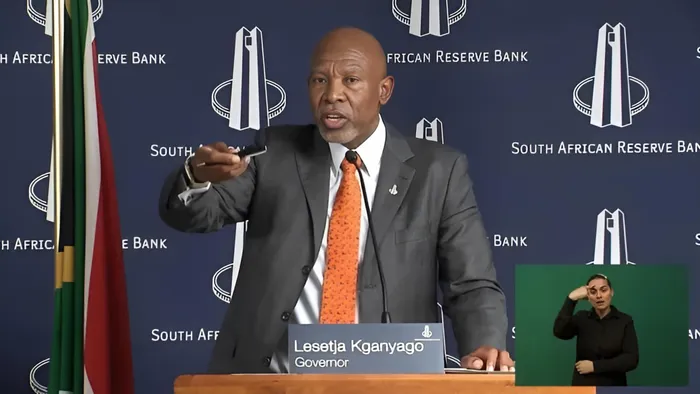
The war in the Middle East has placed pressure on South African Reserve Bank governor Lesetja Kganyago this month.
Image: IOL | File
South African Reserve Bank (SARB) Governor Lesetja Kganyago confirmed that interest rates will remain steady at 10.25%.
Economists had broadly expected the bank to keep rates at 10.25% given the current inflationary outlook, with some suggesting that SARB may start hiking rates in the not too distant future should the war persist.
Addressing media on the outcomes of the Monetary Policy Committee meeting on Thursday, Kganyago said "in previous meetings we warned of elevated risks, and we have been proceeding cautiously in our rate setting. Now a crisis has hit, this prudent approach is proving appropriate".
The bank's projections also have rates staying unchanged for a longer period, postponing the cuts from the January projections. Previously, the outcome was positive for decreases in the lending rate.
The prime lending rate in South Africa has been cut six times between September 2024 and November 2025, dropping a cumulative 1.5 percentage points.
Inflation worries
The Governor added that the inflation risks were to the upside, noting that "the coming months will be crucial for assessing the longer-term inflation consequences". Depending on how long the war lasts, inflation could potentially exceed 5%, he said.
Economists had indicated that the bank would be watching inflation closely, especially for second-round effects from higher fuel and input costs, as oil price volatility linked to Middle East tensions filtered through the economy.
Oil was trading at $105.87 during the early afternoon, up 3.68% on the day, while the rand was at November 2025 lows, trading at R17.10. Oil dropped below $100 on Tuesday after news broke that US President Donald Trump had delivered a 15-point plan to Iran via Pakistan to end the war.
However, the liquid rose sharply again after Iran declined to enter into talks. Over the past month, oil is up 50.78%, with a sharp increase starting the day Operation Fury launched.
Previous expectations
Nedbank pointed out that during the last meeting, in January, the central bank it constructed a “scenario in which Brent Crude shoots up to $75 a barrel, and the rand weakens to R18.50 to the US dollar”.
This would result in higher inflation, although the figure would still remain within the tolerance band, Nedbank said. Inflation, which came in at 3% - spot on target – for February, could now move much closer to 4% in the near-term.
The key driver is currently oil, which will cause fuel prices to drive the next leg of inflation, with hikes of as much as R6 for petrol and R11 for diesel set to hit the pumps on April Fool’s Day.
Unprecedented
Independent economist Elize Kruger warned that the scale of the increase could be unprecedented.
“These increases will be the highest ever to be implemented in a single month in South Africa and will likely derail the fragile economic recovery envisaged for South Africa in 2026,” she said, adding that elevated fuel prices could persist for several months.
Trading Economics said, “beyond oil, increases in electricity and food prices are likely to add upward pressure on inflation”.
Johann Els, chief economist at PSG, said the path for interest rates now depends largely on how the situation in the Middle East evolves.
While a moderation in oil prices could reopen the door to cuts later in the year, Els cautioned that sustained inflationary pressure may instead force the central bank to consider hikes.