Domestic workers demand recognition and protection


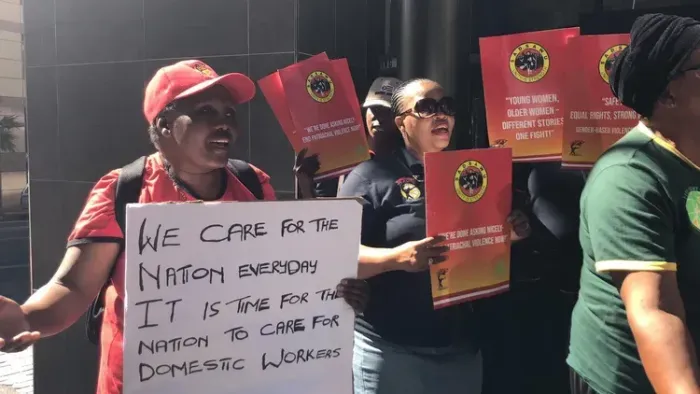
"We care for the nation everyday. it is time for the nation to care for domestic workers" reads the placard at the protest led by domestic workers on Human Rights Day.
Image: Lilita Gcwabe
Domestic workers say that the celebration of Human Rights Day is hollow when their own rights are consistently overlooked and poorly enforced.
As the country commemorated Human Rights Day on Saturday, members of the South African Domestic Service and Allied Workers Union (SADSAWU), supported by Cosatu, marched to the Department of Employment and Labour in Cape Town, where they handed over a memorandum of demands, calling for urgent government intervention.
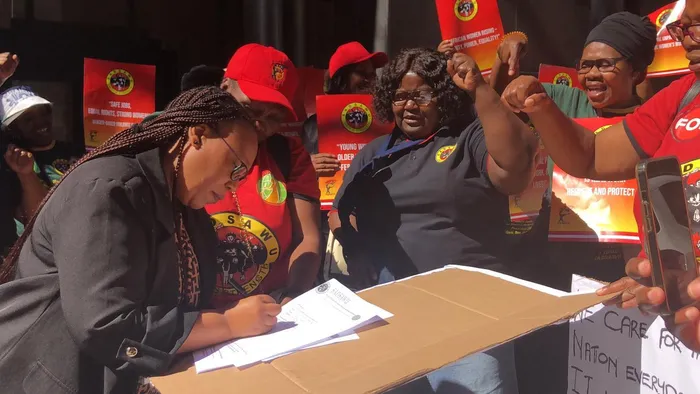
Members of the South African Domestic Service and Allied Workers Union, supported by Cosatu, marched to the Department of Employment and Labour in Cape Town to hand over a memorandum of demands, calling for urgent intervention from the government.
Image: Lilita Gcwabe
At the centre of their demands is a call for Labour Minister Nomakhosazana Meth to urgently engage with domestic workers and ensure they are fully recognised as formal workers, with access to the protections afforded to other sectors.
"We can’t celebrate if employers, government, and society don’t recognise us as workers in South Africa. We carry families, we carry society, and we contribute to the economy," said union leader Gloria Kente.
"It is time for the nation to take care of domestic workers the way domestic workers take care of them," she said.
"They treat us like we don’t have skills because we are seen as uneducated.
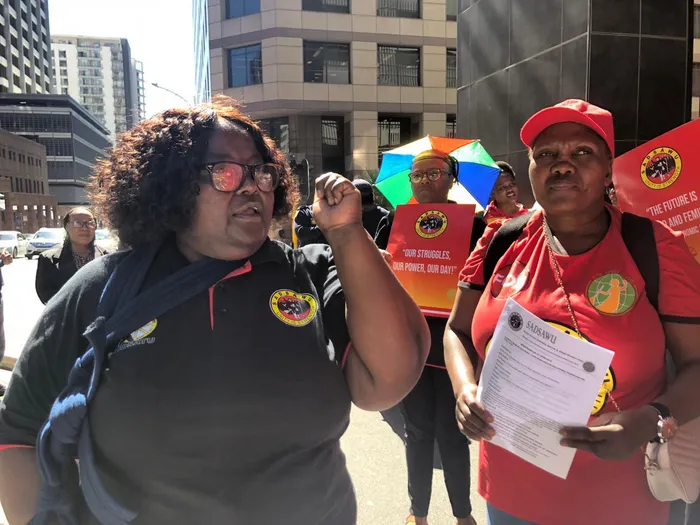
Gloria Kente standing alongside Mary Nkonyana at the protest on Human Rights Day in Cape Town.
Image: Lilita Gcwabe
The protest comes after President Cyril Ramaphosa recently announced that 10,000 labour inspectors would be recruited to strengthen the enforcement of labour laws. However, domestic workers expressed little confidence that the move would improve their conditions.
"There have always been labour inspectors, but they don’t go inside private homes," Kente said. "They don’t check payslips or whether employers are complying with UIF and COIDA registrations."
For many workers, the issues raised during the march are rooted in years of personal hardship.
Vuyokazi Mokoena, who has worked as a domestic worker for 26 years in areas including Table View and Durbanville, described the emotional and financial toll of the job.
"I have dedicated my life to this work," she said. I only see mine on weekends."
Mokoena said she has frequently faced late or incomplete payments, leaving her unable to meet her own family’s needs.
"When it is time to pay me, there are always excuses. Sometimes I get less than what I worked for. Sometimes it’s late. And then I can’t provide for my children," she said.
She added that live-in domestic workers are particularly vulnerable, with employers often disregarding sick leave and days off.
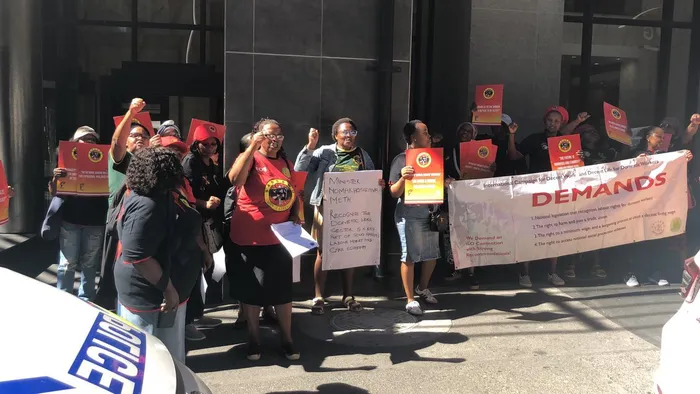
Members of the union chanted at the door of the Department of Labour on Long Street, Cape Town.
Image: Lilita Gcwabe
As the memorandum was handed over, SADSAWU Treasurer Mary Nkonyana delivered an emotional appeal.
"We are bleeding," she said. "We need the department to recognise us."
Nkonyana described widespread mistreatment in the sector, including verbal abuse, low wages, and unpredictable working conditions.
She added that many domestic workers struggle to afford basic necessities and are trapped in cycles of debt.
"We can’t afford to take our children to school. We can’t afford to pay back the loans we depend on to survive. That is the reality of domestic workers. We are bleeding."
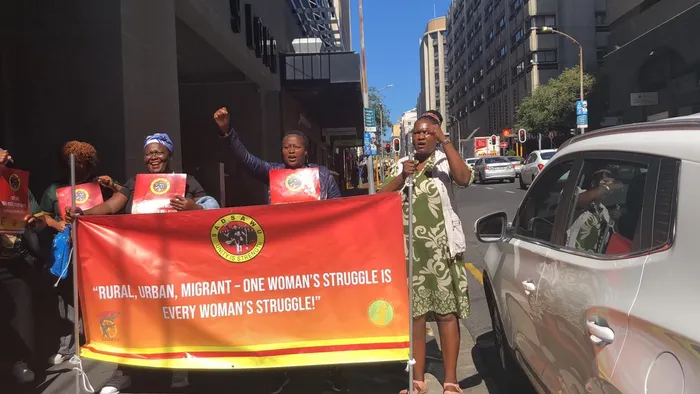
Among the key demands submitted to the department are the formal recognition of domestic workers as care workers, stronger enforcement of labour laws, compliance with minimum wage regulations.
Image: Lilita Gcwabe
Among the key demands submitted to the department are the formal recognition of domestic workers as care workers, stronger enforcement of labour laws, compliance with minimum wage regulations, mandatory registration for UIF and COIDA, and increased labour inspections, particularly within private homes.
Thina Lethu Mazibuko, deputy director of the Labour Centre Operation from the Department of Employment and Labour, received the memorandum and acknowledged the deadline. She declined to comment further.
The department has been given 14 days to respond to the memorandum.