Cape Town's marine outfalls operating within limits during appeal process


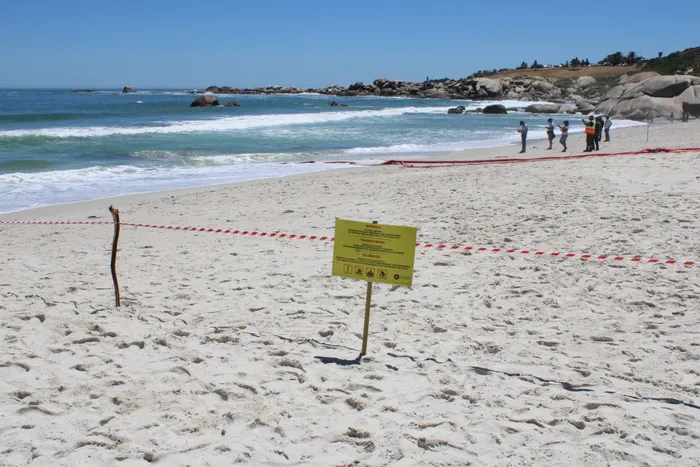
A warning sign and tape warned people not to use this part of Camps Bay beach, this was in February 2022.
Image: File
The City of Cape Town says its marine outfall systems are operating within permitted limits and under regulatory oversight, as an appeal against discharge licences issued by the Department of Forestry, Fisheries and the Environment (DFFE) remains unresolved.
The appeal, lodged in February 2023, challenges licences that allow the City to discharge screened effluent into the ocean via marine outfalls at Green Point, Camps Bay and Hout Bay.
Responding to follow-up questions from the Cape Argus, the City’s Mayoral Committee Member for Water and Sanitation, Councillor Zahid Badroodien, said all three outfalls are operating within their approved discharge allowances.
“Camps Bay has a summer discharge allowance of 5.5 million litres per day and operates on average at around 50% of that. Green Point has a summer discharge allowance of 44 million litres per day and operates on average at about 50% of that. Hout Bay has a summer discharge allowance of 10.78 million litres per day and operates at 50% of that,” Badroodien said.
He said these figures relate to average dry weather flows, adding that higher discharge volumes are permitted during winter months.
Badroodien said the City is complying with the conditions of its discharge permits, referring to operational and environmental monitoring results presented at a recent Permit Advisory Forum.
“The findings show that the outfalls continue to operate reliably and largely within the Coastal Water Discharge Permit conditions, with the surrounding coastal waters remaining suitable for recreational use,” he said.
He added that due to daily and seasonal variations in wastewater composition, compliance levels above 90% are generally regarded as acceptable by regulators.
On environmental monitoring, Badroodien said the City conducts sampling in accordance with a programme approved by DFFE.
“We sample and measure hundreds of environmental factors, including chemical, pharmaceutical, nutrient and metal contaminants at the three outfalls as well as at two False Bay sites every month,” he said.
He said the work is carried out by independent, accredited laboratories and marine science experts, with results presented at public Permit Advisory Forum meetings.
Addressing criticism that untreated sewage is being discharged into the ocean, Badroodien said marine outfalls are designed systems that rely on dilution and natural processes.
“Marine outfalls are in fact treatment systems designed to utilise natural processes occurring via the pipeline as well as those occurring in the ocean to dilute and treat the wastewater while not exceeding the assimilative capacity of the receiving environment,” he said.
He added that the City is undertaking a refurbishment programme at all three outfall pump stations, following the award of a design-and-build contract in January 2026, with completion scheduled for December 2027.
Badroodien said feasibility studies into medium- and long-term alternatives are also under way, including potential upgrades to introduce additional treatment processes, subject to further approvals and funding.
He confirmed that a criminal case previously opened against the City in relation to marine outfalls did not proceed after the National Prosecuting Authority declined to pursue the matter.
“The City has and is still supplying all information to DFFE appeals as and when requests for information are submitted by them,” he said.
DFFE had not provided a substantive update on the status of the appeal at the time of publication.