Rising sea levels pose a growing threat to Cape Town's coastline


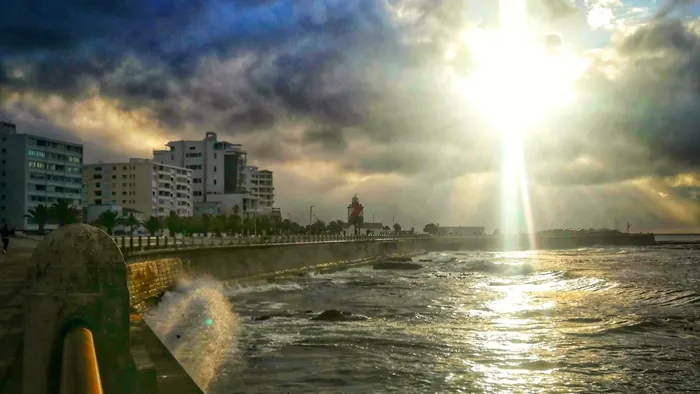
Rising sea levels and storm surges are increasing flood risk along Cape Town’s coastline.
Image: Murray Swart/ Cape Argus
Cape Town’s coastline faces increasing flood risk, with new research showing sea levels along Africa’s coast are rising faster than the global average.
Even small increases in sea level can significantly raise the risk of flooding during storms, particularly when storm surges coincide with high tides.
A study led by the University of Cape Town’s Department of Oceanography found sea levels around Africa have risen by 11.26cm since 1993, with the rate accelerating significantly after 2009 by 73%.
The findings point to increasing risks for coastal cities such as Cape Town, particularly during winter storms when storm surges coincide with high tides.
The most dramatic spike came during the 2023 to 2024 El Niño, which triggered a record 27mm sea level surge, surpassing the 1997 to 1998 event.
Scientists say the surge was driven by a rare alignment of climate systems combined with rising ocean temperatures. Thermal expansion, where seawater expands as it warms, accounted for more than 70% of the increase.
“We are witnessing a fundamental shift in how the ocean responds to climate variability. The 2023 to 2024 event interacted with an ocean already preconditioned by multiple climate forces and excessive heat, creating a compound effect that pushed sea levels to heights we have never seen in the satellite record,” said Dr Franck Ghomsi, lead researcher at UCT’s Nansen-Tutu Centre for Marine Environmental Research.
Wind systems that usually bring cooler water to the surface weakened, allowing heat to build up and become trapped near the ocean surface, driving sea levels higher.
The City of Cape Town said coastal flood risk varies across its approximately 307km coastline due to its complex and dynamic nature.
“Cape Town’s coastline extends approximately 307km and is characterised by a high-energy, naturally dynamic coastal environment. As a result, it is periodically exposed to processes such as coastal erosion and episodic flood events, particularly during winter storms and when these coincide with spring high tides,” said the City’s Deputy Mayor and Mayoral Committee Member for Spatial Planning and Environment, Eddie Andrews.
“Given this complexity and variability, an adaptive management approach is essential for effectively managing coastal flood risk,” Andrews said.
The City said it is implementing a multi-pronged strategy to prepare for rising seas, including a Coastal Management Line to guide development, ongoing coastal hazard modelling and updated risk assessments.
Infrastructure projects including sea walls in Strand and Sea Point, and geobag revetments in Milnerton and Big Bay form part of efforts to protect vulnerable areas.
Dune rehabilitation in areas including Table View, Hout Bay and Fish Hoek is also being used to buffer against storm surge and erosion.
The study estimates that more than 15 million people across Africa’s coastal cities are now at heightened risk of flooding, with researchers warning that the continent’s coastlines are becoming early indicators of compound climate threats.
Scientists warn that, without effective adaptation, rising sea levels combined with more intense climate events could increase the frequency and severity of coastal flooding in cities such as Cape Town.