UCT sociologist calls for a rethink on the burden of care

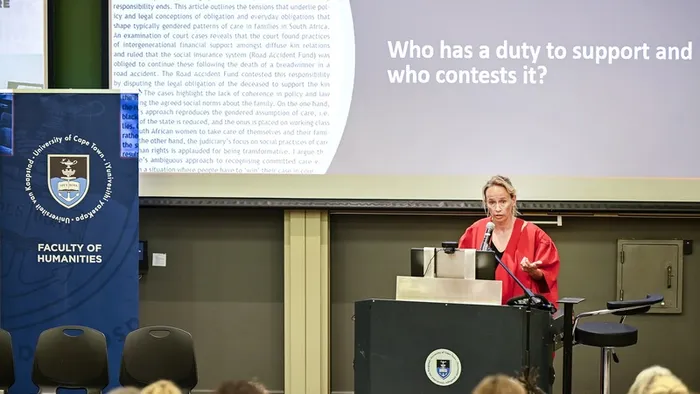
UCT sociologist Professor Elena Moore delivered her inaugural lecture exploring how families, governments and communities share responsibility for care. Photo: Lerato Maduna.
Image: Supplied
A University of Cape Town sociologist is urging society to rethink who carries the burden of caring for the elderly, children and vulnerable people, arguing that the work of care is often invisible, undervalued and shaped by deep social inequalities.
Professor Elena Moore from the University of Cape Town’s Department of Sociology delivered her inaugural lecture on March 4, titled Who Cares? The Directions of State–Family Relationships in Changing Times, drawing on more than two decades of research into how families and societies organise care.
Moore said care is not simply a private or moral responsibility but is strongly influenced by law, public policy, labour markets and historical inequalities.
Her research spans Ireland, South Africa, Botswana, Namibia and Malawi, and explores how governments and families share – or fail to share – responsibility for care.
Moore traced the roots of her research to her postgraduate studies at Trinity College Dublin, where she examined Ireland’s 1937 Constitution and its framing of women’s roles in the home.
Curious about how those constitutional ideas played out in practice, she analysed hundreds of Irish divorce cases and found that women’s unpaid domestic labour was often undervalued in court rulings.
In recent years, Moore’s research has focused on the care of older people, examining who provides this care, under what conditions and at what personal cost.
She led a major project involving 40 researchers working across 19 sites in South Africa, Botswana, Namibia and Malawi. Fieldwork was conducted in 11 languages and explored how elder care is experienced in both rural and urban settings, including how social protection systems, governance structures and even climate change influence care arrangements.
One key finding from the South African component of the research related to the Care Dependency Grant, which supports older people who require regular assistance.
Moore’s team found that awareness of the grant was extremely low. Of 100 older people interviewed in South Africa, only about 15 knew the grant existed and only two had successfully accessed it.
The research also highlighted major barriers in the application process. Applicants were required to engage with five government institutions over a minimum of 40 hours, at a cost estimated be between R1,000 and R1,500.
Working with the Western Cape Alliance for Older Persons, Moore and her colleagues presented the findings to Parliament. A task team was subsequently formed, with Moore as a member, to work with the South African Social Security Agency to streamline the application process.
“We need evidence,” Moore said. “And then we need to fight for change; a shift in narrative, in practice, or in policy.”
Beyond her research, Moore has played a significant role in building academic networks focused on care and ageing.
She has supervised 22 honours, 10 master’s and eight doctoral students to completion and received UCT’s Distinguished Teacher Award in 2022.
Moore has also served as editor-in-chief of the Political and Legal Anthropology Review, led the drafting of the African Union’s Plan of Action on the Family in Africa and contributed to United Nations processes on ageing and care.
The lecture concluded with a broader challenge about how societies distribute responsibility for care.
“We all want good care,” Moore said. “But we also want just care relations.”
Deputy Vice-Chancellor for Transformation, Student Affairs and Social Responsiveness, Professor Elelwani Ramugondo, said Moore’s work encourages society to rethink assumptions about care.
“You have invited us to reconsider something many of us take for granted,” Ramugondo said.
“You have shown that care is not confined to the private sphere. It is shaped by law, policy, economics and history. It reflects power. It reflects inequality. And it reflects the values we choose to uphold as a society.”