How agricultural practices in the Western Cape endanger the Blue Crane

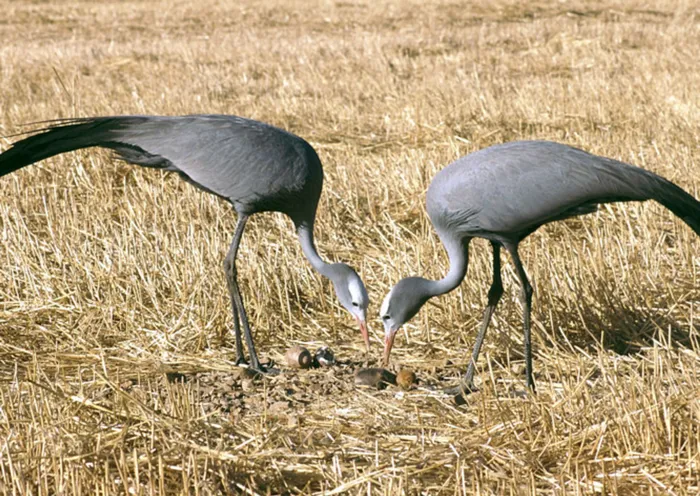
Pair of Blue Cranes with a chick. The population of the Blue Crane, South Africa's national bird, is being monitored.
Image: File
A new study has raised concerns about the future of South Africa’s national bird, the Blue Crane, after researchers found that intensive agricultural landscapes in the Western Cape may be reducing the species’ breeding success.
The research, conducted by scientists from the University of Cape Town’s FitzPatrick Institute of African Ornithology and the International Crane Foundation in partnership with the Endangered Wildlife Trust, suggests that parts of the province’s wheat-growing regions could be acting as an “ecological trap” for the birds.
The study found that Blue Cranes breeding in the Western Cape’s wheatlands, particularly in the Overberg and Swartland, are producing significantly fewer chicks than populations in other parts of the country.
The findings were published in the Ostrich: Journal of African Ornithology.
Breeding success lower in wheatlands
Researchers compared breeding patterns of Blue Cranes in several regions, including the wheatlands of the Western Cape, the Karoo and the eastern grasslands of South Africa.
Their analysis of long-term breeding monitoring data showed that pairs in the Karoo and eastern grasslands produced close to one fledgling per breeding attempt. In contrast, pairs breeding in the Western Cape wheatlands produced roughly half as many chicks.
The study also found fewer successful breeding pairs in the wheat-growing regions. Around two-thirds of pairs in the grasslands and the Karoo raised at least one chick, compared with only about 40% of pairs in the Overberg and Swartland.
“These differences are worrying because the Western Cape wheatlands hold some of the highest densities of Blue Cranes anywhere in the world. If breeding productivity remains low, it could help explain the population declines observed in the region in recent years,” said Dr Christie Craig, the study’s lead researcher and a conservation scientist at the International Crane Foundation and Endangered Wildlife Trust.
Craig completed her PhD at the University of Cape Town in 2024 under the supervision of Emeritus Professor Peter Ryan. Her research examined the conservation status of the agriculturally adapted Blue Crane, including population trends, survival rates, movement patterns and threats such as powerline collisions.
Declining recruitment signals deeper concern
The research team also analysed winter flocks to estimate how many young birds are joining the population each year.
Between 2019 and 2021, juveniles accounted for only about 4% of winter flocks in the Overberg and 3.6% in the Swartland. This is roughly half the proportion recorded about three decades ago, suggesting fewer young cranes are surviving to adulthood.
“If fewer chicks are fledging and fewer juveniles are entering the population, it becomes increasingly difficult for populations to sustain themselves. This pattern raises serious conservation concerns for what has historically been one of the species’ strongholds,” Craig said.
Agricultural landscapes may act as ecological traps
Although Blue Cranes have adapted well to farmland and are commonly found in agricultural areas, the study highlights how modified landscapes can conceal risks for wildlife.
In conservation biology, an ecological trap occurs when animals are attracted to habitats that appear suitable but ultimately reduce their survival or reproductive success.
In the case of Blue Cranes, wheatlands provide open landscapes that resemble their natural habitat and may appear ideal for nesting. However, farming activities and landscape features can disrupt breeding and increase chick mortality.
Nests may be destroyed during harvesting when wheat fields are cut, and disturbance around nests can increase predation risks from species such as the Pied Crow.
Craig said these pressures may be limiting the number of chicks that survive to fledging.
“Blue Cranes have adapted remarkably well to agricultural landscapes, but these environments are complex. Even small disturbances during the breeding season can have significant consequences for reproductive success.”
Hazards continue after chicks hatch
The risks do not end once eggs hatch. Field observations suggest that young cranes may die from several hazards commonly found on farms.
These include entanglement in fencing, drowning in water troughs and possible food shortages or physical abnormalities.
Craig said some causes of chick mortality remain poorly understood and require further investigation.
“There is still much to learn about why chicks fail to survive in these landscapes. Focused research on chick mortality would help identify the most effective conservation interventions.”
Farmers key to conservation efforts
Despite these challenges, the researchers emphasised that collaboration with farmers is essential to protecting Blue Crane populations.
Because most breeding cranes occur on farmland, many conservation measures would need to be implemented in partnership with landowners.
Possible interventions include reducing disturbances near nests during breeding season, modifying water troughs so chicks can escape if they fall in, and adjusting fence designs to reduce entanglement.
“Engaging with landowners is crucial,” Craig said. “Because most breeding cranes occur on farmland, conservation efforts must work in partnership with farmers to improve breeding outcomes.”
However, the relationship between farmers and cranes can sometimes be complex. In some areas, farmers report crop damage caused by the birds, which may influence attitudes toward the species.
Craig said addressing these concerns while promoting conservation-friendly farming practices will be essential for protecting one of South Africa’s most iconic birds.