Judge Siraj Desai looks back on 50 years in the legal world


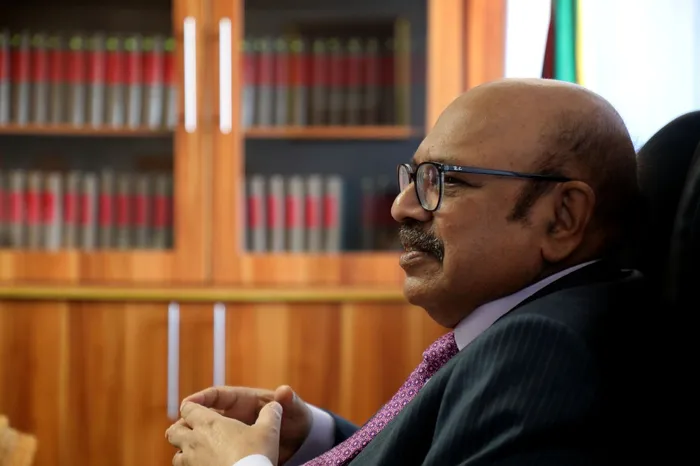
Reflecting on a half-century in the legal profession, Judge Siraj Desai shares his experiences as both a lawyer and a judge.
Image: Oupa Mokoena/Independent Newspapers
Last week, retired Judge Siraj Desai commemorated 50 years since his admission as an attorney.
Reflecting on his career, Judge Desai said, “Looking back 50 years, I would do things exactly the same. It was exciting, meaningful, and I played my role in the Struggle for freedom in this country - as a lawyer and in other capacities.”
It was on March 9, 1976, that Judge Desai was admitted as an attorney, and he said he did not appreciate at the time that a glorious career would follow.
He served as an attorney for five years, was a member of the Cape Bar for 20 years, and served on the Bench for five years before he retired. Although he had hung up his robe, he is still actively involved in the legal profession as the Legal Services Ombudsman.
He comes from very humble beginnings, being born in Salt River in the Western Cape, or “the backstreets of Cape Town”, as he calls it.
“My colleagues at the Bar all smiled when they heard I came from Salt River. I don’t know what the smiles were all about, but it made me an unlikely judge at the time.”
Judge Desai said when he started off in the legal profession, he was different from other members. “When I became an attorney, there were only 12 attorneys of colour in Cape Town. We all knew each other because it is such a small community.”
Judge Desai also recalled doing his articles in 1976 under Dullah Omar, who later became the minister of justice.
“Dullah gave me a robe in my very first week and said, 'Go and defend this guy.' I have never defended anyone before.”
The accused was charged with throwing a stone at a police vehicle, but he missed the vehicle. He defended the man on the basis that it could not have been public violence, as he was about a kilometre away from the scene.
Nor was it malicious damage to property, as he missed the police vehicle.
While he attended to many cases over the years - both criminal and civil - Judge Desai especially recalled defending defence force generals accused of the 1988 Bophuthatswana coup, who stood trial for terrorism and were acquitted in the end.
He also fought for activist Shirley Gunn to have her baby placed with her after she was detained so that she could breastfeed him while in detention. Her son, Haroon Gunn-Salie, became a famous artist.
Judge Desai became a fan of famous Afrikaans writer NP van Wyk Louw and read all his books. This was after he, while sitting as a judge, was asked to ban one of the books for using the “K” word - which he refused to do.
He also, in his early years on the Bench, gave an order that beggars cannot be banned from the Waterfront area in Cape Town.
Some of the big criminal trials he recalled presiding over included that of Najwa Petersen, who was convicted of the murder of her husband, Taliep Petersen.
Judge Desai still laughs when he recalls how, after he had sentenced her to 28 years in prison, the Muslim women he had encountered on the streets wanted to take a “selfie” picture with him.