Cape Town astronomers unveil the hidden Vela supercluster behind the Milky Way

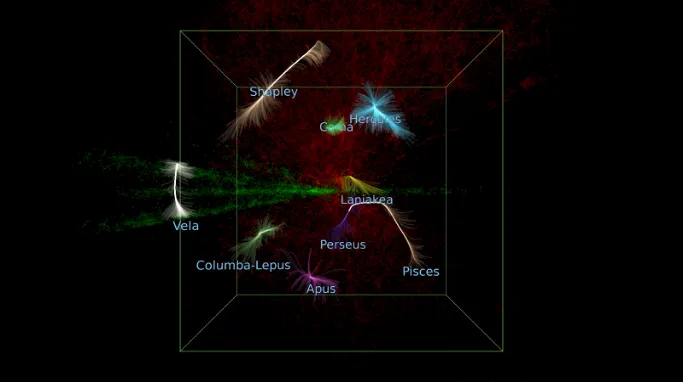
A map of the Local Universe highlighting the main superclusters. Vela, a massive hidden structure, is on the left. The image shows how galaxies flow through space and the large-scale “basins” that channel them.
Image: Supplied
A decade-long search led by Cape Town astronomers has helped reveal the true scale of one of the largest hidden structures in the nearby universe, confirming the immense extent of a colossal concentration of galaxies long concealed behind the dense dust and stars of the Milky Way.
Researchers from the University of Cape Town, working with international partners in France, Australia and Italy, have mapped the true extent of the Vela Supercluster, a vast cosmic structure located about 800 million light-years from Earth.
The breakthrough builds on more than 10 years of work by UCT astronomers led by Emeritus Professor Renée Kraan-Korteweg, whose team had long suspected that a massive structure lay hidden behind the Milky Way’s dense disk.
“I am truly exhilarated that the data gathered by my group could be successfully incorporated into this novel methodology,” Kraan-Korteweg said.
“It has finally confirmed the prominence of the Vela-Banzi supercluster, something I suspected more than a decade ago, and shows that it plays an important role in the large-scale cosmic flows in our region of the universe, including our own Local Group of galaxies.”
For decades, astronomers have struggled to observe parts of the sky hidden behind the Milky Way in a region known as the “Zone of Avoidance”. Thick clouds of dust and billions of foreground stars block the view of distant galaxies, leaving roughly 20% of the sky difficult to study.
To overcome this obstacle, researchers developed a hybrid technique combining two types of galaxy measurements: redshift data showing how fast galaxies are moving away from Earth as the universe expands, and distance measurements that reveal how galaxies move under the influence of gravity across vast cosmic distances.
The team analysed more than 65,000 galaxy distance measurements from the CosmicFlows catalogue and added more than 8,000 new galaxy redshifts collected close to the plane of the Milky Way.
A key breakthrough came from observations made using two major facilities in South Africa: the Southern African Large Telescope (SALT) and the MeerKAT radio telescope, operated by the South African Radio Astronomy Observatory.
MeerKAT can detect hydrogen gas in galaxies at radio wavelengths that pass through cosmic dust, allowing astronomers to observe galaxies that would otherwise remain hidden.
These observations revealed that the Vela Supercluster stretches across about 300 million light-years and contains an enormous amount of matter, equivalent to roughly 30 million billion times the mass of the Sun.
Researchers say massive structures like Vela exert a powerful gravitational pull that influences how galaxies move across vast cosmic distances.
The team has also introduced an affectionate name for the structure, “Vela-Banzi”, derived from isiXhosa and meaning “revealing widely”, reflecting how the supercluster is now emerging from behind the Milky Way.
Kraan-Korteweg said she was particularly proud of the young researchers who helped make the discovery possible.
Over the years, six PhD students and nine MSc students from UCT contributed to the painstaking task of observing galaxies hidden behind the Milky Way’s disk, helping to piece together a clearer picture of the universe beyond our own galaxy.
For the Cape Town team, the discovery not only reveals a vast hidden structure in space, but also highlights the growing role of South African scientists and telescopes in mapping the universe.