V&A Waterfront plans R24 billion expansion, raising traffic concerns in Granger Bay


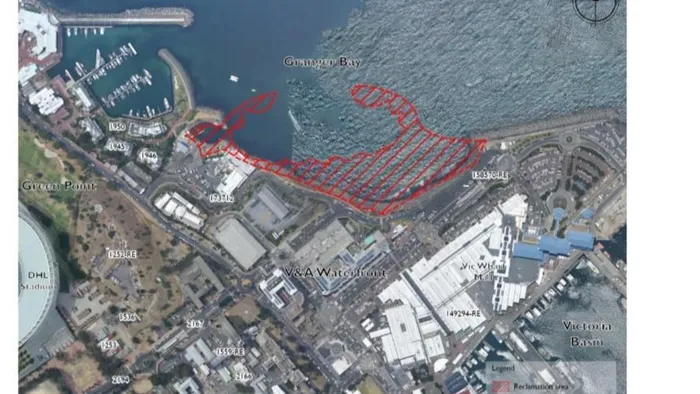
Location of proposed reclamation site.
Image: Supplied
The V&A Waterfront has outlined plans for a major expansion at Granger Bay that could see about 3.81 hectares of land reclaimed from Table Bay to accommodate new coastal public amenities, marine infrastructure and mixed-use development.
In a notice published in the Government Gazette on February 13, the Minister of Forestry, Fisheries and the Environment, Willie Aucamp, invited public comment on V&A Waterfront Holdings’ application for pre-approval to reclaim land from coastal waters in terms of the National Environmental Management: Integrated Coastal Management Act.
The proposed reclamation site lies north of the Granger Bay Point precinct, between the western dolos revetment and the Oceana Power Boat Club public launch site.
V&A Waterfront spokesperson Donald Kau said the proposed development involves reclaiming approximately 3.81 hectares of land from Table Bay to accommodate new public amenities and mixed-use development.
The reclamation would be protected by a permanent rock revetment and two breakwaters forming a sheltered bay of about three hectares. The west breakwater would extend roughly 90 metres into Table Bay and the east breakwater about 140 metres, with a revetment of about 540 metres connecting them.
Kau said new public amenities planned for the area include sheltered waters for boating, kayaking and swimming, as well as a coastal public walkway, a slipway, a fixed quayside, a landscaped promenade, tidal pools, pedestrian paths and open public spaces.
The shoreline protection infrastructure would be constructed in phases over approximately three years.
According to Kau, the environmental approval process is currently under way. The project’s scoping report has been accepted by the Western Cape Department of Environmental Affairs and Development Planning, and permission to proceed with the Environmental Impact Report was granted on March 2.
The environmental process is expected to run until about mid-2027, after which construction of the revetment and breakwaters could begin, potentially towards the end of 2027.
Kau said the development will make use of existing bulk development rights and would not require new development rights for the reclaimed portion. Of the 3.81 hectares proposed for reclamation, about 0.80 hectares would be used for coastal protection infrastructure, 1.47 hectares for open spaces and public amenities, and 1.54 hectares for mixed-use development.
An updated socio-economic study estimates the broader development could cost about R24 billion and create around 27 000 jobs during construction over a 15 to 20-year period. Once operational, the development is expected to support about 822 direct jobs annually.
However, some residents along the Atlantic Seaboard say the expansion raises concerns about congestion in surrounding neighbourhoods.
Sandra Dickson of Stop CoCT said traffic pressure around the Waterfront is already severe.
“The traffic in the area of the Waterfront is already a nightmare and this new development will vastly compound it,” she said. “Maybe these architects should be really mega innovative and incorporate a new highway to access their development into their plans. The half-completed relics of highways in the area come to mind.”
Atlantic Seaboard resident Peter Flentov said the overall impact of the project would depend on how it is implemented.
“The devil is always in the detail,” he said. “The V&A Waterfront is an amazing precinct and one of the things that makes Cape Town the vibrant city that it has become.”
However, Flentov said his biggest concern is what increased traffic volumes would mean for Green Point and Mouille Point, which he described as already congested. He added that if the expansion mainly introduces luxury accommodation not accessible to the average Capetonian, it may not provide broader community benefits.
In terms of national coastal management law, the Minister must decide whether to grant pre-approval following public participation. If granted, the decision must still be ratified by Parliament, and environmental authorisation would be required before any physical reclamation could proceed.