Winde's vibrant socks and shorts cause a stir in the legislature as ANC raises eyebrows


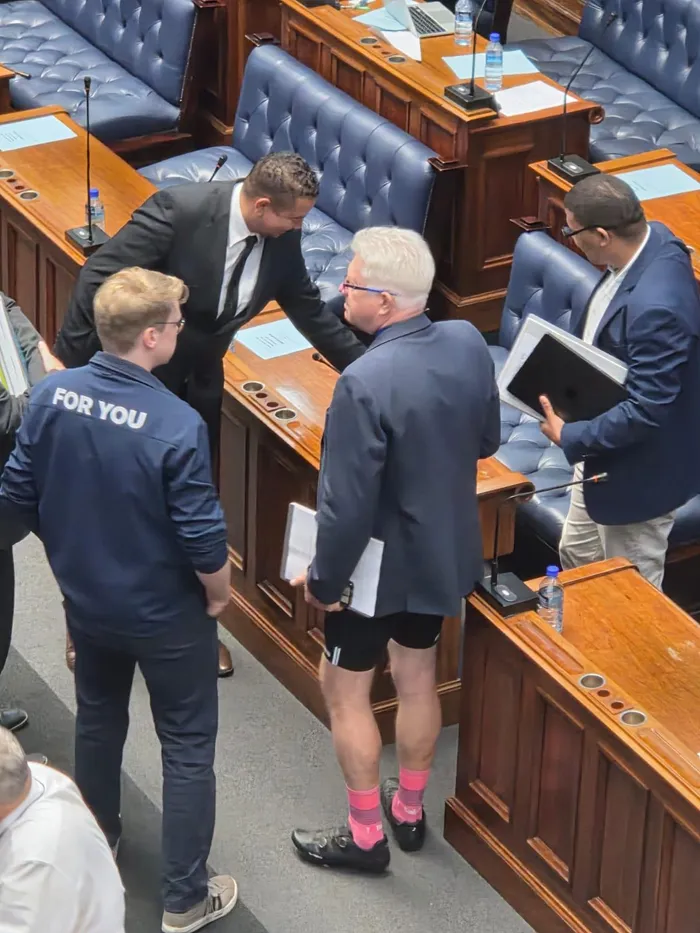
Western Cape Premier Alan Winde in the legislature on Thursday wearing running shorts and bright pink socks
Image: SUPPLIED
Western Cape Premier Alan Winde's bold choice of pink socks and cycling shorts had the ANC in a twist during Thursday's session of the Western Cape legislature.
Winde's unconventional dress code had ANC MPL Rachel Windvogel hot under the collar as she questioned Speaker Daylin Mitchell about the appropriateness of the premier’s outfit for the legislature.
Winde’s top half was more formal, wearing a suit jacket and a neatly buttoned shirt.
“Speaker, I just want you to rule on the dress code of the premier, is it acceptable in this house?” Windvogel, of the ANC, asked.
Mitchell quickly shut the matter down.
“Firstly, that is not a point of order," he said.
"I think we as an institution have gone past where we are prescriptive and dictative on how people are dressed, as long as persons respect the decorum of the house, and the premier is absolutely doing so."
The house then moved on to other business, with Mitchell noting that Brendon “Stamhoof” Adams had been sworn in earlier on Thursday as a member of the legislature.
Adams filled the seat left vacant by the PA's Noël Constable.
Adams recently left the DA and joined Gayton McKenzie's party.
Before his defection, he had served as a DA councillor in the George municipality.
Finance MEC Deidré Baartman then tabled the 2025 Municipal Economic Review and Outlook (MERO), a report that looks at the economic performance of municipalities across the province.
The report is based on the 2024/25 period of review.
She said the report showed how municipalities across the Western Cape were coping with population growth, pressure on services and infrastructure.
Baartman said the Western Cape remained one of the country’s most resilient provincial economies.
“In 2024, the province contributed 14.3% of national GDP,” she said.
She said employment in the province had continued to improve since the Covid-19 pandemic.
“In quarter four of 2025, the Western Cape’s unemployment rate fell to 18.1%, supported by 93,000 additional jobs from quarter three to quarter four,” she said.
But she warned that the province was not immune to national economic problems.
For the period under review, agriculture contracted by 8%, which she said was largely due to climate shocks and rising costs.
Baartman said the Cape Town metro continued to dominate the provincial economy.
“It continued to anchor the provincial economy with a GDPR of R666.3bn, contributing 72% of output and supporting 1.6m jobs,” she said.
She said other district economies were far smaller, with the Cape Winelands at R105bn, the Garden Route at R70.8bn, the West Coast at R47.1bn, the Overberg at R32.1bn, and the Central Karoo at R4.6bn.
Tourism, she said, continued to play a major role in the province’s economy.
“In 2024, domestic visitors from within the Western Cape as well as Gauteng dominated every district,” she said, while international visitors mainly travelled to Cape Town, Stellenbosch, Hermanus and Knysna.
Baartman also said agriculture remained an important sector despite the challenges.
“In 2024, citrus, grapes, apples, pears and wine were the top agriculture exports across the districts,” she said.
She said exports from different districts included products such as fruit, wine, fish, machinery and agricultural goods.
The report also showed the province’s population continues to grow quickly.
“The Western Cape continues to experience rapid population growth, reaching 7.5m people in 2024, with annual growth projected between 1.5% and 1.9% into 2028,” she said.
Baartman said municipalities were investing heavily in infrastructure to deal with this growth.
Across the province, municipalities had directed R18.1bn toward capital assets and infrastructure during 2025/26, she said.
“The Cape metro leads in capital investments in the 2025/26 financial year with a R12.6bn capital budget focused on water, sanitation, electricity and transport systems,” she said.
She added that the Western Cape government itself would spend more than R24bn on infrastructure between 2025/26 and 2027/28, with R8.058bn invested in 2025/26 alone.
Baartman said municipalities and the provincial government together had committed more than R26.1 billion toward capital investment in the 2025/26 financial year.
Private investment in the province was also significant.
“Our districts have further done well in attracting private sector investment, attracting a total of R96.64bn in private sector investment by 2024,” she said.
Baartman said the report showed that despite pressure on municipalities, the province was still making progress.
“Despite immense pressure, the Western Cape’s municipalities continue to move forward; adapting, innovating and building on the basics for growth,” she said.
In a separate matter, a report prepared to be tabled and debated in the legislature shows that Winde, GOOD party secretary-general Brett Herron and Windvogel were all found to have broken the rules governing members’ conduct.
In Winde’s case, the complaint was lodged by opposition leader, the ANC’s Khalid Sayed.
The Conduct Committee found that Winde failed to disclose the sponsorship of an economy-class return flight to New York to attend Climate Week NYC in September 2024.
According to the report, the sponsorship was not listed in Winde’s financial disclosure form when he submitted his declaration in February 2025.
Winde denied breaching the code and said he attended the conference in his official capacity as Western Cape premier and as African co-chair of the Under2Coalition.
He said he was going to appeal the finding.