South African film sector in turmoil due to DTIC delays

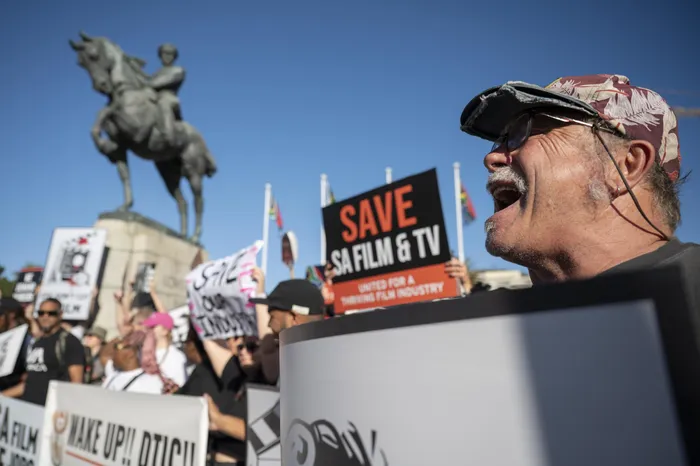
Hundreds of film and television professionals rallied outside Parliament in the Cape Town leg of the “Save SA Film Jobs” protests. Industry leaders warn that the creative sector, once a major economic driver, faces collapse without swift government intervention.
Image: Armand Hough / Independent Newspapers
A month after the South African Film and Television Sector, under the 'Save SA Films Jobs Coalition,' protested outside Parliament for urgent action from Minister of Trade, Industry and Competition Parks Tau regarding the crisis in the DTIC Film and Television Production Incentive, his office has been accused of cancelling another engagement with the City.
In a statement issued by Mayco Member for Safety and Security, JP Smith, it was noted that a meeting with the Department of Trade, Industry and Competition (DTIC) did not proceed. "This morning (Friday), the Department of Trade, Industry and Competition cancelled yet another engagement with the City to discuss concerns surrounding the national government’s handling of the National Film Incentives.
"This is the second such cancellation, and we have now been requested to submit representations in writing – even though the Mayor has already addressed the issues in a letter to Minister Parks Tau in November 2025, along with a request for an urgent meeting."
"The film and television sector further amplified the issues at play when it gathered outside Parliament a month ago to highlight how the mishandling of the incentives scheme is hurting local production houses, foreign investment, and ultimately the economy and job prospects in the sector," Smith added.
He joined the protest last month and requested urgent intervention from the Deputy Minister of Finance, Ashor Sarupen and the Deputy Minister of the DTIC, Zuko Godlimpi.
"But we are losing that edge as productions stall or change filming locations due to the slow pace of rebate payments via the National Film Incentives," he said.
He argued that the data spoke for itself: between 2021 and 2024, employment in the industry decreased by an average of 43.6% per year, dropping from 4,943 full-time equivalent jobs (FTEs) in 2021 to 884 FTEs in 2024. Film production investment has fallen sharply, from over R6 billion in 2021 to approximately R962 million in 2024.
The Coalition, representing various industry bodies, submitted a memorandum of demands. The industry supports over 30,000 jobs in Cape Town, with employment dropping by an average of 43.6% annually between 2021 (4,943 FTEs) and 2024 (884 FTEs).
Film production investment plummeted from over R6 billion (2021) to R962 million (2024). Despite a memorandum submitted over a year ago, the DTIC has failed to address concerns, provide timelines, or communicate the incentive's status, creating damaging uncertainty.
A week ago, Tau, leading a delegation from the DTIC, briefed Parliament regarding protests and governance issues related to the Film and Television Production Incentive. He confirmed the commitment to investigating malfeasance and finding solutions for industry challenges.
Godlimpi outlined actions to resolve industry demands: securing urgent interim funding, exploring re-prioritisation, and engaging National Treasury for future allocations; establishing a national industry working group; considering alternative incentive structures, such as tax incentives for foreign productions; collaborating with the Industrial Development Corporation and National Empowerment Fund for blended financing; implementing an automated online system and additional human resources to expedite processing; and encouraging provinces like the Western Cape to offer incentives to lessen the burden on national funds.
Cape Argus has since reached out to the Ministry for its response to Smith’s concerns which said it would respond on Monday. The Coalition did not respond to queries.