Cape Town's gridlock: How traffic congestion steals four days from commuters


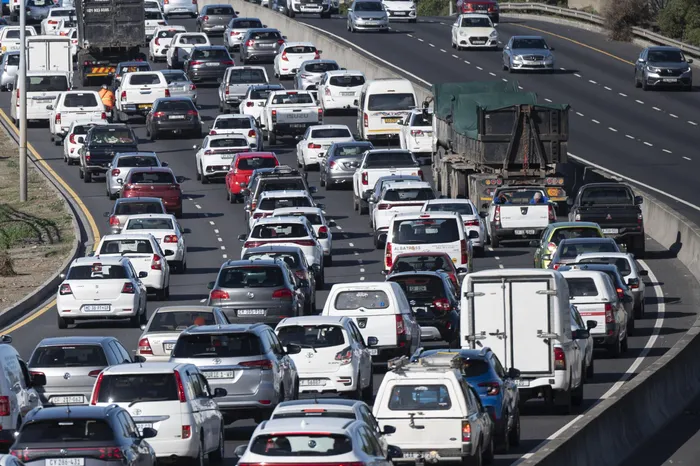
Brake lights stretch along Cape Town’s major routes during rush hour. A new global report shows commuters lose nearly four days a year in traffic.
Image: Armand Hough/Independent Newspapers
By 6:15am, the N1 is already slowing to a crawl.
For commuters leaving Brackenfell, what should be a 30km drive into the city can stretch to 90 minutes before sunrise. From Khayelitsha, a 22km journey that takes about 25 to 30 minutes in free-flow conditions often doubles or triples during peak hours.
“You plan your life around traffic,” said a northern suburbs commuter. “If you leave a little late, you’re stuck for more than an hour.”
That lived experience is now reflected in global data.
The 2025 INRIX Global Traffic Scorecard ranks Cape Town sixth worldwide for traffic delay, with the average driver losing 96 hours a year in peak congestion — up from 94 hours in 2024. Based on the report’s estimate, that amounts to roughly four full days annually spent in traffic.
Only Istanbul, Chicago, Mexico City, New York City and Philadelphia recorded higher annual delays. The ranking places Cape Town among the world’s 10 most congested cities — and well ahead of every other South African metro.
Within South Africa, Johannesburg drivers lose 59 hours annually, Pretoria 48 hours, Durban 33 hours and Gqeberha 30 hours. The gap underscores how disproportionately congestion affects Cape Town residents.
GOOD secretary-general Brett Herron said the ranking confirms what commuters already know.
“It is self-evident that Cape Town has an extreme traffic congestion problem,” Herron said. “Anyone who uses the road network will confirm this from their own experience.”
He warned that the impact extends beyond inconvenience.
“The traffic congestion crisis has the potential to destroy our City’s successes in tourism and economic growth. The reputation of severe traffic congestion has the potential to deter investment and visiting,” Herron said.
Herron argued that congestion is the result of structural weaknesses in transport planning and integration. He pointed to reduced public transport reliability, delays in expanding the MyCiTi bus network and the long-term decline and disruption of commuter rail services, which he said have shifted thousands of former rail users onto the road network.
He also raised concerns about spatial development patterns that increase commuting distances.
“If we continue expanding outward without properly integrating transport and land use, we are building congestion into the city’s future,” Herron said.
Stop CoCT’s Sandra Dickson similarly linked congestion to rapid expansion and densification.
“The rapid expansion of Cape Town in all directions, together with densification programmes, has contributed significantly to the City of Cape Town’s traffic headaches,” she said.
Dickson pointed to school start times and drop-off patterns in suburbs such as Brackenfell and Khayelitsha as compounding peak-hour bottlenecks.
Responding to the report, the City’s Mayco Committee Member for Urban Mobility, Councillor Rob Quintas, said the municipality would need additional time to study the findings before commenting fully.
Quintas emphasised that the INRIX scorecard measures vehicle delay rather than person delay — a distinction he said is central to the City’s strategy.
“The City prioritises the efficient movement of people rather than vehicles,” Quintas said.
He explained that the ranking compares peak congestion speeds to free-flow speeds, which can affect how cities are positioned. Cities with lower free-flow speeds may appear to perform better because the differential is smaller, while cities with higher operating standards can rank worse due to larger peak differentials.
Given limited resources and evidence that expanding road capacity offers only short-term relief, Quintas said the City focuses on reducing person delay, particularly for road-based public transport users through its Mobility Priority Programme.
“The majority of commuter trips in Cape Town are road-based, which is unsustainable and unaffordable,” he said, adding that shifting commuters from private vehicles to public transport remains a key long-term objective.
Quintas highlighted the ongoing rollout of Phase 2A of the MyCiTi bus service — linking Khayelitsha and Mitchells Plain with Claremont and Wynberg — as part of the City’s Integrated Public Transport Network plan aimed at addressing spatial inequality and improving access to employment hubs.
Urban mobility analysts have long identified Cape Town’s spatial layout as a contributor to congestion pressure. Many residents live far from major employment centres, generating long daily commutes that funnel onto key arterial routes during peak hours.
For commuters, however, methodology debates offer little relief in the morning queue.
Ninety-six hours a year is more than a statistic. It represents early alarms, late arrivals and evenings shaped around traffic reports. It means factoring congestion into school runs, meetings and family plans.
Whether measured in vehicle delay or person delay, congestion has become one of Cape Town’s most visible and felt urban challenges — one that residents navigate long before the sun rises and long after it sets.
Get your news on the go, click here to join the Cape Argus News WhatsApp channel.
Cape Argus