Premier Winde's 2026 address: A bold plan to combat crime, land reform, and water security


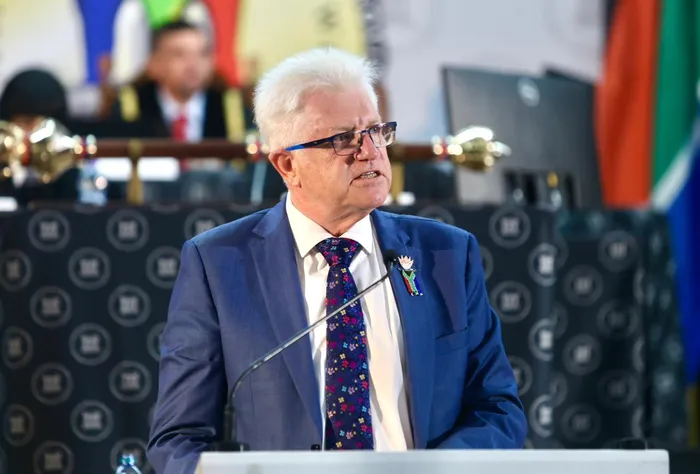
Premier Alan Winde delivered the Western Cape’s State of the Province Address (SOPA2026) in George on Wednesday evening.
Image: Supplied
Delivering the 2026 State of the Province Address (SOPA2026) in George on Wednesday night, Premier Alan Winde placed land reform, violent crime, water security, municipal collapse, and job creation at the centre of the Western Cape’s agenda.
The address, delivered at the opening of the Western Cape Provincial Parliament in the Garden Route town, comes at a critical moment as municipalities face water shortages, residents struggle with rising crime and violence, and communities continue to demand access to land, housing, and basic services.
George itself has faced recent infrastructure strain and disaster recovery challenges, placing additional focus on governance and development in the region.
Opening his address with a call for unity, Winde described the province as resilient but under pressure.
"A State of the Province is a moment in time," he said, "but tonight, I want it to also be a unifying cry for oneness and togetherness."
Land and housing remain central to addressing spatial inequality. The provincial government says it has created over 213,000 housing opportunities since 2009, benefiting about 850,000 residents.
Winde confirmed progress on social housing developments, such as Conradie Park, and announced that the national government has committed to the next phase of District Six restitution, describing it as "long overdue".
He added that housing delivery is not only about shelter but restoring dignity and access to opportunity, saying the government is working to build "hope, access, and opportunities one brick at a time".
He said the province is "actively bringing residents close to economic opportunities in the Cape Town city centre".
Crime and violence dominated a significant portion of the speech. More than 345 people were murdered in the Western Cape in January alone.
Winde described communities as being turned into "war-zones", calling the situation "a national shame".
He sharply criticised national policing structures, saying detectives are "set up to fail", with some investigating up to 150 dockets each and sharing basic resources.
"We are doing everything within our mandate to address crime," he said, while warning that if national reforms do not materialise, the province may approach the courts.
At the same time, Winde argued that economic growth is a critical crime-fighting tool. "Nothing fixes a life like a job, nothing builds dignity like a job. And Speaker, nothing stops a bullet like a job."
The province has created roughly 360,000 net new jobs over five years, nearly 90% of all net jobs created nationally during that period.
Unemployment stands at 18.1%, significantly below the national average. Water security emerged as another urgent concern. "This region, like many others across our province, is facing serious water security challenges," Winde said.
He pledged that the province is "on track to secure an additional 310 million cubic metres of water by 2035".
He warned that climate change is already affecting communities, with floods, wildfires, and drought damaging infrastructure, farmland, and homes. "Climate change knows no borders," he said, describing extreme weather events as an increasing threat to economic stability and water supply.
Projects include desalination, dam expansion, and upgrades to municipal systems, including the raising of the Clanwilliam Dam wall.
Municipal dysfunction was also highlighted, with Winde pointing to service delivery failures in towns such as Knysna. "Mistakes last five years and much damage can be done in that time," he said, arguing that poor governance undermines water, infrastructure, and billing systems.
He said fixing municipalities is essential to restoring public trust and ensuring residents have access to basic services, including water, electricity, and housing.
Provincial government interventions are ongoing to stabilise struggling municipalities and improve governance and infrastructure delivery.
Concluding his address, Winde returned to his central theme of resilience and delivery: "It is a place where we will be spending 2026 getting to work and getting it done."