Premier Alan Winde faces backlash over crime crisis in Western Cape


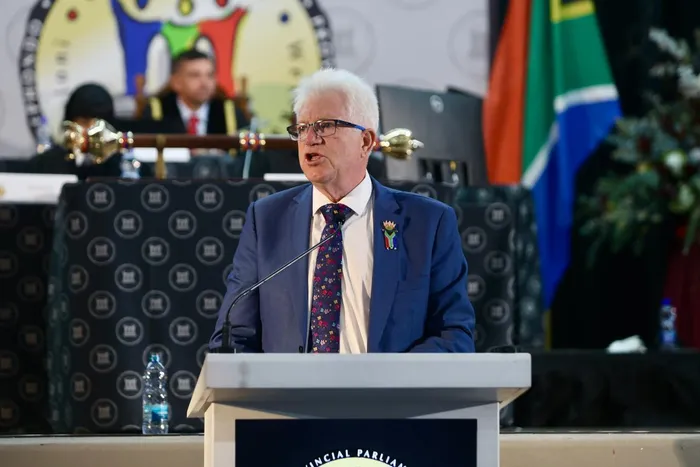
Alan Winde delivers his State of the Province Address at Conville Community Hall in George on Wednesday night.
Image: Henk Kruger/ Independent Newspapers
Crime, inequality and infrastructure dominated a heated Western Cape State of the Province Address (Sopa) debate on Thursday, as opposition parties accused Premier Alan Winde of presenting an overly optimistic picture.
The Democratic Alliance (DA) defended what it described as a record of delivery.
The debate at Conville Community Hall in George followed Winde’s address on Wednesday night under the theme “Getting it done with kindness”.
Crime emerged as the central fault line across party benches, with broad agreement that violence remains the province’s most urgent crisis but sharp divisions over responsibility and solutions.
DA MPL Benedicta van Minnen told the House that, according to police figures presented in Parliament, more than 1,100 people were murdered in the Western Cape between October 1 and December 31, last year.
“Between October 1 and December 31, 2025, more than 1,100 people were murdered in our province. Twelve people a day,” she said.
Van Minnen further said a parliamentary reply from the South African Police Service (SAPS) indicated that more than 290 000 active criminal cases in the province were being handled by 2 729 detectives.
“In Pacaltsdorp, a single detective carries 439 active cases,” she told the House, criticising what she described as chronic under-resourcing of detectives and crime intelligence at national level. She cautioned that the recent deployment of the South African National Defence Force could only serve as a temporary stabilising measure.
“Soldiers do not build dockets. They do not run informant networks. They can hold the line. They cannot fix the system,” she said.
ANC MPL and SACP Provincial Secretary, Benson Ngqentsu, who serves on police oversight and community safety, accused the Premier of failing to present a “concrete, actionable plan” to confront violent crime.
“As the head of the provincial government, entrusted with both authority and a substantial budget, Premier Winde occupies a position of responsibility — not commentary,” Ngqentsu said.
He further told the House that the Premier had misstated police capacity figures in his Sopa address, arguing that the number of officers in the province was higher than the 12 000 cited. At the time of publication, no formal clarification had been issued.
Leader of the Opposition Khalid Sayed framed the debate as a contest between what he termed “two Western Capes” — one benefiting from investment and infrastructure, and another grappling with unemployment, housing backlogs and service delivery failures.
“We meet in George approaching two years since the tragic building collapse. That was not merely an accident. It was a governance failure,” Sayed said.
He warned that growth without structural inclusion would deepen inequality and spatial injustice.
GOOD MPL Brett Herron echoed those concerns, telling the House that rising employment figures did not reflect the lived reality of many working-class households.
He said moderate food insecurity had increased from 10.6% in 2024 to 13.1% in 2025, and that overall food insecurity sat at roughly 50%, according to figures he cited.
“We are witnessing the rise of a brutal new reality: the working poor,” Herron said, arguing that job growth alone would not address deep-rooted poverty and inequality.
Responding during the debate, DA speakers defended the provincial government’s performance.
Western Cape Infrastructure MEC Tertuis Simmers said the province was accelerating infrastructure delivery through a structured pipeline valued at R152 billion.
“The R152 billion infrastructure pipeline is not a spreadsheet. It is a commitment,” Simmers told the House, adding that routine road maintenance contracts were now in place across the province and that the R300 Wingfield Extension had been approved as a strategic freight and mobility project.
Mobility spokesperson Prof Nomafrench Mbombo pointed to the GoGeorge integrated public transport system as an example of provincial delivery. She told the House that GoGeorge transported nearly 21,000 passengers daily and that R65.1 million had been invested in road upgrades in Thembalethu to improve access to the network.
Building on the province’s Jobseeker Travel Voucher Programme in Cape Town, Mbombo said the initiative would be expanded to George this year to provide free travel to jobseekers. She also highlighted energy resilience projects and upgrades at George Hospital, including a ventilation system overhaul valued at R9.5 million.
The debate unfolded against the backdrop of next year’s local government elections, with crime, service delivery and inequality expected to dominate campaigning across the province.
While opposition parties argued that the province’s successes were unevenly distributed, DA members maintained that stable governance and infrastructure investment were driving growth and job creation.
Premier Winde is expected to respond to the criticisms in his closing address, as political battle lines ahead of the elections become increasingly defined.
Get your news on the go, click here to join the Cape Argus News WhatsApp channel.
Cape Argus