Plans unveiled for new 'Livelihood Grant' as social relief adjustments take shape


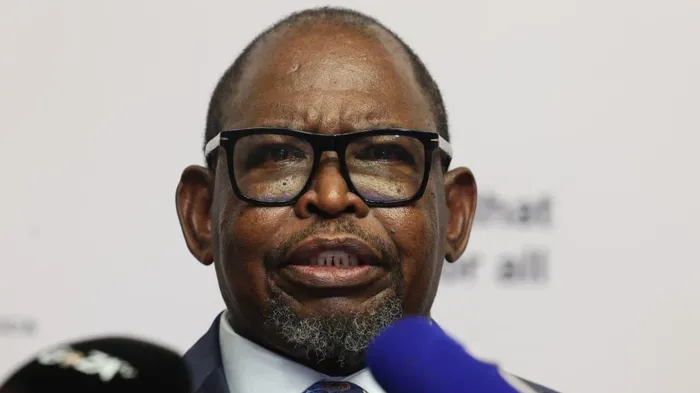
Finance Minister Enoch Godongwana said the Social Relief of Distress grant is allocated an additional R36.4 billion to extend payments until 31 March 2027 at the current R370 per month per beneficiary.
Image: Supplied
Finance Minister Enoch Godongwana shared that talks are underway about a new Livelihood Grant that will replace the popular Social Relief of Distress Grant.
During a closed media briefing before his 2026 Budget Speech in Parliament, Godongwana mentioned that they are still working out the details and format of the Livelihood Grant, which President Cyril Ramaphosa has referred to.
“The final details will be outlined in the Medium Term Budget Policy Statement after we have a better understanding of how the Livelihood Grant will work,” he said.
The Social Relief of Distress Grant, introduced during the Covid-19 pandemic in March 2020, has been a lifeline for millions of South Africans facing food insecurity.
Ramaphosa pointed out in his State of the Nation Address earlier this year, that this grant has played a pivotal role in alleviating widespread poverty.
“This year, we will redesign the grant to more effectively support livelihoods, skills development, work opportunities and productive activity,” he said.
As Godongwana addressed the MPs, he said the Social Relief of Distress grant will continue in its current form during the 2026/27 financial year.
“The Social Relief of Distress grant is allocated an additional R36.4 billion to extend payments until March 31, 2027 at the current R370 per month per beneficiary,” he said.
The allocation of the Social Relief Grant allocation is up from the R34.2 billion allocated in 2025/26 financial year.
Godongwana disclosed that the overall allocation for all social grants in the new 2026/27 financial year was R292.8 billion.
However, the Budget Review document said the social grant allocation has been adjusted down over the medium term in line with a lower inflation outlook and improved grant targeting and verification, which is expected to yield savings of R2 billion in 2026/27 and R1 billion in 2027/28.
According to the vote for Social Development Department, the allocations are set to decrease from R285.9 billion in 2025/26 to R277 billion in 2028/29.
“This is mainly due to the anticipated discontinuation of Social Relief of Distress related to the Covid-19 pandemic from 2027/28.”
The number of grants administered by the agency, excluding social relief of distress related to the Covid-19 pandemic, is set to decrease from 19.1 billion in 2025/26 to 18.9 billion in 2028/29.
“This is mainly attributable to efficiency reforms aimed at strengthening legislative compliance to ensure that grants are disbursed only to those who rightfully qualify for them.”
The budget document also stated that the department is in the process of reviewing social security policies.
“This is expected to lead to the updating of the draft basic income support policy by strengthening the link to employment pathways and sustainable livelihoods for beneficiaries.
“Expenditure for this work is funded through the allocation of R237.6 million over
The MTEF period in the Social Security Policy Development sub-programme in the Social Security Policy and Administration programme.”
The document added that the department was also in the process of finalising a longer‑term support package for those aged 18 to 59 without income protection.
During his Budget address, Godongwana announced that the old age grant, disability grant and care dependency grant will increase by R80 in April 2026, to R2,400.
The war veterans grant also increases by R80 to R2,420.
The foster care grant goes up to R1,290 in April, a R40 increase and to R1,300 in October, a R10 increase.
The child support grant and grant-in-aid grant increase by R20 to R580.
In response to the budget, Brett Herron, GOOD Secretary-General and Unite for Change Leadership Council Member cautioned that these numbers must translate into concrete benefits for the most vulnerable members of society.
"Another year has passed without the introduction of a Basic Income Grant. Instead, the Social Relief of Distress grant has merely been rebranded as a “livelihood grant.” At R370 per month, it does not lift a single recipient above the food poverty line," he said.
"A meaningful Basic Income Grant is not charity; it is economic justice."
Deidré Baartman, Western Cape MEC of Finance also provided her insight into the budget's delivery: "We welcome the provincial allocations to the Western Cape over the 2026 Medium Term Expenditure Framework, with the Provincial Equitable Share increasing to R69.55 billion in 2026/27. This allocation, together with conditional grants totalling R17.43 billion, totals R86.98 billion for 2026/27."
Get your news on the go, click here to join the Cape Argus News WhatsApp channel.
Cape Argus