Wildlife crime in the Western Cape: Are current penalties enough to deter offenders

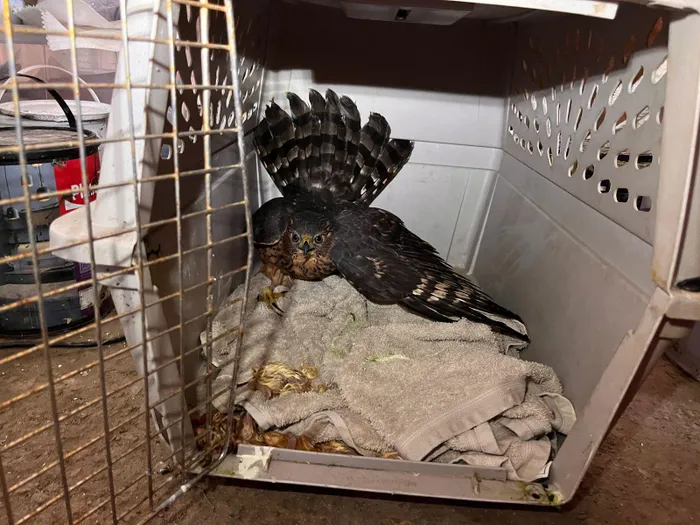
A rescued bird of prey rests inside a transport crate following intervention by animal welfare officials.
Image: Supplied
From a protected eagle owl beaten to death on the Sea Point Promenade to a tourist found with dozens of protected reptiles in a West Coast hotel room, wildlife crime in the Western Cape is increasingly unfolding in public view and in court.
While arrests and convictions are being secured, recent outcomes are prompting debate about whether penalties provide a meaningful deterrent.
In one of the most disturbing recent cases, a protected Spotted Eagle Owl was violently beaten to death near Sunset Beach in Sea Point on February 16 last year. The attack, captured on video by horrified witnesses, showed the bird being struck repeatedly with a stick after landing on the promenade barrier.
A post-mortem confirmed multiple fractures throughout the owl’s body.
Gustigu Mthini was arrested and remained in custody for seven months before his case was finalised. In September 2025, he was found guilty on charges including animal cruelty under the Animals Protection Act, the illegal killing of a protected species under the Nature Conservation Ordinance 19 of 1974, and contravention of immigration laws.
The court imposed fines and suspended prison terms for the wildlife-related offences, while ordering that he serve one month in prison for the immigration violation, after which he was deported to Mozambique. A charge relating to a City of Cape Town Coastal By-Law was withdrawn by the State.
At the time of the incident, SPCA spokesperson Belinda Abraham described the killing as “a barbaric act that not only ended the life of a protected species but also left an indelible mark on those who witnessed it.”
SPCA chief inspector Jaco Pieterse said the conviction demonstrated that wildlife crimes would be pursued through the courts.
“Our swift action led to the speedy gathering of evidence, including affidavits from witnesses and the video footage. The owl’s remains were collected and sent for a post-mortem, the results of which confirmed the brutal impact of the attack,” Pieterse said.
In a separate case highlighting the illegal wildlife trade, a 41-year-old Spanish national was convicted in the Vredendal Regional Court after protected reptiles were discovered in his hotel room without permits.
David Navarro Roman was arrested on November 29, 2025, during a joint operation by SAPS’ Stock Theft and Endangered Species Unit and CapeNature officials following a tip-off that he had been enquiring about Armadillo Girdled Lizards in the area.
Officers found 22 Armadillo Girdled Lizards and one Speckled dwarf tortoise in his possession — species that may not be possessed, transported or traded without authorisation.
He pleaded guilty in February 2026 to possession of protected fauna without documentation, and to importing and transporting wild animals without permits in terms of the Nature Conservation Ordinance. He was also convicted under the Prevention of Organised Crime Act.
The court sentenced him to five years’ direct imprisonment for possession of fauna without documentation, wholly suspended for five years on condition that he is not convicted of similar environmental offences during that period. Two-year direct imprisonment sentences on the importation and POCA-related charges were also wholly suspended.
Navarro agreed to a R500,000 confiscation order in terms of POCA, with the funds to be divided between the Criminal Assets Recovery Account and CapeNature. The reptiles were forfeited to CapeNature and placed in an appropriate care facility.
Eric Ntabazalila, spokesperson for the National Prosecuting Authority in the Western Cape, said the case underscored the seriousness of environmental crime.
“Illegal trade in fauna and flora ranks among the largest criminal activities globally, alongside drug trafficking, weapons smuggling and human trafficking. Environmental crime is time-critical — once species are removed from fragile ecosystems, the damage can be permanent,” he said.
Dr Ashley Naidoo, CEO of CapeNature, warned that illegal collection places further pressure on vulnerable species and could drive some populations closer to extinction.
Meanwhile, the SPCA continues to pursue criminal prosecution following a 2023 raid on the former wildlife facility Eagle Encounters, where inspectors removed six birds of prey, three snakes and an Egyptian goose. Although the facility withdrew its High Court application challenging aspects of the intervention and will pay the SPCA’s legal costs, authorities say the criminal process relating to alleged abuse uncovered during the raid remains ongoing.
More recently, the SPCA confirmed it is attempting to trace a man seen in a viral video allegedly offering a live snake for sale at the corner of Swartklip and Spine roads. Conservation officials have reiterated that the capture, possession and trade of indigenous reptiles require permits under provincial legislation.
Taken together, the cases range from deliberate cruelty in a public space to the illegal possession and attempted trade of protected species. While enforcement efforts by the SPCA, CapeNature, SAPS and prosecutors are visible, several recent convictions have resulted largely in suspended prison terms — a reality that is likely to intensify debate about whether existing penalties are sufficient to deter wildlife crime in the province.
Get your news on the go, click here to join the Cape Argus News WhatsApp channel.
Cape Argus