UCT students protest as 1 400 face registration holds despite debt relief measures
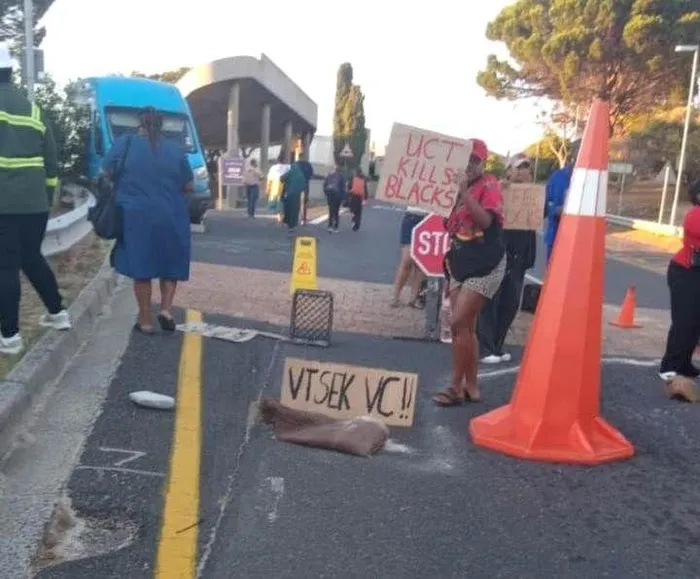
Protesting students block the M3 entrance to the University of Cape Town on Monday as demonstrations over fee debt and registration continue.
Image: Facebook
Nearly 1 400 students at UCT remain unable to register due to outstanding debt, despite the university confirming that 2 883 students have already benefitted from fee debt relief measures following recent protest action.
The figure was disclosed by UCT vice-chancellor Professor Mosa Moshabela in a letter to students and staff published on the university’s website.
The developments follow protest action that disrupted access to the Rondebosch campus, including the busy M3 entrance, as students demonstrated against financial exclusion linked to historic debt.
While the Students’ Representative Council (SRC) said an agreement had been reached with management to allow certain categories of students to register, the university framed developments as part of ongoing engagement and existing debt relief interventions.
“Following negotiations between the SRC and the executive, the SRC would like to announce that an agreement has been reached,” SRC secretary-general Takalani Makhwathana said in a statement.
According to the SRC, the arrangement would allow students with full funding for 2026 to register irrespective of historic debt, as well as those whose funding covers at least 50% of fees, previously funded final-year students who have been defunded, and certain postgraduate students affected by the NSFAS accommodation cap.
“It is evident from today’s demonstrations that students are tired of the rising costs of tuition and accommodation fees,” Makhwathana said, describing the measures as interim relief.
According to UCT, the 2 883 students who have benefitted include current NSFAS-funded students, NSFAS-eligible students with household incomes below R350 000, and “missing middle” students with household incomes between R350 000 and R600 000 who qualify for NSFAS loans. Financially vulnerable students with confirmed funding for the 2026 academic year have also been assisted.
However, management estimates that approximately 1 400 students remain subject to registration holds. Nearly 900 of these are postgraduate students, around 100 are from the Graduate School of Business, and about 400 are undergraduates.
The university said many of the remaining students are regarded as self-funded, although some continue to make payments toward their debt. Management has agreed to review appeals on a case-by-case basis and is encouraging affected students to consider study loans and sign acknowledgements of debt to proceed with their studies.
The recent protest followed a march organised by the SRC from Sarah Baartman Hall to Bremner Building, where a memorandum of demands was handed to management. The demands relate largely to registration holds for students with debt exceeding R10 000 — the maximum amount allowable for registration under a Council-approved policy.
UCT confirmed that the registration deadline has been extended to February 20 following a request from the SRC after negotiations with relevant stakeholders.
In the letter, Moshabela reiterated that members of the university community have the right to legitimate and peaceful protest, but warned that unlawful and disruptive conduct including blocking entrances, obstructing academic activities, vandalism, or violating an existing interdict protecting academic operations would result in appropriate action.
The university also rejected claims of an accommodation crisis, stating that approximately 852 beds remain available to registered students.
“The executive continues to prioritise support for any academically eligible NSFAS-funded and/or financially vulnerable students who have fee debt,” Moshabela said, adding that management remains committed to safeguarding the 2026 academic programme against unlawful disruption.
Get your news on the go, click here to join the Cape Argus News WhatsApp channel.
Cape Argus