Debate ignites over race and merit in Stellenbosch University's admissions process


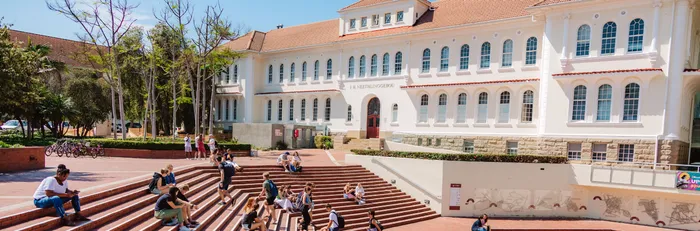
Stellenbosch University (SU) maintains that applicants are asked to indicate race as one of several factors considered for purposes of redress and transformation, and that self-classification is voluntary not affecting admission.
Image: Stellenbosch University
The Chair of the Parliamentary Higher Education Portfolio Committee has dismissed Vanessa Le Roux's allegations that there was a lack of communication regarding concerns over race-based admission criteria.
Le Roux, founder of Parents for Equal Education South Africa, recently drew public attention after accusing Stellenbosch University of admitting students based on race rather than academic performance. She made the allegations on Facebook, where her post received significant support, with several parents sharing similar suspicions about the university’s admissions practices.
According to Le Roux, more than ten families across her social media and WhatsApp groups have come forward to describe their experiences. She said her resolve to challenge the university was strengthened after her niece was rejected despite meeting the required academic criteria. Le Roux claims her niece, who was among the top 10 learners at her high school, received an automated rejection despite excelling academically.
"My niece was one of the top 10 performing learners in her high school. She worked hard through different hardships in the community, but still got rejected with an automated response," Le Roux said.
She further alleged that after submitting a reconsideration application, her niece received no meaningful response. "Only for her to get an automated and generic rejection letter. It was not written to her. It had no name and no application number," she said.
"We are not asking for special favours. She meets the requirements and she applied on time. Why is she being rejected? Why is she receiving general automatic emails of rejection with no name or application number?" Le Roux added.
Le Roux also claimed that she approached the Portfolio Committee on Higher Education but received no response. However, Anele Kabingesi, secretary of the Committee on Higher Education, denied this claim.
“We sent her complaint to the Registrar of the university to respond. She got her response through our intervention,” said Kabingesi.
He explained that the Registrar of Stellenbosch University, Dr Retief, provided a detailed response and evidence outlining the admission criteria used for the BA (Humanities) programme.
An email seen by the journalist states:
"Dear Ms Le Roux,
I share again the admissions data. This information provides broader context regarding the selection outcomes for the BA (Humanities) programme. A total of 656 applicants were accepted (final offers) out of 7,984 applications. The applicants offered places in the BA (Humanities) programme were as follows: 1 Asian, 256 Black African, 141 Coloured, 13 Indian, 193 White, 13 International and 39 Unknown.”
Responding to Le Roux’s claim that students were accepted based on race rather than marks, and that some admitted students had lower marks than her niece, the Registrar stated:
“4,393 unsuccessful applicants had lower marks than [this specific applicant] in Grade 11, and 1,500 applicants had higher marks and were also unsuccessful. (This number excludes applicants who declined offers or whose offers lapsed.)"
The email concludes by noting that approximately 1,500 applicants who achieved higher Grade 11 averages than the applicant in question were also not offered places in the BA (Humanities) programme.
"The reality is that places are limited and we are unable to accommodate all applicants who meet the minimum requirements. We understand that this remains disappointing. However, we must now consider this matter as closed," the email reads.
Despite the response, Le Roux remains adamant that her niece’s rejection was race-driven. She further alleges that the dismissal of the reconsideration application was a personal attack linked to her previous efforts to secure admission for her son, who is now a second-year student. Le Roux claims her son was initially rejected on unfair grounds and that she had to fight for his admission.
"I fought so hard to get my son into the university because they did the same thing to him, excluded him for no reason other than to keep Coloured students out of the university," she said.
Le Roux continued: "How can the majority race in the province be the minority in a university? It is also divisive towards Black and Coloured learners because now Black students appear to be more accepted, dividing our children and deepening existing divisions."
She added that she has begun communicating with SASCO members at the university, with plans to mobilise students in support of those who believe they have been excluded on the basis of race.
Stellenbosch University (SU) maintains that applicants are asked to indicate race as one of several factors considered for purposes of redress and transformation, and that self-classification is voluntary. The university stated that, across all faculties, the demographic profile of admitted students who accepted offers prior to registration for 2026 is as follows: Black African 3,531; White 3,578; Coloured 1,236; Indian 252; Asian 23; International 611; Unknown 236.
"These figures provide context to claims regarding disproportionate outcomes. The University’s admissions data does not support the assertion that non-white applicants are being disproportionately rejected," SU said.
Get your news on the go, click here to join the Cape Argus News WhatsApp channel.
Cape Argus