City of Cape Town under fire over Bromwell Street housing delays


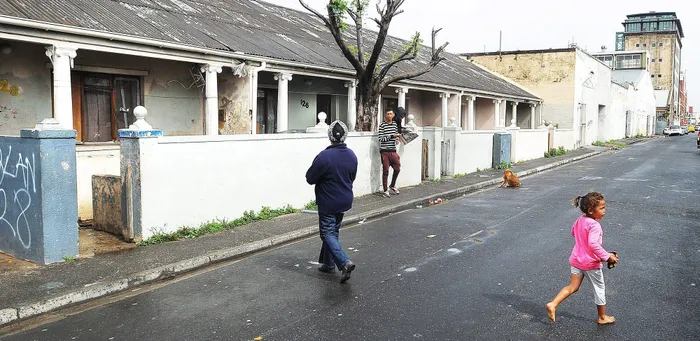
Residents of Bromwell Street face uncertainty as the City of Cape Town navigates housing policies amid ongoing eviction disputes.
Image: file
The Bromwell Street eviction case has lasted 12 years, remaining unresolved despite a December 2024 Constitutional Court order requiring the City of Cape Town to provide transitional housing for affected families and establish a Temporary Emergency Accommodation (TEA) Policy.
In response to the Cape Argus on the position of the order, the City states it is seeking the necessary planning approvals for the proposed emergency housing, which has caused a delay. The City has been granted a ConCourt extension until October.
The City said the Bromwell Street occupants have agreed to this extension and are kept fully informed. The City was also ordered to pay the litigation costs, which are pending taxation.
The ConCourt ruling came after years of advocacy by Ndifuna Ukwazi and Reclaim the City, who have called for a TEA policy. Ndifuna Ukwazi Law Centre represented the Bromwell families, securing the landmark victory.
The ConCourt declared the City's National Housing Programme unconstitutional, set aside the High Court and Supreme Court of Appeal decisions, and found the City unreasonably failed to adopt a TEA Policy and declined to consider providing TEA in the inner city.
The City was directed to implement a TEA Policy alongside the National Emergency Housing Programme, provide transitional housing near the inner city within six months, and report on its planning.
The City finally released a draft TEA Policy for public comment on February 2 with a March 2, 2026 deadline.
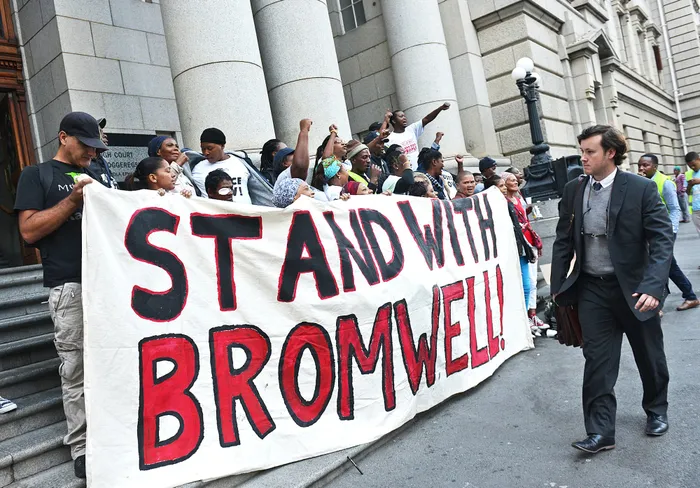
Bromwell Street residents gather at court, advocating for their rights and a fair Temporary Emergency Accommodation Policy.
Image: file
Housing activists view this as a positive moment, as the policy will determine how displaced persons are treated.
The City said in its response: “The City is in the process of obtaining the planning approvals needed for the proposed emergency housing in question, and once this is achieved, we will immediately proceed with the construction of the emergency housing for the Bromwell Street occupants as ordered by the ConCourt.
“The City has been granted an extension until October to do this, the delay being occasioned by the land use planning and approval process that has to be followed, including the determination of appeals or objections in respect of the proposed development by the receiving community.
"The extension of the deadline by the ConCourt has been agreed by the Bromwell Street occupants, who the City keeps fully appraised as the development process unfolds. The costs of the litigation matter have to be taxed by the taxing master.”
The case stems from the families, some generational residents, being served eviction notices in 2014 after the property was sold to Woodstock Hub, which sought to redevelop the property for higher rentals (R5,000-R9,000/month), displacing the current residents who paid R300-R2,000/month.
The victory was celebrated by Ndifuna Ukwazi, with lead attorney Disha Govender stating it was a win for residents who "held the torch" and vindicated the rights of poor, working-class people, asserting that development must include them. Lead applicant Charnell Commando expressed thanks for the outcome. “For over a decade, Ndifuna Ukwazi and Reclaim the City have been calling for a Transitional Housing / Temporary Emergency Accommodation (TEA) Policy,” it said this week.
“In a landmark victory, with Ndifuna Ukwazi Law Centre representing the Bromwell Street families, the Constitutional Court on 20 December 2024 ordered the City of Cape Town to develop a reasonable Temporary Emergency Accommodation Policy.
“On 2 February 2026, the City of Cape Town finally released a draft Temporary Emergency Accommodation Policy for public comment, with a deadline of 2 March 2026.”
The Good Party’s Secretary-General, Brett Heron, argued that the City had not kept to its commitment: “After a long 12-year battle, this case is still unresolved, despite the Constitutional Court ordering the City of Cape Town to house them in transitional or temporary housing in the Woodstock area. It still has not happened, but even worse, what the City of Cape Town’s leadership proposes demonstrates their lack of commitment to spatial justice, a lack of empathy, a lack of vision, and also profound dishonesty."
Get your news on the go, click here to join the Cape Argus News WhatsApp channel.
Cape Argus