Stellenbosch University under fire over 2026 admissions criteria


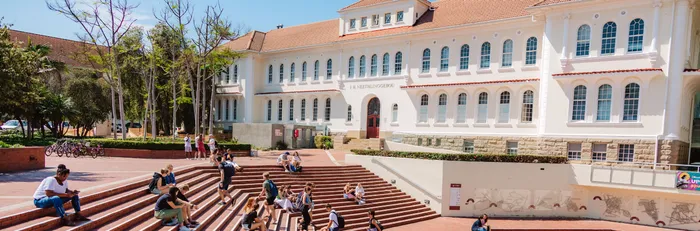
Stellenbosch University has defended its 2026 admissions process after a parent alleged unfair treatment, as figures show 106,000 applications for just over 6,000 available places.
Image: Stellenbosch University
Stellenbosch University (SU) has defended its 2026 admissions process after a dispute over a rejected application escalated publicly, with a parent alleging unfair treatment and questioning whether coloured students were being disproportionately affected.
The university confirmed that it received approximately 106,000 undergraduate applications for the 2026 academic year but was able to accommodate just over 6,000 students across all faculties.
Within the Faculty of Arts and Social Sciences (FASS) alone, more than 40,000 applications were received for 1,100 first-year places, according to SU.
The matter gained attention after Vanessa Le Roux, founder of Parents for Equal Education South Africa (PEESA), shared correspondence publicly alleging that her niece had been unfairly denied admission.
“It is clear the divide and rule card is at play,” Le Roux wrote. “I will not let anyone tell me otherwise.”
She further stated: “The marginalisation is on the coloured child, and I refuse to be silent on the opportunity of any child.”
In emails and social media posts seen by Cape Argus, Le Roux said this was the second year a child in her family had been unsuccessful and questioned whether that was “coincidence.” She alleged that different officials had provided inconsistent explanations regarding admission thresholds and available places.
Le Roux said she had been contacted by several other parents who, she claimed, had experienced similar outcomes in the admissions process and believed her niece’s case was not an isolated incident.
Cape Argus has seen correspondence between Le Roux and other parents raising concerns about admission outcomes and communication from university officials.
In the correspondence, some parents questioned why applications that met minimum requirements were not reconsidered after final matric results were released. Others raised concerns about the timing of rejection notices, clarity around conditional offers, and uncertainty relating to residence placements.
Le Roux said she had escalated her concerns to the Department of Higher Education and Training (DHET), members of Parliament and the Portfolio Committee on Higher Education.
Responding to media enquiries, SU said it was aware of “a complaint regarding an admission outcome in the Faculty of Arts and Social Sciences, as well as broader allegations relating to the 2026 admissions process.”
“We recognise that admission outcomes can be deeply emotional for applicants and their families, and we understand the disappointment that accompanies an unsuccessful application,” the university said.
SU said admissions decisions are governed by a Senate-approved Admissions Policy and are subject to enrolment targets agreed with DHET.
For the 2026 intake, applicants whose Grade 11 results met the required threshold received conditional offers. The university said that in the most recent admissions cycle, the threshold for mainstream admissions for applicants from designated groups was an average of approximately 67% for a prescribed list of subjects.
Applicants whose averages fell below that level were considered for the Extended Curriculum Programme within a narrow band below the threshold.
“No applicant whose average fell outside the very narrow band below the threshold received a conditional offer,” SU said. It added that applicants who did not receive a conditional offer based on their Grade 11 results could not be reconsidered solely on the basis of their Grade 12 results because the number of applications substantially exceeded the number of available places.
SU said the Registrar reviewed the case that had been publicly referenced and determined that the applicant had been treated in accordance with the Admissions Policy. The university further stated that it had received one formal complaint alleging unfair treatment in the 2026 admissions cycle, which it said had been addressed.
SU said its Admissions Policy allows race to be considered as one of several factors for the purposes of redress and transformation, and that applicants are invited to self-classify voluntarily.
Within FASS, approximately 57.6% of first-year students are Black, broadly defined, while 5.6% are international students, predominantly from elsewhere on the African continent.
Across the university, the demographic profile of admitted students who accepted offers prior to registration for 2026 is as follows: Black African 3,531; White 3,578; Coloured 1,236; Indian 252; Asian 23; International 611; Unknown 236.
“These figures provide context to claims regarding disproportionate outcomes. The University’s admissions data does not support the assertion that non-white applicants are being disproportionately rejected,” SU said.
The scale of demand facing SU reflects broader national pressures on higher education. In January, Cape Argus reported that public universities across South Africa could offer approximately 235,000 first-year places for 2026, fewer than the number of qualifying learners. In 2025, Cape Argus also reported that SU received 90,027 first-year applications for 6,005 available spaces — nearly 15 applications for every place.
SU said that, as in previous years, it had received inquiries and requests for reconsideration from unsuccessful applicants from various population groups.
Unsuccessful applicants may reapply when admissions for the 2027 intake open later this year, although the university cautioned that reapplication does not guarantee admission.
SU said it remained committed to ensuring that its admissions processes are applied consistently, transparently and in line with national policy.
Get your news on the go, click here to join the Cape Argus News WhatsApp channel.
Cape Argus