MJC opposes e-death certificate burial law


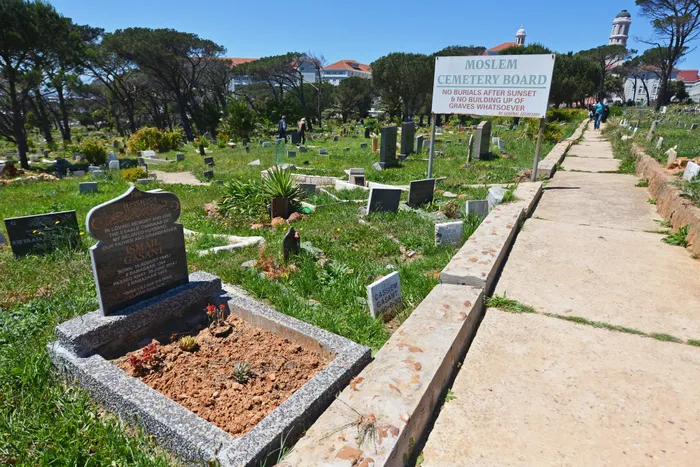
The MJC said that it is within Islamic jurisprudence that the burial of the deceased is done as quickly as reasonably possible, which is derived from established principles of Shari’ah.
Image: Independent Newspapers Archive
While the Muslim Judicial Council (MJC) has come out against a new White Paper by the Department of Home Affairs that has proposed a system that may require an electronic death certificate before burial can take place, the Western Cape Muslim Undertakers Forum has said that the system is not new.
The MJC has undertaken a considered review of the Draft White Paper on Citizenship, Immigration, and Refugee Protection, Government Gazette No. 53853 of December 12, 2025, "insofar as its proposed administrative architecture may bear upon the release of deceased persons for purposes of burial."
The MJC said that it is within Islamic jurisprudence that the burial of the deceased is done as quickly as reasonably possible, which is derived from established principles of Shari’ah.
“The prompt burial of the deceased is integrally linked to the dignity of a person and forms part of the collective religious duty of the Muslim community. Importantly, the principle of expeditious burial is not unique to Islam. Other faith traditions, including Judaism and certain Christian denominations, similarly maintain theological and doctrinal obligations favouring burial without undue delay.
“The constitutional protection of religious freedom, therefore, extends beyond a single community and reflects the broader commitment of our constitutional order to accommodate diverse religious burial practices in a manner consistent with dignity and pluralism,” they said.
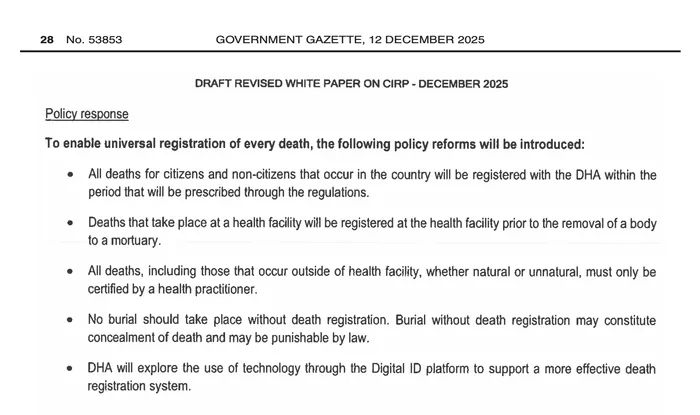
Draft White Paper on Citizenship, Immigration, and Refugee Protection, that is Government Gazette No. 53853 of 12 December 2025,
Image: Screenshot
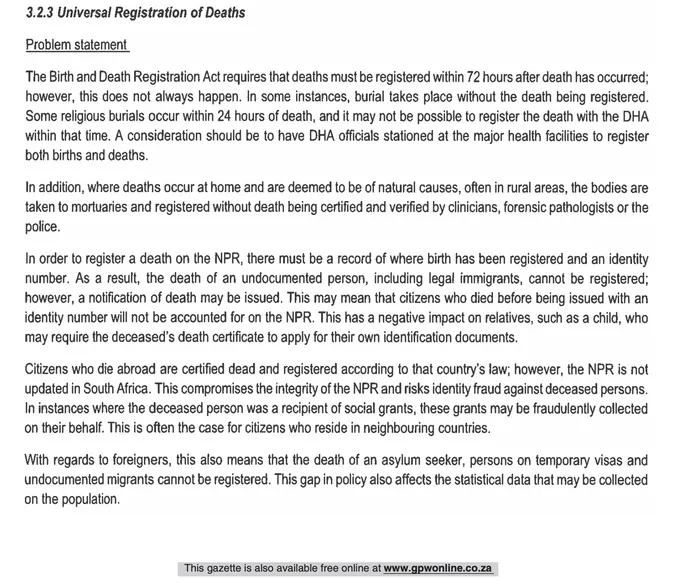
Draft White Paper on Citizenship, Immigration, and Refugee Protection, that is Government Gazette No. 53853 of 12 December 2025,
Image: Screenshot
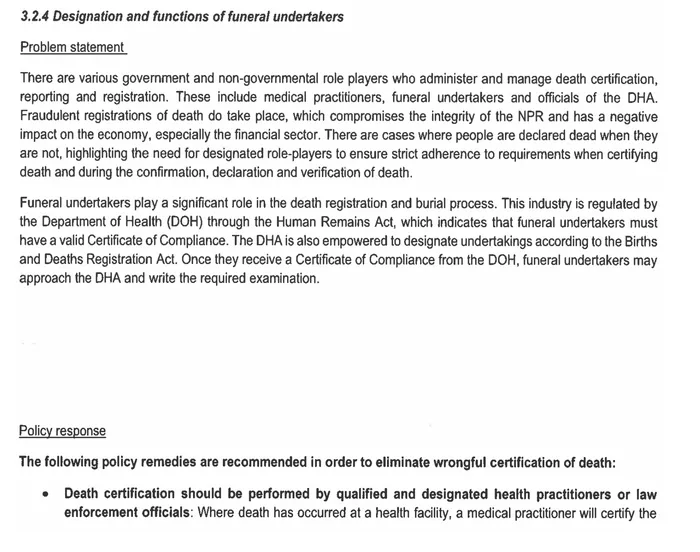
Draft White Paper on Citizenship, Immigration, and Refugee Protection, that is Government Gazette No. 53853 of 12 December 2025,
Image: Screenshot
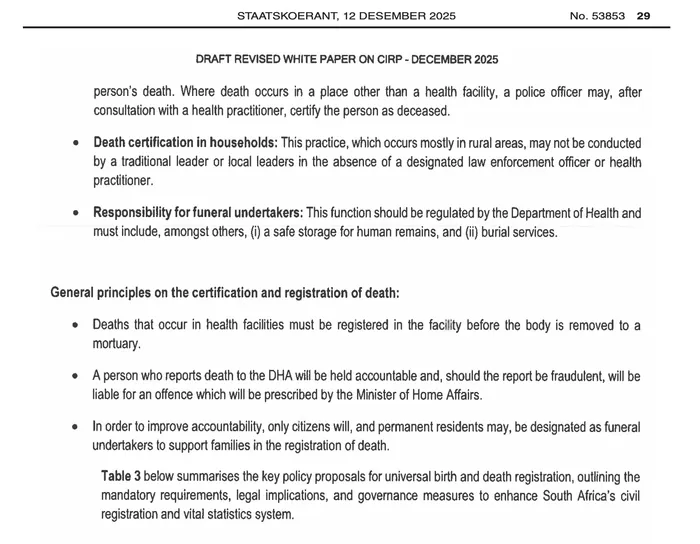
Draft White Paper on Citizenship, Immigration, and Refugee Protection, that is Government Gazette No. 53853 of 12 December 2025,
Image: Screenshot
The MJC said that burial rites fall squarely within the protected domain, and emphasised that it has never sought exemption from lawful processes in circumstances where forensic investigation, medico-legal examination, or statutory mortuary procedures are legitimately required.
“The rule of law demands compliance in such exceptional instances, and the Muslim community has historically cooperated with investigative authorities where legal grounds necessitate intervention,” they said.
“Further, there are instances that arise where bodies require storage, which the Muslim Judicial Council’s Burial Administration Department is engaged in. This is not considered a statutory impediment, which the new proposed legislation would be instead.”
They added that in the absence of criminal investigation, forensic inquiry, or any lawful basis justifying retention of a body, “the imposition of a generalised statutory delay would be constitutionally untenable”.
“A legislative measure that operates as a blanket administrative impediment to prompt burial would require justification. It is difficult to conceive how such a limitation could satisfy the proportionality analysis required by the limitation clause, particularly where less restrictive means exist to achieve legitimate governmental objectives without infringing religious practice.
“Accordingly, the MJC hereby places on record that it will formally object to, and where necessary oppose through appropriate legal and constitutional mechanisms, any provision within the proposed policy framework that directly or indirectly impedes the Muslim community’s ability to conduct burials in accordance with Islamic norms in circumstances where no lawful investigative basis exists for delay,” they said.
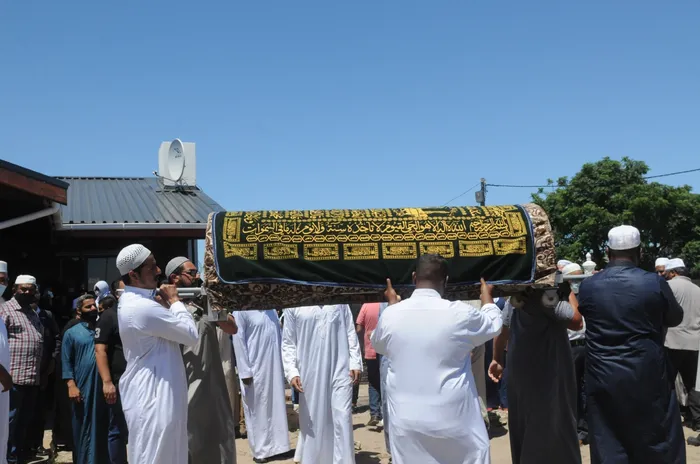
Pictured is the janaza for Shariefa Khan, which occurred in 2022, the oldest District 6 claimant who passed away at the age of 100.
Image: Ayanda Ndamane/Independent Newspapers (Archives)
Chairperson of the Western Cape Muslim Undertakers Forum, Ebrahim Solomon, has explained that the draft legislation in the White Paper has existed for years, with the only big difference he noted being that people would be open to being prosecuted. They do still, however, have their concerns.
“I’ve been an undertaker for more than 30 years. For many years, we've done this, where we have buried, then gone and registered the death.
“Now, what they want us to do according to this Draft, they want us to go and register first, and then go bury - the legislation already says that. It’s not a change. The only change that I picked up was that you can be prosecuted,” Solomon said.
“If you go back to the gazettes of former years, you will see that that's exactly the same. The only thing that has been added there is that you can be prosecuted…
“But as Muslims, we never had to do that because they trusted us, and they exempted us from giving those documents before burial. From our side, what we are saying is that we need a written exemption.”
Solomon said that what they may want from the legislation is to have the exemptions reflected within it, where “in certain instances, you are allowed to bury before registering with you”.
“Because as an undertaker, we all know that we need to register the death within 48 hours.”
The Department of Home Affairs has since come out clarifying the matter and, echoing Solomon's remarks, explaining that the current law already requires deaths to be formally recorded before burial, but this is not always followed.
Officials warned that the loophole “opens the door to acts of fraud and identity theft and undermines the integrity of the country’s civil registry”.
Get your news on the go, click here to join the Cape Argus News WhatsApp channel.
Cape Argus