UCT MSc student builds sustainable home from soil and recycled waste


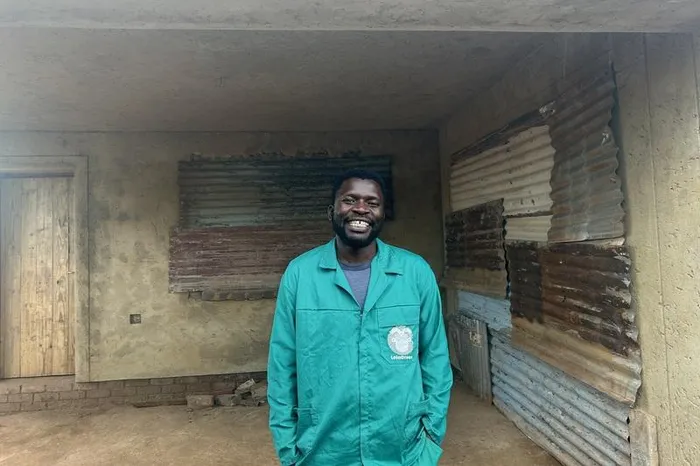
Matimba Mabonda standing in front of the house he built with soil and recycled waste.
Image: Supplied
A master’s student at the University of Cape Town has completed a three-bedroom house constructed largely from soil and recycled waste, positioning the project as a practical response to South Africa’s housing and waste challenges.
Matimba Mabonda, who holds a degree in chemical engineering and is currently completing his MSc, led the pilot build in Ennerdale, Johannesburg. The house was constructed using natural soil combined with plastic and glass waste, resulting in a fully functional home designed to deliver comfort and energy efficiency while reducing environmental impact.
South Africa generates an estimated 122 million tonnes of solid waste each year. Mabonda’s project aims to demonstrate how some of that waste can be repurposed into durable housing materials.
After graduating, Mabonda partnered with his father, Ben Mabonda, a contractor with decades of experience and hundreds of completed builds, to turn the concept into reality. By that stage, he had already founded his start-up, LolaGreen, which focuses on developing alternative building solutions by collecting waste from landfills and the environment and converting it into construction materials.
“Sustainable building has always been an area of interest for me, and after graduating with my degree it made sense to venture into how to make it work and that’s what I did,” he said.
Mabonda’s drive is rooted in his upbringing. He grew up in a shack in Grasmere, Ennerdale, where he witnessed the effects of South Africa’s housing shortage first-hand.
“I always wanted to improve things for my family. We also have a massive housing crisis in South Africa. So, I thought if I could contribute to solving this crisis while keeping sustainability top of mind and changing circumstances for my family and others out there, that would be great and make me so happy,” he said.
The initial plan was to use “lolabricks” — blocks made from plastic and industrial waste without cement or water. However, the high cost of industrial machinery required for large-scale production proved a major hurdle. Mabonda then shifted focus to earth-build technologies, which use raw soil as a primary construction material.
Preparing soil for construction requires testing and analysis to determine the correct composition for structural integrity. According to Mabonda, soil composition varies by location and the size of the structure, meaning builders must blend different soil types to achieve optimal results.
For the pilot house, the team incorporated plastic waste into the soil mix while maintaining the structure’s strength and stability throughout construction.
“More than 90% of our walls were made from earth materials, as well as plastic waste. Our house is comfortable. It’s warm in winter and cool in summer – making it the ultimate living space and there’s no need for expensive air conditioners either,” he said.
Located in Ennerdale, the three-bedroom home includes a living area, kitchen, bathroom and garage. It was completed in less than a month and is visually indistinguishable from neighbouring homes built using conventional brick-and-mortar methods.
“Until someone tells you that this house was built using soil and other waste material, you’d never say that this is not a brick-and-mortar house. It looks the same,” Mabonda said.
Following the pilot build, Mabonda said LolaGreen has received a significant number of requests from prospective clients, citing the model’s sustainability, cost-effectiveness and shorter construction timeline compared to traditional builds.
Mabonda’s longer-term ambition is to help decarbonise the construction sector by reducing reliance on carbon-intensive materials. He is currently in discussions with the Council for Scientific and Industrial Research to pursue certification and is engaging with Agreement South Africa, which evaluates non-standard construction materials for fitness of purpose.
“We are incredibly proud of where we are at; it’s a massive milestone in our journey. Gaining a bit more traction and obtaining the necessary certification will take us to the next level, which is another step towards truly transforming the construction industry and contributing to solving South Africa’s housing crisis,” Mabonda said.
Get your news on the go, click here to join the Cape Argus News WhatsApp channel.
Cape Argus