Stellenbosch University biochemist spearheads US$60 million initiative to fight antibiotic resistance
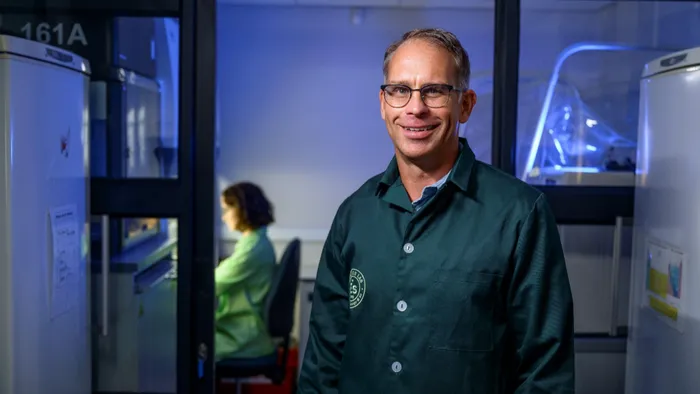
Prof Erick Strauss in his laboratory in the Department of Biochemistry at Stellenbosch University. He is leading one of two African project teams selected to participate in a global consortium to transform antibiotic discovery to counter the growing antimicrobial resistance (AMR) crisis.
Image: Supplied
Stellenbosch University (SU) biochemist Professor Erick Strauss has been selected to lead one of only two African teams in a US$60 million global consortium aimed at transforming antibiotic discovery and tackling the escalating antimicrobial resistance (AMR) crisis.
Strauss, from SU’s Department of Biochemistry, will join the newly launched Gram-Negative Antibiotic Discovery Innovator (Gr-ADI) consortium, supported by the Gates Foundation, Novo Nordisk Foundation and Wellcome.
In a joint announcement, the funders confirmed $60m in grant funding over the next three years to support 18 research projects across 17 countries. The teams were selected for their potential to revolutionise antibiotic discovery for Gram-negative bacteria — particularly Klebsiella pneumoniae, one of the leading drivers of AMR-related deaths worldwide.
The Gr-ADI consortium is designed as a first-of-its-kind collaborative platform, with multiple funders and research teams openly sharing data and learnings to accelerate the development of urgently needed antibiotics. It marks the first investment under a broader $300m global health research and development partnership launched by the three philanthropic organisations in 2024.
Strauss, a chemical biologist and head of SU’s Department of Biochemistry, is also co-director of the Africa Centre for Therapeutic Innovation. His team includes Professor Andrew Whitelaw from SU’s Department of Medical Microbiology, Professor Adrienne Edkins of Rhodes University, the Ersilia Open-Source Initiative in Spain led by Dr Miquel Duran-Frigola, and Professor Willem van Otterlo from SU’s Department of Chemistry and Polymer Science. The second African team in the consortium is led by Professor Stephen Dela Ahator of the University of Ghana.
Gram-negative bacteria are increasingly resistant to available antibiotic classes, complicating the treatment of life-threatening infections. New strategies are urgently required — particularly those that work differently from existing drugs — to reduce the likelihood of resistance developing.
Strauss’s team will explore an approach inspired by advances in cancer research. Instead of blocking essential bacterial processes, the strategy hijacks a cell’s natural protein-degradation machinery to destroy specific target proteins. This is achieved using specially designed bifunctional molecules known as PROTACs (proteolysis-targeting chimeras).
While PROTACs have been investigated as cancer therapies for more than two decades, bacterial versions — known as BacPROTACs — were first described in 2022 as potential treatments for mycobacterial infections, including tuberculosis.
Strauss’s group previously received funding in 2023 from the Gates Foundation and LifeArc under the Grand Challenges African Drug Discovery Accelerator to apply this strategy to multi-drug-resistant tuberculosis. The new project will build on that work, establishing a BacPROTAC development workflow focused on Gram-negative bacteria, starting with Klebsiella pneumoniae.
Explaining the concept, Strauss said traditional antibiotics work by interfering with essential processes in disease-causing organisms, such as protein synthesis or cell wall formation. “If the concentration of the antibiotic is maintained at effective levels, the pathogen will be killed or at least prevented from multiplying, giving the immune system time to fight the infection,” he said.
By contrast, the new approach enables bacteria to destroy their own essential proteins.
“What is especially exciting about this approach is that the drug is recycled, since it effectively acts as a fishing rod with a baited hook to catch the target protein; just as one needs only one fishing pole to catch many fish, the drug can be used repeatedly to exert their destructive effect on the target protein in question,” Strauss explained. “This suggests that lower doses may be needed, and that the effects may be longer lasting.”
He said the team ultimately hopes to develop BacPROTACs capable of targeting validated drug targets or resistance-inducing factors in Gram-negative pathogens.
“We are excited to be joining the Gr-ADI consortium, and to be able to contribute to solutions to health challenges for which Africa carries an especially heavy burden. It is a significant investment in our ability to develop new therapies for infectious diseases,” Strauss added.
Get your news on the go, click here to join the Cape Argus News WhatsApp channel.
Cape Argus