Uncertainty looms for CPUT students amid residence placement issues


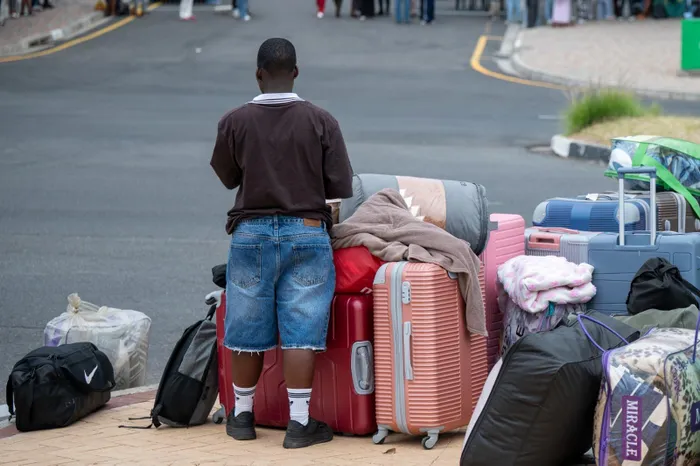
A student stands beside a pile of suitcases and bedding on a city pavement, highlighting the pressure and uncertainty facing those forced to relocate or seek temporary accommodation.
Image: Armand Hough / Independent Newspapers
As students at the Cape Peninsula University of Technology (CPUT) continue to queue outside the District Six campus waiting for residence placements, neighbouring universities say they are experiencing a smooth and largely disruption-free start to the 2026 academic year.
At CPUT, some students have been left sleeping outside campus gates and on nearby streets with their luggage, despite having applied for residence before the closing dates. Several affected students said they travelled from outside the Western Cape to begin their studies, only to arrive without confirmed accommodation.
CPUT spokesperson Lauren Kansley said the university intervened over the weekend, moving about 150 people who had been outside the District Six campus into temporary accommodation.
“These individuals have a mixture of statuses, including students awaiting appeal outcomes, students who never applied for residence and now require it, and others who have been declined,” Kansley said.
She added that first-year classes only begin on February 8, with new students expected to arrive from February 6, and noted that CPUT accommodates nearly half of its student population of about 37 500 students.
“CPUT has the most residence spaces, with 16 200 campus-owned and operated beds and an additional 4 000 private beds that can be utilised,” Kansley said.
Student organisations say some progress has been made but warn that uncertainty remains. The Pan Africanist Student Movement of Azania (PASMA) said 166 students with confirmed NSFAS funding who were temporarily housed at Adowa Living Residence would now be permanently placed there following engagements between students, the SRC and management. Discussions are continuing to secure additional accommodation, particularly for Bellville Campus students.
In contrast, other Western Cape universities report no comparable challenges.
University of Cape Town spokesperson Elijah Moholola said UCT was not experiencing any difficulties related to student allocation, registration or accommodation for the 2026 academic year.
“All students with accommodation offers are being allocated into residences as and when they arrive on campus,” Moholola said, adding that UCT has 8 700 beds across on-campus and leased off-campus residences and can accommodate 79% of eligible students who applied for housing.
At the University of the Western Cape, spokesperson Gasant Abarder said the institution was also on track for the start of the academic year.
“The University of the Western Cape is not experiencing any challenges as we have reached capacity across our programmes and are set to begin the first term next week,” Abarder said, noting that competition for space remains a reality but is being managed.
Stellenbosch University has likewise reported a stable registration and accommodation process. Spokesperson Martin Viljoen said registration for newcomer first-year students concluded on Tuesday and had “been running smoothly”.
On accommodation, Viljoen said Stellenbosch’s primary challenge was affordability rather than availability, adding that students are informed of their accommodation status well in advance and encouraged to secure housing before arriving on campus.
As UWC, UCT and Stellenbosch prepare to begin lectures under stable conditions, students at CPUT say ongoing uncertainty around accommodation continues to place pressure on those unable to afford private housing, raising concerns about safety, well-being and equal access to education as the academic year gets under way.
Get your news on the go, click here to join the Cape Argus News WhatsApp channel.
Cape Argus