Steenhuisen's exit from DA leadership opens the door for new leadership


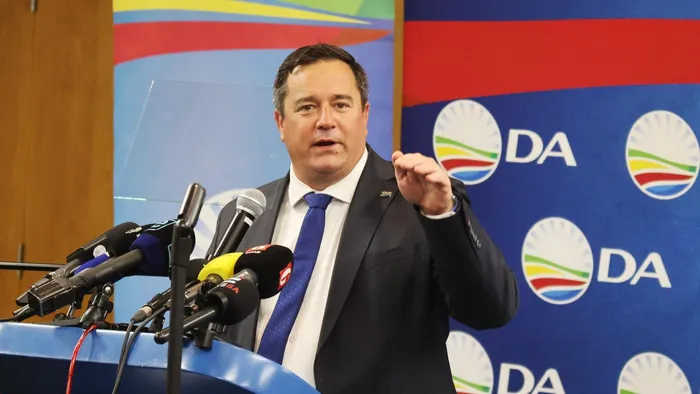
John Steenhuisen announces he will not seek re-election as DA leader, opening the race to succeed him as the party prepares for its federal congress.
Image: Boitumelo Pakkies/ Independent Newspapers
John Steenhuisen on Wednesday announced that he will not seek re-election for a third term as leader of the Democratic Alliance, with political analysts confident the party could survive disruptive leadership losses as mayor Geordin Hill-Lewis, is widely regarded as a potential successor.
Political analyst Sipho Seepe argued that Steenhuisen’s departure would not fundamentally weaken the DA, noting that the party had previously survived leadership losses. “The DA has weathered the exits of figures such as Lindiwe Mazibuko, Patricia de Lille and Mmusi Maimane,” Seepe said. “It is not a party whose strategic direction hinges on one individual," he said.
The announcement has opened a wide-ranging succession contest ahead of the party’s federal congress and it came just hours before the DA reveals its Western Cape mayoral committee candidates for the upcoming local government elections which is set to take place today at 11am in Cape Town.
Addressing supporters, colleagues and family in eThekwini, Steenhuisen framed his decision as the completion of a political mission rather than a retreat under pressure, saying he had fulfilled the mandate he received when elected DA federal leader in 2019.
“As I stood there looking out over South Africa’s capital city, I realised: it is mission accomplished for me,” he said, reflecting on a recent visit to the Union Buildings. “I have delivered everything that I promised my party when I was first elected as Federal Leader back in 2019.”
Steenhuisen confirmed that he would instead focus his full attention on his role as Minister of Agriculture in the Government of National Unity (GNU), particularly the fight against what he described as the most devastating foot-and-mouth disease outbreak in the country’s history.
“That is not a part-time job,” he said. “It would not be fair to the incredible farmers of South Africa for me to split my time between battling the worst FMD outbreak ever and running an internal campaign for the next three months.”
Seepe said Steenhuisen’s decision reflected a rare but constructive leadership choice in South African politics, where leaders often cling to office long after their influence has waned.
“There is something positive about a leader stepping down when he feels his time is up, or when he believes he no longer commands support within the organisation,” Seepe said.
Seepe also dismissed suggestions that Steenhuisen’s exit would undermine the DA’s role in the GNU, saying the party had been clear-eyed about its objectives from the outset. “The DA has been frank that it is not in government to save the ANC, but to weaken the ANC’s electoral dominance. That strategic objective would not be frustrated by a single individual,” he said.
Addressing criticism that Steenhuisen had grown too close to the ANC, Seepe said such accusations ignored the realities of coalition politics. While the DA had not abandoned its opposition to key ANC policy positions, its leaders had also sought to demonstrate that “where they govern, they do it better,” he said.
He added that Steenhuisen’s decision not to contest again could, in fact, level the internal contest. “It is difficult to run against an incumbent. The power and influence of incumbency are deep and widespread,” Seepe said.
Within the DA, Steenhuisen’s announcement was met with strong praise from senior leaders. Cape Town mayor Geordin Hill-Lewis, widely regarded as a potential successor, said Steenhuisen deserved recognition for steering the party through a turbulent period.
“John Steenhuisen deserves honour and recognition for what he’s achieved as DA leader over the past six years. He took over at a very difficult time for the party, steadied the ship, returned the DA to growth in 2024, and led the party into national government for the first time,” Hill-Lewis said.
However, criticism came from outside the party. AfriForum chief executive Kallie Kriel said Steenhuisen had increasingly aligned himself with the ANC after the election, particularly on the Basic Education Laws Amendment Bill and issues of racial transformation.
With Steenhuisen’s departure confirmed, attention has now turned to who could succeed him at a critical moment for the DA, among the names being discussed are Hill-Lewis, Communications Minister Solly Malatsi, Western Cape Premier Alan Winde, Basic Education Minister Siviwe Gwarube, Gauteng opposition leader Solly Msimanga and uMngeni mayor Chris Pappas, although none has formally declared a candidacy.
“For the true test of whether you love a thing, is the ability to let it go when the time is right,” he said in closing.
Get your news on the go, click here to join the Cape Argus News WhatsApp channel.
Cape Argus