Political dynamics in the DA as leadership contest heats up


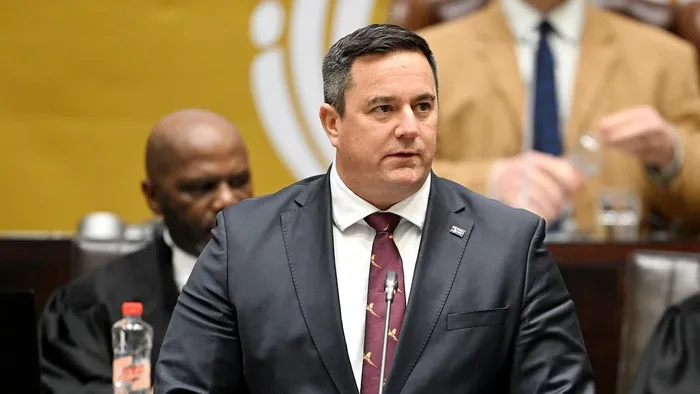
DA leader John Steenhuisen may not seek re-election at the party's Federal Congress in April.
Image: Phando Jikelo / Parliament of RSA
As reports circulate that DA federal leader John Steenhuisen will not be contesting the party’s leadership race in April, the political arena is abuzz with speculation about who might step into his shoes.
This comes as the country approaches a crucial local government election year, placing immense pressure on the Democratic Alliance (DA) to select a leader capable of expanding its appeal beyond its traditional stronghold.
Political analysts say the leadership contest will test whether the party can position itself as a credible alternative government rather than a permanent opposition.
At this stage, two names are emerging as likely frontrunners: Gauteng opposition leader Solly Msimanga and Cape Town Mayor Geordin Hill-Lewis.
Other figures being mentioned include Western Cape Premier Alan Winde and Communications and Digital Technologies Minister Solly Malatsi. However, analysts suggest that Steenhuisen’s decision not to run has fundamentally reshaped the race.
Political analyst Professor Bheki Mngomezulu said Steenhuisen’s withdrawal has “opened a Pandora’s box”, despite assurances from DA Federal Council Chairperson Helen Zille that the party will not fracture during the succession process.
“There was no clear indication that Steenhuisen would pull out of the race,” Mngomezulu said. “His withdrawal creates space for almost anyone to emerge. It could even open the door for someone like Solly Msimanga.”
Mngomezulu cautioned, however, that the final outcome may hinge on uncomfortable realities around race and internal party dynamics.
“The DA always says race and gender do not matter, but that is theory,” he said. “If it comes down to a straight contest between Geordin Hill-Lewis and Solly Msimanga, then Msimanga will struggle.”
Another analyst, Professor Kedibone Phago, said Steenhuisen’s exit may be linked to mounting internal pressure following the fallout involving former DA MP Dion George, who resigned from the party after accusing its leadership of lacking transparency and honesty.
George claimed internal processes were opaque and that raising concerns came at personal cost, reigniting debate about whether the DA practices internally the values it promotes publicly.
Zille rejected these claims, accusing George of bringing the party into disrepute and noting that he had resigned before answering to a pending disciplinary process.
“It is unfortunate that Dr George resigned before accounting to the DA’s Federal Legal Commission,” Zille said.
Behind the scenes, relations between Steenhuisen and George had deteriorated sharply. Their disagreements centred on strategy, communication, and the DA’s role in the Government of National Unity (GNU).
While Steenhuisen has defended the DA’s participation in the GNU as pragmatic and responsible, critics within the party view it as a dilution of the DA’s role as a distinct opposition force.
Phago believed that, despite Zille publicly backing Steenhuisen during the dispute with George, recent developments suggest that influential factions within the party no longer see him as the right leader for the road ahead.
“It means there is a faction, led by Zille, that believes he is not the right fit,” Phago said. “They know the ANC is weakening and they see an opening. That is why the DA is aggressively targeting Johannesburg. This is strategic.”
He added that Steenhuisen was unlikely to attract the black middle class that the party now needs to grow.
“I am not surprised he stepped aside. He was never going to be the leader when it mattered most,” Phago said.
Get your news on the go, click here to join the Cape Argus News WhatsApp channel.
Cape Argus