South African film and TV industry on 'life support' amid crisis

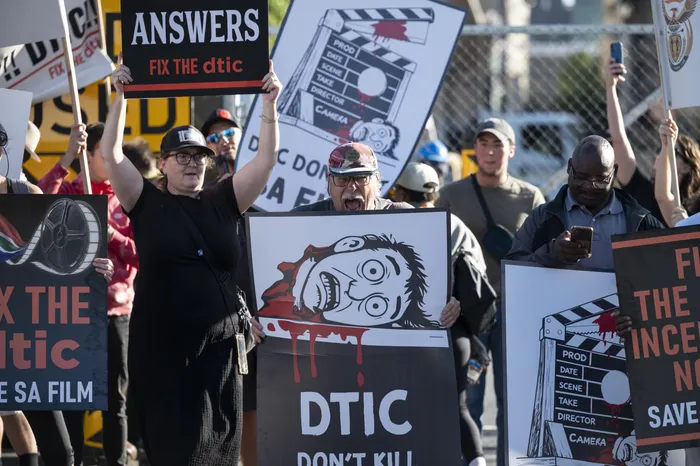
Hundreds of film and television professionals rallied outside Parliament yesterday in the Cape Town leg of the ‘Save SA Film Jobs’ protests.
Image: Armand Hough / Independent Newspapers
The South African film and television sector has called on the Minister of Trade, Industry, and Competition, Parks Tau, to resolve the crisis stemming from prolonged dysfunction of the DTIC Film and Television Production Incentive.
Under the banner, “Save SA FilmsJobs Coalition”, they held a mass protest outside Parliament.
Save SA Films Jobs Coalition includes: Animation South Africa (ASA) Cinegear World Documentary Filmmakers Association (DFA), Independent Producers Organisation (IPO),Personal Managers’ Association (PMA), Creative20 (SA), South African Guild of Actors (SAGA), South African Guide of Editors (SAGE), South African Stunt Association (SASA), South African Society of Cinematographers (SASC), South African Performing Artists Managers Association (SAPAMA), South African Screen Federation (SASFED),Soweto Film Festival and Writers Guild of South Africa (WGSA).
According to JP Smith, Mayco Member for Safety and Security, who joined the protest, the film industry supports over 30, 000 jobs in Cape Town, many of which are now at risk due to a declining investment landscape. Between 2021 and 2024, employment decreased by an average of 43.6% per year, dropping from 4,943 FTEs (2021) to 884 FTEs (2024).
Smith said the Film production investment has fallen sharply, from over R6 billion in 2021 to approximately R962 million in 2024.
The South African Film and Television Sector said this paralysis has stalled productions, contracted industry activity by nearly 50%, and led to significant job and income losses, reducing foreign direct investment.
Despite a memorandum submitted over a year ago, the DTIC has failed to address concerns, provide timelines for working groups, or communicate the incentive's status, leaving the industry in damaging uncertainty it stated.
It said the Film Incentive, introduced in 2004, is vital for the local industry and attracts Foreign Direct Investment (FDI).
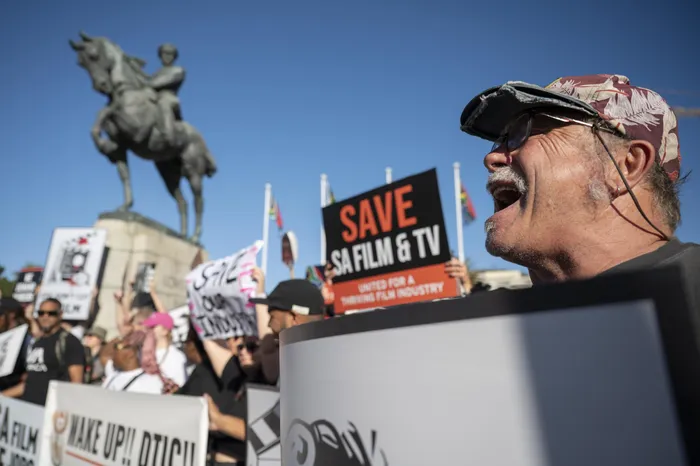
Hundreds of film and television professionals rallied outside Parliament on Wednesday in the Cape Town leg of the “Save SA Film Jobs” protests. Industry leaders warn that the creative sector, once a major economic driver, faces collapse without swift government intervention.
Image: Armand Hough / Independent Newspapers
It added that the Olsberg Report (2025) confirms the incentive's economic value, generating ZAR26.4 billion in Gross Value Added (GVA) and a ZAR5.1 return on investment, but highlights a marked decline since 2022 due to administrative uncertainty and delayed payments, which undermines South Africa’s competitiveness.
They said the sector, now on "life support," and stated that renewed mass action as a last resort due to the sustained lack of response.
The Save SA Film Jobs Coalition demands:
- Urgent Meeting: An in-person meeting with DTIC leadership (Minister, Deputy Ministers, Director-General) to agree on immediate corrective actions.
- Immediate Resumption of Adjudication: Restart Adjudication Committee meetings immediately to approve projects.
- Establishment of Working Groups: Form joint industry/DTIC working groups within 21 working days to develop short-term stabilisation and long-term reform strategies, including third-party specialists, status updates on backlogs and finance, and the establishment of an online tracking portal and an Animation/Documentary Film Incentive.
- Regular Workshops: Quarterly workshops to clarify and consistently interpret incentive guidelines.
- Priority Approvals: Prioritised adjudication for productions already underway but awaiting final approval.
- Transparency: Publish minutes of adjudication meetings and disclose remaining incentive funds immediately and quarterly.
- Investigation: Immediate appointment of an independent third party to investigate allegations of mismanagement within the DTIC Film Incentive Programme, with public findings.
- Financial Agencies: The Minister must compel the NEF and IDC to establish a dedicated, specialised Film Fund with preferential interest rates.
- Reduction of Red Tape: Immediate and meaningful reduction of excessive bureaucracy, unclear requirements, and prolonged processing times, coupled with increased staffing capacity.
The coalition said the industry submitted a memorandum to the DTIC outlining its concerns in February 2025 and is asking for a response within ten days.
Queries to Tau's office for a response went unanswered..
“Despite repeated attempts at constructive engagement over the past 2 years, including formal correspondence, prior memoranda and peaceful protest action, there has been no timely or adequate administrative response from the DTIC to resolve the dysfunction in the incentive," the coalition said.
“This sustained lack of meaningful consultation and operational certainty has left the sector effectively on “life support” and has made renewed mass action unavoidable as a last resort to secure basic continuity of the scheme.”
Provincial MEC of Cultural Affairs and Sport, Ricardo Mackenzie said he supported the call: "We therefore echo the call for meaningful engagement in order to restore confidence. This is crucial if South Africa is to retain its competitive position as a preferred global filming destination.”
Smith explained that the City, through the Mayor’s office, requested a meeting with the Minister Tau.
“The meeting was scheduled for January 23 2026, but then cancelled, and all attempts to secure a new date have so far come to nought, “ he said.
“The film sector plays a central role in Cape Town’s local economy and has become one of our city’s most globally competitive industries.
“The incentive administered by the Department of Trade and Industry has historically been a critical enabler of this success.
Kaden Arguile, GOOD National Youth Organiser supported the plight stating that the Department of Trade and Industry (DTIC) had made a crucial error in its mismanagement and failure to safeguard its Incentive Scheme for the film industry.
“With 100,000 households set to be economically impacted by its removal, the government must come to the negotiating table or risk the collapse of an industry pivotal not only to South Africa’s economy but also its identity.,” he said.
Cape Argus also reached out to Wesgro, Cape Town & Western Cape tourism, trade and investment for comment and await feedback.
Get your news on the go, click here to join the Cape Argus News WhatsApp channel.
Cape Argus