R19 million spent on bringing in other resources to help battle fires, says Winde

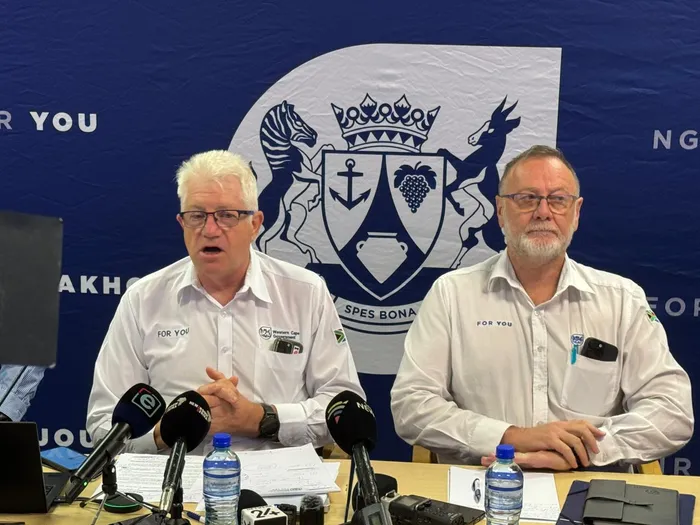
Western Cape Premier Alan Winde says the 2025/26 fire season is among the worst in a decade, with firefighting budgets depleted and a provincial disaster declaration now being sought as dry conditions and water risks intensify.
Image: Murray Swart/ Cape Argus
The Western Cape’s 2025/26 fire season has already emerged as one of the most severe in a decade, with firefighting budgets exhausted with growing concern over water security.
Winde said the province has spent R16 million on helicopters and R19 million on bringing in resources.
Premier Alan Winde said Cabinet has agreed to request a provincial disaster classification to unlock emergency funding and allow resources to be shifted as both wildfire and drought pressures intensify.
“A number of us were onsite in Knysna in the Southern Cape yesterday to look at the issues there and Cabinet has agreed that we will ask for a disaster classification,” Winde said.
“Firstly on the water situation in a number of our towns that are highly at risk. The second one, because it’s so dry, fires have now depleted our budget systems and we need extra resources to come in from other parts of the country and reallocate funding which can happen through that declaration.”
According to provincial figures, approximately 132 000 hectares have burned so far this season — the worst since 2015, with double the number of fires recorded compared to the same period last year. Multiple structures have been destroyed and significant wildlife losses have been reported, although no human fatalities have occurred.
The escalating cost of fighting the fires has placed immense strain on provincial and municipal resources.
“From our own budget in the province, we have spent R16 million on the helicopters and that budget is now depleted. R19 million has been spent on bringing in other resources,” Winde said.
He explained that the province funds the first hour of aerial firefighting, which is critical to containment. “Those initial helicopters only go in for the first hour while the second and third hour is paid for by the local authorities.
"If we estimate it at nearly R20 million just since the beginning of December, you can probably multiply that by three in each of those municipalities across the province because they are all putting in their own resources to bring these fires under control."
Provincial MEC of Local Government, Environmental Affairs and Development Planning Anton Bredell said the crisis highlighted the importance of sustained investment in disaster readiness. “The question isn’t if a disaster is going to hit you but when. When it does, you have to be ready. You cannot start to design a system when the disaster hits you,” he said.
Bredell said the province has been building disaster management capacity for more than a decade.
Since 2018, the Western Cape Government has spent R250 million on water resilience and upgrading municipal water systems, supported by additional municipal and national funding. “If you add their budget and the national budget to this, you get the golden thread going right through which allows you to secure water longer-term,” Bredell said.
Around R50 million has also been spent on engineering and geohydrological support to municipalities as climate pressure, population growth and economic expansion increase demand.
“We’ve already depleted the budget and lost more hectares than we did in the whole fire season last year,” he said, urging residents to report fires immediately, avoid negligence and use water responsibly.
Get your news on the go, click here to join the Cape Argus News WhatsApp channel.
Cape Argus