How do humans and honeyguides communicate? New research uncovers local dialects

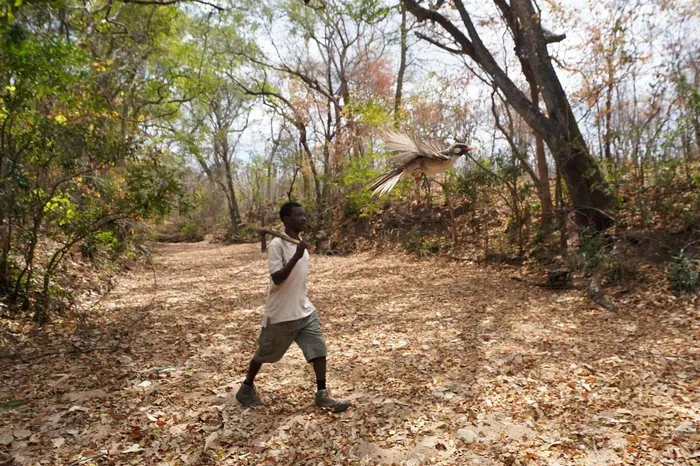
Carvalho Nanguar, Yao honey-hunter from northern Mozambique, with a male greater honeyguide released from the hand after being caught for research purposes.
Image: David Lloyd-Jones and Dominic Cram
Humans and wild birds are communicating in local “dialects” in northern Mozambique, according to new research led by the University of Cape Town (UCT), offering rare insight into how culture shapes cooperation between species.
The study, published in People and Nature, shows that honey-hunters use regionally distinct calls when working with greater honeyguides (Indicator indicator), revealing a striking parallel to how human languages develop local dialects. Researchers say it is the first time that human-to-wildlife communication has been shown to vary within a region in such a structured, language-like way.
In parts of sub-Saharan Africa, honey-hunters and honeyguides cooperate to locate wild bees’ nests, coordinating their behaviour using distinctive calls. Humans benefit by finding and harvesting more honey, while the birds gain access to wax and larvae once nests are opened using fire and tools. The honeyguides are not domesticated or trained, but instead learn to interpret human signals in the wild, making this one of the few known examples of sustained, two-way cooperation between humans and free-living animals.
To investigate whether these calls vary between neighbouring communities, the research team recorded calls from 131 honey-hunters across 13 villages in Mozambique’s Niassa Special Reserve. Most participants were from Yao communities that depend heavily on wild honey and honeyguides for their livelihoods. The researchers analysed both loud recruitment calls used to attract honeyguides over long distances and quieter coordination calls used while following a guiding bird at close range, including trills, grunts, whoops and whistles.
The analysis showed that regional variation in calls increases with distance, with communities farther apart using more distinct signals. Environmental factors such as habitat acoustics did not explain these differences. Honey-hunters who moved between villages also appeared to adopt the calls used in their new communities, reinforcing the idea that the variation is culturally transmitted rather than environmentally driven.
“These regional honey-hunting calls pattern across space in a way that looks remarkably similar to human dialects,” said lead author Jessica van der Wal of UCT’s FitzPatrick Institute of African Ornithology. “It suggests that cultural processes within human communities, rather than environmental pressures, are the primary drivers of this diversity.”
Despite the regional differences, cooperation between humans and honeyguides remains effective across the reserve, suggesting that the birds are also adapting. Senior author Professor Claire Spottiswoode, who leads UCT’s Honeyguide Research Project, said both species appear to be adjusting to each other across the landscape. Humans learn and maintain local signals, while honeyguides are likely learning and reinforcing these local dialects, much as they respond to broader differences in human calls across Africa.
The findings highlight how human cultural diversity can shape interactions with wildlife, even with undomesticated animals, and offer a rare window into the evolution of communication between species.
Get your news on the go, click here to join the Cape Argus News WhatsApp channel.
Cape Argus