UCT study uncovers resilient fossil ecosystem that revived ocean life after mass extinction


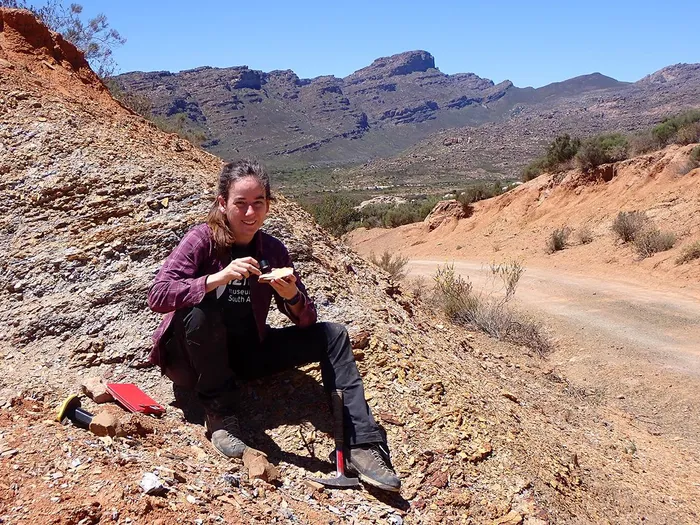
Dr Claire Browning, lead author, in the Cedarberg mountains digging for fossils.
Image: Supplied
An international team of scientists led by the University of Cape Town (UCT) has uncovered fossil evidence of a tiny but resilient ecosystem that helped Earth’s oceans recover after one of the planet’s most devastating mass extinctions.
The research, led by Dr Claire Browning, an honorary research associate at UCT, reveals how microscopic life forms played a crucial role in stabilising marine ecosystems following the end-Ordovician ice age around 444 million years ago, when about 85% of marine species disappeared.
The findings, published in Nature Ecology & Evolution, are based on advanced micro-CT scanning of ancient mudrock collected from the Cederberg Mountains. The scans allowed scientists to visualise the interior of the rocks in three dimensions, revealing fossilised burrows and droppings just fractions of a millimetre wide.
These traces were left by meiofauna, organisms so small they lived between grains of sand — including nematodes (tiny, unsegmented worms) and foraminifera (single-celled protists with intricate shells). Together, they formed a “small food web” that recycled nutrients and carbon on the ancient seafloor, supporting the recovery of larger marine life.
“This was an unexpected find because the Cederberg rocks formed on a seafloor thought to be intermittently devoid of oxygen and toxic to life,” said Browning.
“Although some amazing fossils have been found in the Cederberg rocks in the past, these are from creatures that swam in the surface waters. We did not expect to find fossils of creatures living on the harsh seafloor, especially from a period immediately following a mass extinction. Remarkably, these tiny creatures were able to withstand those conditions, and even thrive.”
By examining the mudrock layer by layer, the researchers also found evidence that pulses of organic matter — produced by phytoplankton in sunlit surface waters — regularly sank to the seafloor, feeding this hidden community. The discovery provides some of the earliest evidence that seafloor ecosystems stabilised rapidly after catastrophic environmental change.
The study places UCT at the forefront of research reshaping scientific understanding of early marine resilience and highlights the growing role of cutting-edge imaging technologies in uncovering ancient biological processes.
Beyond its historical significance, the research contributes to global discussions on how ecosystems respond to climate shocks, offering deep-time parallels to challenges facing today’s oceans.
The team now aims to determine how widespread these tiny ecosystems were in ancient seas, both in South Africa and elsewhere.
“Geology does not respect modern borders,” Browning said. “Rocks of the same age in South America were once connected to those in the Cederberg mountains and may also hold hidden evidence of marine snow, dust and meiofauna. Mapping the extent of these ecosystems will help us understand their broader role in regulating ancient oceans’ carbon and nutrient cycles.”
The work forms part of UCT’s broader commitment to research that links Earth’s deep past with its environmental future, with insights that could help inform models and strategies for responding to today’s human-driven climate change.
Get your news on the go, click here to join the Cape Argus News WhatsApp channel.
Cape Argus