Experts warn of health risks as Cape Town's water supply dwindles


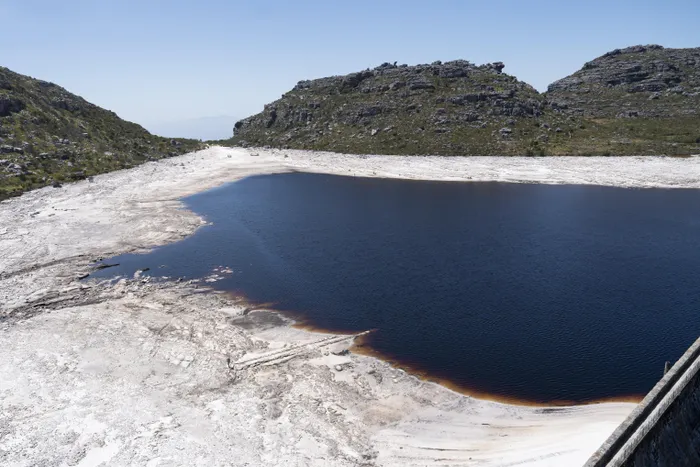
Woodhead Reservoir is dunning dry. Cracked earth rims a shrunken pool of tannin brown water, receded to roughly half its depth amid the mountain's stark granite and fynbos. The City of Cape Town has issued an early drought caution, urging residents to keep daily use below 975 million litres amid rising summer demand and forecasts of unpredictable rainfall.
Image: Armand Hough / Independent Newspapers
As the City of Cape Town’s Water and Sanitation Directorate urges everyone to reduce water consumption due to dam levels dropping to 69%, experts warn that while rainfall is uncontrollable, prioritizing the protection of existing water resources is essential. They cited that a lack of water could see disease and sickness outbreak and stressed preparedness.
Dr Jo Barnes, Department of Global Health, Health Systems & Public Health, Faculty of Medicine and Health Sciences said the impact on communities when safe and reliable water supplies fail or become seriously restricted, can be severe.
“Some of the important public health concerns include outbreaks of waterborne diseases (diarrhoea, cholera, typhoid, dysentery etc.), increased risk of viral infections (hepatitis, norovirus) due to poor hygiene, and chemical poisoning from possible pollutants (lead, arsenic, nitrates) in the water system,” she added.
“Those pollutants can lead to acute illness, malnutrition, dehydration, and also long-term health issues. The vulnerable segments of our population, such as children, persons suffering from other health conditions such as HIV or TB, malnourished persons, pregnant women, and the elderly are particularly susceptible to heightened risks.
She stated that illnesses arising in the community can overload already strained health services and impact on the care that patients suffering from other health concerns face.
“The biggest immediate impact is on health and sanitation. Lack of clean water to wash food, clean the home environment and provide proper personal hygiene can spread diseases very fast,: she detailed.
Barnes warned this is exacerbated during summer heat when food spoils faster and animals and children are in greater need of being kept clean due to their exposure to the environment outside of the home.
“Municipalities often claim that they provide water tankers for people to fetch water, but that is a poor substitute for the planning and expansion that should have happened a long time ago,” she cited.
“Water is heavy and carrying water supplies from a central point to homes can be an onerous task, especially for the elderly and the infirm.
“The health care system can be a hotspot for antibiotic resistant organisms and they themselves face constraints to keep the hospitals and clinics clean and hygienic.
“Beyond the immediate health concerns, a lack of safe and clean water impacts food production (especially fruit and vegetables) as well as impacts on the economic system. Absenteeism due to illness as well as lack of water for industrial processes are all ripple effects from poor water supply situations.”
Caroline Marx, the director of the environmental non-profit organisation, RethinkTheStink, who has challenged the city previously on its position that air quality around the Milnerton Lagoon poses no immediate health risk said preservation at this stage was important.
“Recycled treated effluent water normally used for irrigation has been unavailable in Milnerton for months, forcing the use of potable water simply to keep costly landscaping alive,” she explained.
“Although recycled water is available, the dedicated pipeline has been problematic for years. Protecting potable water supplies by ensuring reliable effluent water delivery for irrigation should be a key priority.
“While water losses from leaks have been steadily reduced to around 24%, bringing this figure down to a more acceptable 15% is critical. Some countries have achieved losses as low as 5%, highlighting how much further improvement is still needed.
“We cannot control rainfall, but we can and should — prioritise protecting the water we have.”
The City’s Mayco Member for Water and Sanitation, Councillor Zahid Badroodien explained that recent trends published in the City’s weekly water dashboard show excessive average daily water use by Capetonians.
Badroodien said reduced annual rainfall has led to lower inflows into the dams, intensifying the strain on the City's water supply system.
Although taps are not currently at risk of running dry, this situation could quickly change, potentially leading to water restrictions, if high water consumption is not urgently reduced.
The City's current dam storage level is 69.1%. This volume must be sufficient to maintain the water supply until the subsequent seasonal rainfall begins.
‘This is a critical moment for us, where we must reduce the unnecessary litres of water used in our homes, in industrial and agricultural processes and at work. We can’t afford to be complacent any longer and we must closely keep track of consumption indicators on a weekly basis,” said Badroodien.
“Early proactive measures are far more effective than emergency restrictions. We need to be water-wise at all times.”
In 2018, Cape Town experienced a significant drought, leading to a tightening of water restrictions. This period included tariffs and a ban on garden watering, all part of an aggressive conservation effort to avert the feared "Day Zero."
However, dam levels began to recover. Consequently, restrictions were gradually eased in late 2018.
Badroodien said the City is busy with various actions, including consistently resolving reported pipe bursts and water leaks within the shortest timeframe.
“Since the drought, the City has and continues to invest in upgrading aged water pipes, improving pressure management, fixing leaks faster and strengthening metering along the water supply network," he detailed.
He added in the long term, to reduce dependency on rain-fed dams, the City is scheduled to proactively add new water sources, such as desalination and water reuse to our supply from 2031.
Get your news on the go, click here to join the Cape Argus News WhatsApp channel.
Cape Argus