Breaking the bank: South African parents grapple with soaring school costs


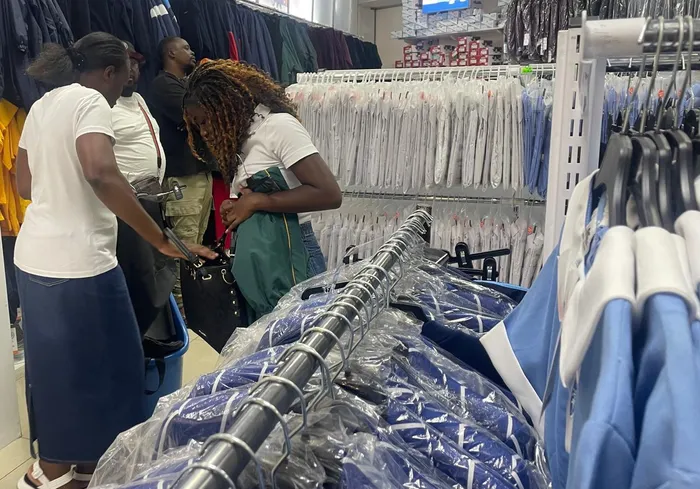
The big Back-to-School shopping spree has began as parents flock to school wear and stationery retail outlets to kit their kids out for the new school year. Pictures/Video: Ian Landsberg
Image: Ian Landsberg/ Independent Media
As South Africa’s unified school calendar gets underway on Wednesday, January 14, parents say the cost of sending a child to school has reached breaking point — driven not only by uniforms and fees, but by increasingly long and expensive stationery lists.
New analysis by Teneo Online School estimates that the minimum “entry fee” for a Grade 8 learner at a public, fee-paying high school has risen to R5,015.78 in 2026. This covers compulsory uniforms, stationery and specialist tools, but excludes school fees, transport and food.
Uniform essentials including a blazer, shirts, jersey and trousers or skirt make up the biggest share at R2,714.90, followed by stationery packs costing R1 336.90. Footwear, a school bag and items such as a scientific calculator push the total beyond R5 000.
For low-income households, the figures are particularly stark. With the national minimum wage set at R30.23 an hour, a parent earning the minimum would need to work 166 hours, more than a full month, to afford these basics alone.
“South African parents are facing a compliance crisis where the cost of looking like a student is becoming a barrier to being one,” said Saul Geffen, CEO of Teneo and founder of the Smart School System. “When a school blazer costs nearly half a month’s minimum wage, the system is failing its most vulnerable.”
But parents say it is the scale and sometimes the logic of stationery lists that is fuelling frustration.
“My son is only going to grade 4,” said Durbanville mother Anike Viljoen. “I don’t see how he is going to go through four reams of paper on top of the dozens of books and exam pads he will be writing in.”
“I just wonder how many parents are actually buying all the items on the list to compensate for those who don’t,” Viljoen said.
A father of a Grade 2 learner from Worcester said cleaning products on stationery lists were particularly hard to justify.
“My daughter has about 30 classmates, each of who has been told to bring two cans of air freshener at the start of the year,” he said. “That means the class goes through more than a can per week before you factor in holidays and weekends.
Former teacher and mother of two, Joanne Trout, said some hygiene items were understandable, but others felt excessive. “I do feel that wipes are necessary in some cases and that each grade should have their preference, but I’m not sure about the handwash,” she said. “I also don’t see the need for tissues when toilet paper is also available. These items are quite pricey.”
Trout said the January timing made matters worse. “Paying R2,000 for two children is expensive, but what about families with three or four children, especially where only one parent is working? December is a long month and the festive season is expensive. It’s a lot of money in one go.”
The Western Cape Education Department said it does not keep provincial averages for uniform or stationery costs, as these are determined by individual school governing bodies. Parents unable to afford fees may apply for exemptions, with R85.089 million paid in 2024 to support 83 793 learners.
Get your news on the go, click here to join the Cape Argus News WhatsApp channel.
Cape Argus