A rare encounter: An injured African penguin seeks help from kayakers

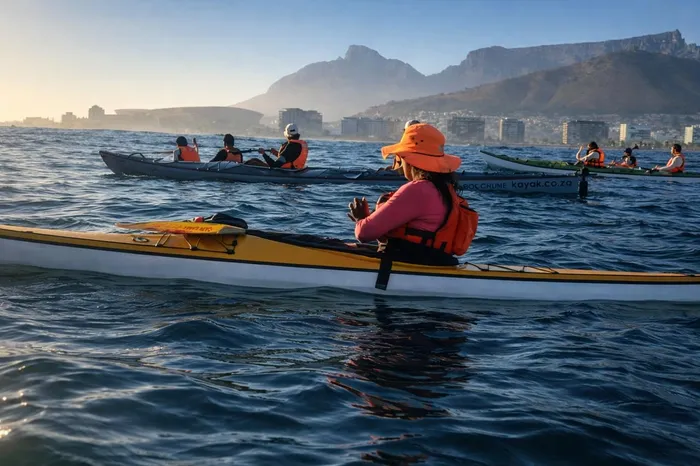
A morning paddle in Three Anchor Bay became a viral moment when an injured African penguin climbed onto a kayak — a powerful reminder of the ocean’s magic and the urgency of protecting endangered penguins.
Image: Murray Swart/ Cape Argus
An early-morning paddle in Three Anchor Bay offered far more than calm waters and scenic views, unfolding instead into a rare and moving encounter that has since captured hearts far beyond the shoreline.
Photos and videos of an injured African penguin climbing onto a kayak went viral this week, drawing widespread attention to the extraordinary moment — and to the fragile state of one of South Africa’s most endangered seabirds.
On Thursday, the Cape Argus joined Kirshia Govendar from Cape Kayak Adventures on the water, following her now widely shared encounter. Govendar, who is also Programme Manager at the International Ocean Institute – Southern Africa, says the experience underscored just how closely human activity and marine conservation are intertwined.
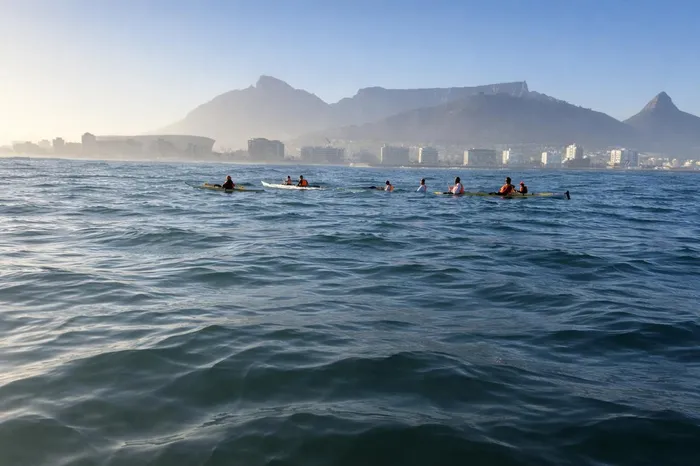
A morning paddle in Three Anchor Bay
Image: Murray Swart/ Cape Argus
While large swells hampered visibility, the ocean was teeming with life — a personal observation reinforced by sightings of dolphins, seals and penguins moving through the bay.
It was during a similar paddle that a lone African penguin suddenly surfaced beside the kayaks.
“It was an incredible encounter,” Govendar said. “We saw the little African penguin pop up out of nowhere. It was quite vocal as it started circling our kayaks.”
What initially appeared playful quickly became concerning.
“We soon realised that something was actually wrong with this animal and went closer to check,” she said. “We got to the point where it allowed me to get close enough to actually cradle it, and the next moment it hopped up along my arm and onto my kayak.”
The penguin’s behaviour suggested an unusual level of trust.
“Hearing that penguin, thank us was just the most incredible sound,” Govendar said. “It was so grateful to be on board.”
A closer inspection revealed the seriousness of its injuries.
“When I looked closer, I noticed a hole in its chest area that was deep enough that we could actually see its bones,” she said. “It was chirping as if to communicate to us that it needed help, so we called SANCCOB.”
The paddle back to shore took about 30 minutes, during which the penguin appeared calm and settled.
“It seemed so content along the way,” Govendar said. “It’s quite dangerous to have an African penguin that close to your face because they have very sharp beaks, but I think there was a level of trust between us. I just cradled it and we shared a few hugs.”
At one point, the penguin began preening — a behaviour associated with comfort and safety.
“Eventually it started preening, taking oil from its preening gland to waterproof its feathers,” she said. “Then it started preening me, which is a sign that the animal felt content and safe.”
The only moment of aggression came once they reached land.
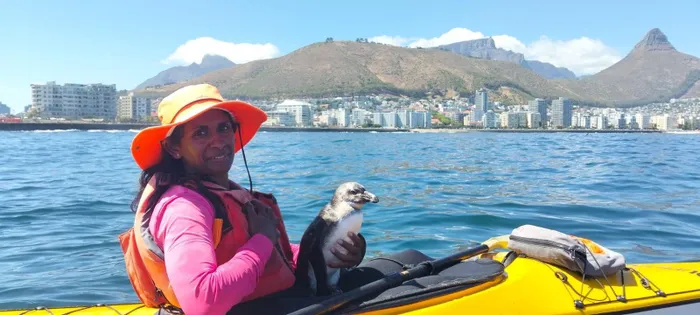
Kirshia Govendar and the young penguin she rescued near Three Anchor Bay
Image: Supplied/ Cape Kayak Adventures
“When it saw two dogs off lead, that was the only time it tried to bite and peck at me,” Govendar said. “It was incredible to see its defence mechanism while it displayed such a level of trust with me and the team.”
Beyond the emotional rescue that has since resonated across social media, the encounter has shone a spotlight on the urgent need to protect South Africa’s marine ecosystems. Govendar emphasised the role of marine protected areas, where fishing is prohibited and regulations are designed to safeguard ocean life, including African penguin colonies.
“When we are consuming seafood, make sure you are making informed decisions — ask where it’s from, the name of the fish, how it was caught,” she said. “And it’s crucial to keep our beaches clean.”
African penguins, also known as jackass penguins because of their distinctive braying call, are the only penguin species that breeds in Africa. Once numbering in the millions, their population has collapsed due to overfishing, climate change and human activity along the coast. Now listed as Critically Endangered, fewer than 10 000 breeding pairs remain in the wild, with conservationists warning that without urgent intervention the species could face functional extinction within the next decade.
As the kayaks cut back across the swell, the morning left a lasting impression: moments that move the internet in seconds are often born from quiet encounters at sea — and they carry a powerful reminder of what is at stake if marine life is not protected.
Get your news on the go, click here to join the Cape Argus News WhatsApp channel.
Cape Argus