DFFE warns public against consuming shellfish amid ongoing red tide concerns

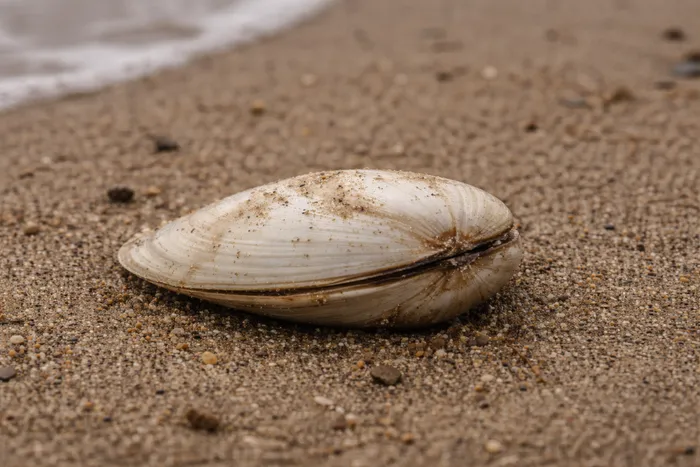
A single dead white mussel lies washed up on the shoreline, one of several marine species affected by recent red tide activity along the coast.
Image: AI Generated
The Department of Forestry, Fisheries and the Environment (DFFE) has renewed its warning to the public to avoid consuming shellfish and washed-up marine life as red tides continue to affect parts of the West and South coasts.
In an update issued on Sunday, January 4, the department confirmed that the earlier incident in which large numbers of dead white mussels, whelks and other shellfish washed ashore has remained confined to St Helena Bay and Elandsbaai on the West Coast.
Observations by Fisheries Control Officers and satellite imagery indicate visible red tides extending from Elandsbaai northwards for about 100km to beyond the Olifants Estuary. While no fish or shellfish mortalities have been reported in association with these newly visible blooms, the department stressed that the risk of toxicity remains high.
“All shellfish, irrespective of being washed out or collected from shore or subtidal, should not be eaten,” the DFFE warned.
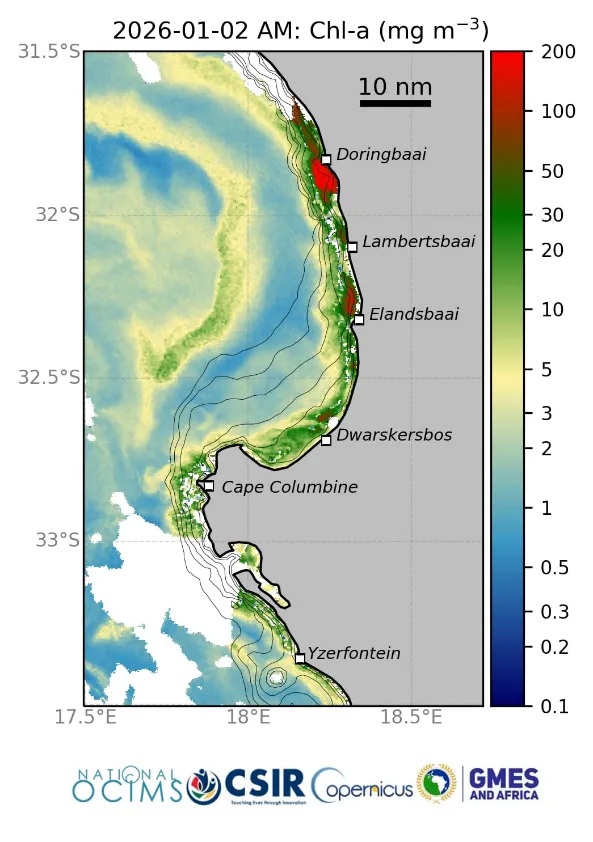
Satellite image of chlorophyll concentrations on the West Coast 2 December 2026. Cloud cover resulted in zero visibility and imagery on 3 December 2026.
Image: Supplied
Satellite imagery and reports from members of the public and fisheries officials have also confirmed a visible red tide in Walker Bay near Hermanus. This red tide is bioluminescent, with phytoplankton producing flashes of light at night. No fish or shellfish mortalities have been reported in this area, but authorities said a precautionary approach remains necessary, advising that no shellfish be collected or eaten.
Further east, the department reported a mass fish mortality in the Hartenbos Estuary in Mossel Bay. However, the DFFE clarified that this incident is not linked to a red tide, but is instead the result of sewerage discharge, leading to eutrophication and ammonia toxicity in the estuary.
The update follows an earlier public warning issued on December 31, 2025, after large numbers of dead white mussels and other shellfish were found washed up along the West Coast.
At the time, the department said the shellfish had likely died after being paralysed by toxins associated with a harmful algal bloom, including a colourless red tide that is not visible to the human eye but produces highly dangerous paralytic shellfish poisoning neurotoxins.
The DFFE said there are multiple causes behind the recent fish kills and shellfish wash-outs along the West and South coasts, but reiterated that all washed-up marine animals pose significant health risks and are unsuitable for consumption.
The department said it will continue monitoring the extent of red tides and related mortalities and will issue further updates as the situation develops.
Get your news on the go, click here to join the Cape Argus News WhatsApp channel.
Cape Argus