Environmental activists challenge Cape Town's air quality claims around Milnerton Lagoon


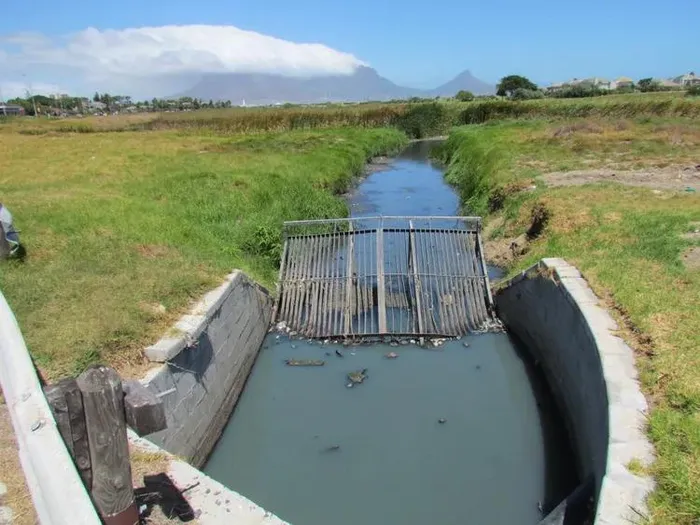
A polluted water channel flowing into the lagoon near Woodbridge Island, an area at the centre of ongoing concerns about sewage contamination, air quality and public health impacts raised by residents and civic groups.
Image: File/ Karen Watkins
THE City of Cape Town’s position that air quality around Milnerton Lagoon poses no immediate health risk has been challenged by environmental activists and an opposition councillor, who argue that the monitoring approach does not adequately reflect real exposure conditions or residents’ reported health impacts.
Responding to questions, Francine Higham, the Mayoral Member for Community Services and Health, said City Health recommissioned continuous ambient air-quality monitoring at Woodbridge Island in February 2025 after earlier equipment was vandalised.
She said monitoring shows hydrogen sulphide (H₂S) concentrations remain “well below” the World Health Organization’s daily guideline of 110 parts per billion, and that a review of current scientific literature indicates low-level exposure has limited impacts on human health.
Based on these findings, Higham said a formal Health Risk Assessment is “not currently warranted”, adding there are “no immediate health concerns” for residents from air exposure at this time.
She said monitoring would continue and that public health guidance would be communicated should levels approach guideline thresholds.
However, environmental group Rethink The Stink has disputed the City’s conclusions, saying the assurances rely on a narrow interpretation of risk.
The group said it does not dispute that 24-hour average H₂S levels have not exceeded WHO acute guidelines, but argues that this does not address chronic low-level exposure or short-term peak events.
Rethink The Stink questioned the height at which the City’s monitoring equipment is installed, arguing that hydrogen sulphide is heavier than air and tends to accumulate closer to the ground, particularly during calm conditions.
The group said City monitors are positioned at approximately 3.5 metres above ground, while international guidance and occupational-health standards recommend monitoring at breathing height.
The organisation also raised concern about short-term spikes in hydrogen sulphide levels, saying City data shows frequent peaks, including readings above 200 ppb, which are diluted when averaged over a 24-hour period. According to the group, these peaks correspond with intense odour episodes and symptoms reported by residents.
Caroline Marx of Rethink The Stink said: “The City’s air monitoring data may be technically accurate, but hydrogen sulphide, the gas responsible for the rotten-egg smell, is heavier than air and tends to settle close to the ground unless dispersed by wind. Measuring it at 3.5 metres can underestimate real exposure, especially for children and the elderly.”
She added: “You cannot assess public health risk if you are not measuring pollution in the breathing zone.”
Marx said that while odour incidents have subsided for now, conditions could change. “Without ground-level monitoring, the City is unprepared should conditions deteriorate again,” she said.
Political pressure has also come from Karl Bodin, who said residents continue to experience health problems linked to lagoon conditions.
“Residents are still experiencing the same toxic odour from the lagoon as before and still experiencing nasal and airway issues with wheezy lungs,” Bodin said.
“The Cape Independence Party (CAPEXIT) feels it is unacceptable that residents will continue living like this into 2026 and the near future.”
Higham said the City would continue air-quality monitoring and maintain signage warning that the lagoon water is not suitable for recreational use as part of its public health precautions.
Get your news on the go, click here to join the Cape Argus News WhatsApp channel.
Cape Argus