City of Cape Town refutes ActionSA's claims of unlawful sewage discharge into the ocean


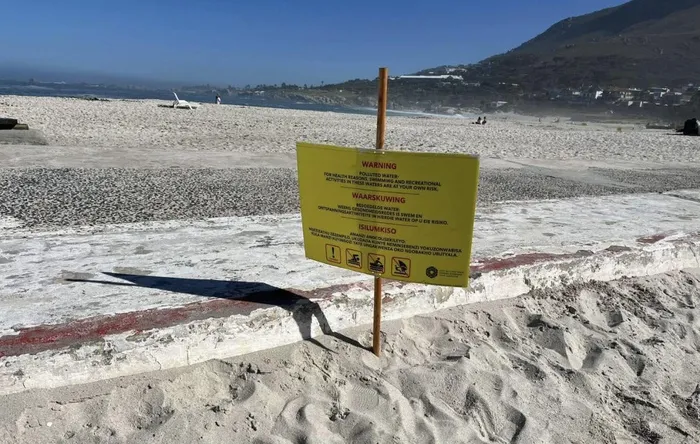
A warning sign advising beachgoers of polluted water conditions is seen amid ongoing political debate over Cape Town’s marine outfalls and coastal water quality.
Image: Michael Beaumont/ Facebook
The City of Cape Town has refuted claims by ActionSA that it is unlawfully discharging raw sewage into the ocean, accusing the party of misleading the public about the operation and impact of the City’s marine outfalls.
ActionSA’s claims stem from appeal submissions it lodged with a Department of Forestry, Fisheries and the Environment (DFFE) panel, in which the party alleges that the City is unlawfully discharging untreated sewage into the ocean via marine outfalls at Green Point, Camps Bay and Hout Bay, and has accused the City of breaching licence conditions and endangering public and environmental health.
Responding to ActionSA’s submissions to a Department of Forestry, Fisheries and the Environment (DFFE) appeals panel, the City’s Mayoral Member for Water and Sanitation, Councillor Zahid Badroodien, said the City “continues to closely monitor not only our three marine outfalls but our coastal waters along the stretches of beach as well”.
He said the outfalls do not affect recreational areas, explaining that “the outfalls do not impact recreational areas or blue flag beaches and are positioned far from the shoreline where effluent is dispersed within what is termed an ‘allowable mixing zone’”.
Badroodien rejected ActionSA’s assertion that the City had applied for new licences. “ActionSA intentionally seeks to mislead the public by claiming that the City has applied for new licences. This is not the case,” he said.
Instead, he said the City is working with the DFFE to review licence conditions that are inconsistent across the three marine outfalls. “It is incorrect to claim that the City is discharging an uncontrolled volume of screened sewage into the ocean,” Badroodien said. “Independent scientists monitor ocean conditions and the City reports to the regulating authority on all necessary parameters in line with the original licensing conditions.”
Addressing claims of permit exceedances at the Hout Bay marine outfall, Badroodien said these were based on outdated permits. “The City has asked the DFFE to review these permits based on inconsistencies identified,” he said. “It’s therefore incorrect to intentionally confuse the public by suggesting there are exceedances, because in line with original parameters, the City is compliant.”
Badroodien also rejected comparisons between Cape Town and eThekwini, saying: “In an attempt to fear monger amongst our residents and visitors, ActionSA attempts to create a false comparison between our well-run city and the failing city of eThekweni.”
He said it was misleading to suggest Cape Town’s marine outfalls were responsible for beach closures, noting that “scientific data simply does not support this claim”. According to Badroodien, “regular coastal water monitoring confirms that our recreational beaches are safe for recreational use and that coastal water quality is within the acceptable recreational parameters”.
He further pointed to the City’s Permit Advisory Forum (PAF) meetings, which are open to the public and where environmental monitoring data are presented. “It is to be noted that ActionSA does not attend any of these public PAF meetings and they are also recycling dated data not consistent with scientific findings reported and discussed at the most recent PAF,” he said.
At the most recent PAF meeting, data presented showed that the City continues to operate the marine outfalls with current permits and licence conditions issued by national authorities.
The City’s independently appointed environmental monitoring organisation also released first-year results of its 2024–2025 Receiving Environment Monitoring Programme, confirming that the Green Point, Camps Bay and Hout Bay marine outfalls are operating safely and within environmental standards.
Badroodien said seven major independent studies cited by the City have concluded that “the marine outfalls are meeting their design objectives in reducing potential deleterious ecological and human health effects of discharged effluent by taking advantage of increased effluent dilution offered by deep water”.
He added that marine outfalls account for 5% of the City’s total wastewater discharge, with the remaining 95% treated at land-based wastewater treatment works.
Outlining the City’s position, Badroodien said Cape Town is pursuing a multi-phase programme to address marine outfalls, including a R200 million refurbishment tender awarded in November 2025, as well as medium- and long-term treatment options currently under feasibility study. Early estimates place the potential total cost of these projects at about R12 billion.
“The City is committed to implementing practical alternatives to better manage our sewage discharge at the marine outfalls,” he said.
Get your news on the go, click here to join the Cape Argus News WhatsApp channel.
Cape Argus