Gang violence escalates in Western Cape as Government response falters

Young boys in the Western Cape are increasingly being used as gang recruits.
Image: File
Gang-related violence in the Western Cape continued to escalate throughout 2025, sustaining a worrying upward trend of the past five years and exposing serious weaknesses in the provincial government's response.
This is according to the latest Western Cape Gang Monitor released by the Global Initiative Against Transnational Organised Crime (GI-TOC) .
The December 2025 report reviews gang dynamics over the past year and sets out a 12-point plan for rapid intervention, which the authors say can largely be implemented within one to three months.
According to SAPS data cited in the report, gang-related murders in the first six months of 2025 were 58 higher than in the same period in 2024, after already doubling between 2020 and 2024. The monitor shows that violence is highly concentrated in specific clusters, particularly Hanover Park, Manenberg and Mitchells Plain, where multiple gangs control adjacent territories and conflicts have become increasingly unpredictable
Mapping of incidents between November 1, 2024, and October 31, this year shows that these hotspots overlap with police precincts identified as vulnerable to corruption and weak service delivery.
It describes a more volatile, fragmented and heavily armed gang landscape, driven by turf wars, breakaway factions, illegal firearms and systemic failures in policing and the criminal justice system.
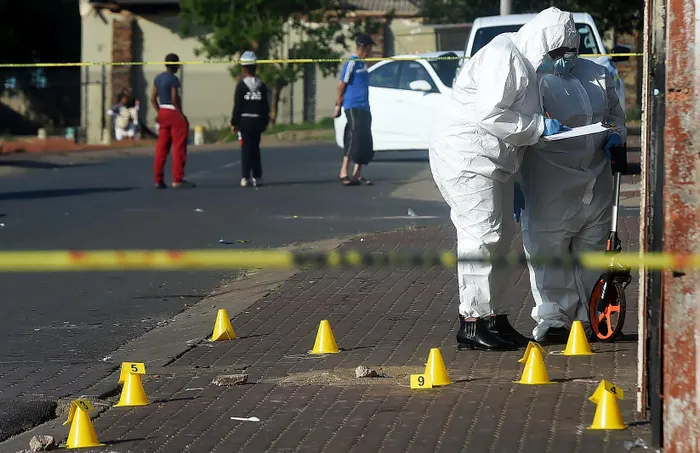
Crime investigators comb an area of a crime scene due to gang violence.
Image: Itumeleng English / Independent Newspapers
The report identifies accelerating gang fragmentation as a key driver of violence, with established gangs splintering and new factions emerging.
The monitor highlights the rapid expansion of the Fancy Boys, who have grown significantly since 2020 by absorbing members from rival gangs and expanding access to firearms, drugs and illicit profits.
It also identifies the unchecked flow of illegal firearms as a central factor fuelling violence, with weapons diverted from police and military sources, corrupt licensing systems, private security companies and smuggling routes, including firearms trafficked from Namibia.
The report notes that almost all major gang leaders reportedly have links to private security companies, which are legally able to purchase firearms and ammunition that can later be diverted for criminal use.
It further highlights serious weaknesses in the criminal justice system. Since 2021, the conviction rate for offences involving firearms seized in the City of Cape Town stands at just 5%, while SAPS performance targets for 2025 set a national murder detection rate of 11.33%, meaning most murders are expected to go unsolved.
GOOD Party secretary-general Brett Herron said the report "should be required reading for a Western Cape Government that is singularly failing to counter the culture of gang association and violence".

A man puts his hands against a wall, with '28' (referring to a gang) written on it as he is searched during a combined visible policing and stop-and-search operation in Lavender Hill near Cape Town on August 28.
Image: RODGER BOSCH / AFP
"What the Western Cape Gang Monitor tells us is that the Province's strategies are not sophisticated enough to address the deeply rooted gang culture, and that there are better ways in which taxpayers' money should be spent," he said.
The report warns that more children than ever before are being recruited into gangs, with civil society organisations reporting recruitment of children as young as eight, particularly in and around schools.
To address the crisis, the GI-TOC sets out a 12-point plan targeting three critical failings: inadequate police accountability, the absence of a coherent prevention strategy, and unchecked flows of illegal firearms.
JP Smith, Mayoral Committee Member for Safety and Security, said the City had seen the publicly accessible document which is reviewed by the relevant Safety and Security departments.
Asked whether the city was considering implementing the recommendations, Smith said: "The majority of the report's recommendations fall outside the mandate of local government and sit primarily with national law enforcement and the criminal justice system.
"However, the three recommendations that are applicable to local government are already being actively implemented by the City.
"These include continued investment in prevention and intervention programmes, sustained stop-and-search operations in known gang-affected areas, and the ongoing scaling up of information-gathering capacity and operational responses aimed at the detection and removal of illegal firearms."
The Cape Argus also queried how the city's deployment of LEAP has helped in addressing gang violence.
Smith added that LEAP, together with Metro Police, Law Enforcement, Traffic Enforcement and the NSOs, have increasingly demonstrated their ability to make a meaningful contribution to addressing gang violence through arrests, firearm seizures and visible policing.
"However, their impact is undermined by systemic challenges within the criminal justice system, including low conviction rates, delays in ballistic testing, and the continual influx of illegal firearms," he said."
"This is precisely why the City has been campaigning for increased powers and systemic reforms to better support the criminal justice system and to improve conviction rates, in line with the report's recommendations."
He said the city has Cape Town has expanded its policing capacity by 48% since 2021, adding 1,263 new officers to reach a total force of 3,883 personnel.
"Over the same period, SAPS has shed an estimated 1,300 officers in the city – a 15% decline that has left the national police service with just 7,355 active duty officers in Cape Town," he explained.
When asked about how the city currently views the main concern around illegal firearms in Cape Town, Smith explained: "The City has been consistently vocal about the extremely low number of convictions linked to illegal firearm arrests, prolonged delays in ballistic processing, and the persistent and unchecked supply of illegal firearms. These challenges significantly undermine enforcement efforts and fuel ongoing violence.
"Expanding the policing powers of the Metro Police will significantly enhance the City's ability to assist SAPS in the fight against illegal firearms. Beyond making arrests, City enforcement would be able to actively investigate cases and prepare conviction-ready dockets for submission to the National Prosecuting Authority.
"The City continues to call on the National Minister to make the right decision and expand these powers, in line with the recommendations contained in this report."
Get your news on the go, click here to join the Cape Argus News WhatsApp channel.
Cape Argus