Deaf graduate Trevolin Pillay breaks barriers at Stellenbosch University


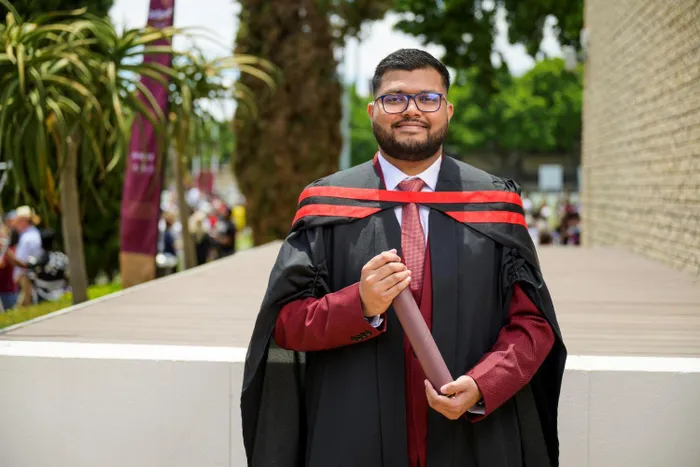
Deaf graduate Trevolin Pillay celebrates earning his BSc Honours in Bioinformatics and Computational Biology at Stellenbosch University’s December graduation ceremonies.
Image: Stefan Els
Fresh from crossing the stage at Stellenbosch University’s December graduation ceremonies, Trevolin Pillay is celebrating a landmark achievement — earning his BSc Honours in Bioinformatics and Computational Biology after a year as the institution’s only Deaf honours student.
Born profoundly Deaf, Trevolin identifies proudly with the Deaf community, which he describes as having “a unique culture, primary language (South African Sign Language or SASL), and identity.” He often downplays his achievements, calling himself “just a simple Deaf person from Chatsworth, KwaZulu-Natal”, yet he is driven “to break the barriers of communication between the deaf and hearing in this world.”
His academic journey began at Fulton School for the Deaf in Gillitts, KwaZulu-Natal. “I was top learner in all the grades and received many awards, including the DUX award,” he writes. At Belgium Campus iTversity, he joined the first group of six Deaf students to complete a bachelor’s degree in IT — and became the first to graduate magna cum laude. “There were good resources and materials for the deaf students, as well as good SASL interpreters to support us to achieve our goals and graduate,” he explains.
Starting honours at SU early in 2025 meant being the only Deaf student in his programme. “My schooling and undergraduate studies were always with other Deaf students. I had to learn to adapt to this new environment. Slowly I started enjoying being independent and roaming around the place.”
Administrative assistant Rahkeenah Peterson, who had recently completed a beginner’s SASL course, was one of the first to welcome him. “The day Trevolin walked into my office, I was able to greet him, sign my name, and ask him how he was doing,” she says. “Throughout the year, he came to my office with various enquiries, and in most cases, I was able to understand him. I also learned from him – whenever I signed something incorrectly, he kindly corrected me.”
His supervisor, Dr Lenine Liebenberg from the Centre for Epidemic Response and Innovation (CERI), says working with him has been “one of the most humbling and rewarding experiences” of her career. “As a team, we made a conscious effort to create an inclusive environment — encouraging the use of SASL apps, speech-to-text tools, and WhatsApp messaging for real-time communication, and promoting SASL training,” she says. SU’s sign language interpreters, Trudie Theunnissen and Marsanne Neethling, joined meetings and supported him during presentations.
What stood out most was Trevolin’s determination. “He entered a space that was mostly new to him—both biologically and computationally—and engaged it with courage and grace,” Liebenberg says. “By the end of the year, not only had he developed strong bioinformatics skills, but he had also gained a deep understanding of human papillomavirus, its role in cervical cancer, and a practical understanding of the tools used to study viral dynamics.”
Interpreter Trudie Theunissen says Trevolin’s story highlights the rights Deaf students should expect in higher education. “Many Deaf students aren’t always aware that they have the right to professional SASL interpreting, accessible learning materials, and equal participation in academic spaces,” she says. “Simple things—like sharing slides in advance —make a huge difference.”
She stresses that “needing an interpreter doesn’t put them at a disadvantage academically. With proper access, Deaf students can thrive in any field, even highly specialised areas.”
Trevolin admits the programme tested him early on. “I was very close to quitting during the first two weeks of my studies after seeing and reading the cell biology materials. I struggled to understand the biology, especially the long and difficult words,” he writes. “Today I am glad that I overcame these odds and never gave up, thanks to my mentor, supervisor and co-supervisors.”
He credits his mentor, Dr TJ Sanko, for sharpening his technical skills: “He played a crucial role in mentoring me to improve my bioinformatics knowledge and skills, especially some new tricky skills when it comes to coding and running the command line on the High Performance cluster.”
Now a graduate, Trevolin hopes to “create more opportunities for deaf people in the hearing world.”
“I’m just a simple Deaf person from Chatsworth, KwaZulu-Natal, who has set his eyes on accomplishing goals – this is who I am.”
Get your news on the go, click here to join the Cape Argus News WhatsApp channel.
Cape Argus