Residents await Kloof Road repairs as City of Cape Town confirms timeline


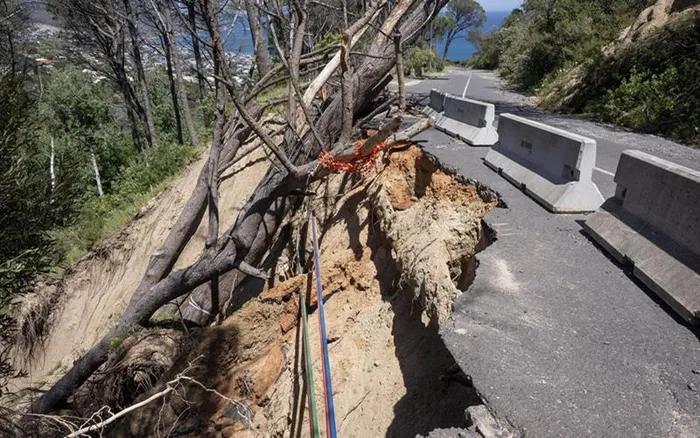
The City will start with the repair work to Kloof Road by March 2026. A section of the road was damaged during a Level-9 storm in September 2023 and has been closed to the public since then.
Image: Supplied
Repairs to Cape Town’s storm-battered Kloof Road are finally on the horizon — but residents eager for action are being warned not to expect visible construction until March 2026, when crews are due to move onto the fragile Table Mountain National Park site.
Repairs to the key route between the City Bowl and the Atlantic Seaboard are expected to start by March 2026, the City of Cape Town confirmed, ending months of uncertainty over one of the metro’s most frustrating road closures.
The City’s Urban Mobility Directorate says the first two months of 2026 will be dedicated to securing construction permits and approvals required under the project’s environmental management plan, as the route falls inside Table Mountain National Park. Only after this process will full physical repairs begin.
Kloof Road, between Kloof Nek Road and Round House Road, has been shut since a Level-9 storm in September 2023 destabilised its supporting embankments. A second slip in 2024, triggered by heavy winter rainfall, caused further damage and kept the road closed to the public.
Environmental approvals in terms of the National Environmental Management Act, along with a Water Use Licence, have already been granted — greenlighting rehabilitation in the protected, environmentally sensitive area.
Councillor Rob Quintas, the City’s Mayoral Committee Member for Urban Mobility, stressed both the urgency and complexity of the project.
“Kloof Road is an important access route and we are well aware of the inconvenience and frustration as a result of this closure,” he said. “We are eager for the project to start, and I can confirm that if all goes as planned, the contractor will be on site by March 2026 at the latest. The first two months will be used to get the construction permits and the contractor will have to prepare a method statement on what measures they will take to minimise and limit the impact on the sensitive natural environment. Thus, if residents don’t see spades in the ground in January 2026, they should not be alarmed and think nothing is happening.”
The City says repairs will take roughly 11 months once underway, given the scale of the slip failure and the need to work within an ecologically sensitive landscape.
Crews will face steep terrain, major access constraints and significant logistical hurdles. Work must start from the bottom of the kloof and progress upward, but no heavy-machinery access road can be built, making the movement of materials and equipment difficult.
Large trees at the collapse site must be removed before construction starts. Critical services such as fibre lines and water mains, which run along Kloof Road, will also need to be relocated or maintained during the rebuild. The City emphasised it can only restore what was damaged and cannot add new features such as walking or cycling lanes.
The road has remained closed in the interest of public safety since the September 2023 long weekend, when the initial embankment failure made it unsafe to carry vehicle loads. A second slip in 2024 reinforced the need for a full rehabilitation.
The City says it remains committed to reopening the strategic link — but with environmental safeguards, engineering limitations and site constraints at play, residents should expect a careful, methodical rebuild rather than rapid visible progress.
Get your news on the go, click here to join the Cape Argus News WhatsApp channel.
Cape Argus