Finance MEC adjusts Western Cape budget in response to R1 billion national funding


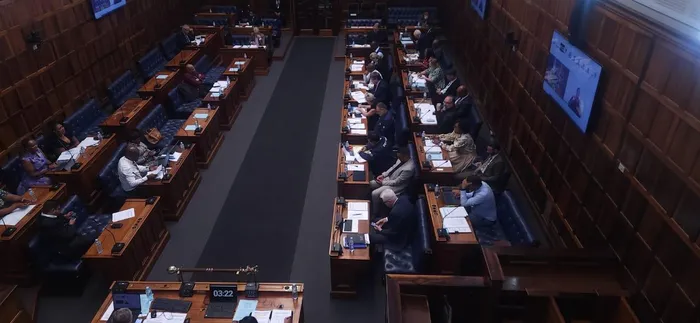
Western Cape MPLs debated the mini-budget on Thursday
Image: BRANDON NEL
A shock R1.07bn windfall from national government has forced the Western Cape to tear up and rework more than R2.3bn in its budget as it scrambles to fund strained hospitals, crowded schools and storm-hit roads.
The money landed after national finance minister Enoch Godongwana and his team pushed through late-year adjustments for provinces, leaving the Western Cape racing to fit the allocations into its books while dealing with rising pressure on basic services.
The province’s economy is expected to grow by 1.2% in 2025, almost double the national forecast of 0.7%.
The province’s total spending now rises from R87.99bn to R89.72bn for the year.
This is driven by national grant top-ups, extra equitable share funding, R924m in rollovers for delayed national transfers and ongoing projects and shifts between departments for shared services such as infrastructure and school sport delivery.
None of these movements represent cuts.
The mini budget for the 2025/26 financial year as well as the adjustment for the current budget, which was tabled by finance MEC Deidré Baartman in the Western Cape provincial legislature last week, was debated on Thursday.
But whether it will be passed is another story as the house will only vote on the mini budget on Friday.
A major share of the revised funding comes from the R1.07bn national allocation.
This includes about R496.51m in conditional grants and R573.50m in equitable share adjustments.
Early childhood development receives the biggest increase, with R232.05m to raise subsidies and widen access to early learning.
Health receives R90.92m to keep HIV treatment stable after PEPFAR funding ended.
A further R53.84m is added to the health facility revitalisation grant for upgrades at Klipfontein and Belhar regional hospitals.
The national tertiary services grant is increased by R40m to correct a national miscalculation.
Roads receive R79.69m through the provincial roads maintenance grant to repair disaster damage from earlier storms.
On top of this, the province is receiving R1.01bn in equitable share funding meant to help the education and health departments retain staff, hire more educators and absorb unemployed doctors.
Of this, R292.10m is meant for education and R712.70m for health.
Because the national budget process ran late, only R573.50m can be spent this year, and all of it is being applied to urgent health pressures.
The remaining R431.20m, including the full education share, will be allocated over the 2026 Medium-Term Expenditure Framework (MTEF), ensuring the money stays within the department’s budget instead of being lost.
Rollovers of R924m have also been added for programmes where national funding arrived late and for projects already under way, which must continue into this financial year.
There are also R814.88m in shifts between departments for services they provide to one another, such as infrastructure work led by the infrastructure department or school sport projects delivered jointly by Western Cape education department and its sports, arts and culture counterpart.
R1.74bn is added through additional adjustments, including provincial reserves, bringing the final adjusted budget to R89.73bn.
Every department sees changes, though no department has been cut.
Instead, funding that cannot be spent before year-end is being moved into future years of the 2026 MTEF so departments can plan properly and deliver at scale.
Education’s budget shows a net shift of R520.92m into the 2026 MTEF.
The money remains within the department’s baseline and will be used over the next three years.
Health receives a net increase of R641.69m from national grants and internal adjustments.
The infrastructure department receives a R1.10bn increase, not only for road and storm-damage repairs but also to speed up housing projects and continue major health and education builds.
Social development increases by R34.22m, agriculture by R282.23m and the mobility department by R141.66m.
The environmental affairs and development planning department shows a decrease of R21.78m for the current year, but the money remains in its baseline and will be spread across the 2026 MTEF.
Local government shows a R7.03m decrease for the year, but likewise retains the funding over the medium term.
These changes are formalised in the adjustments appropriation bill, which authorises the new amounts and sets out funds that are specifically and exclusively appropriated for defined purposes.
The financial context in the mini budget notes that the Western Cape receives 10.4% of SA’s provincial equitable share.
The province’s estimated funding envelope rises to R90.8bn in 2026/27, R93.2bn in 2027/28 and R95.5bn in 2028/29.
Unemployment nationally stands at 31.9%, while the Western Cape’s rate is 19.7%.
The documents also highlight that the late national budget process resulted in “the most stringent deadlines to date”, leaving departments with far less time to spend allocations legally and responsibly.
Baartman said by spreading delayed transfers into the next three years instead of forcing rushed spending, departments now have the chance to prepare for accelerated delivery rather than cut or lose funds.
IOL News