City of Cape Town defends fixed tariffs in High Court



Legal proceedings unfold as the City of Cape Town defends its fixed tariffs in the Western Cape High Court, facing challenges from SAPOA and AfriForum.
Image: File / IOL Archives
The Western Cape High Court heard arguments concerning the City of Cape Town's fixed tariffs and its decision to link certain fixed charges to property values.
On Tuesday the Court heard that the City possesses broad powers, with no restrictions on the impositions it can make.
Judge President Nolwazi Mabindla-Boqwana, as well as presiding judges Judge Andre Le Grange and Judge Katharine Savage, were fastidious as they heard arguments from SAPOA, AfriForum, and the city.
In its court application, SAPOA is asking for the three tariffs in the budget, namely the Cleaning Tariff, the Fixed Water Charge, and the Fixed Sanitation Charge be declared unconstitutional and invalid.
SAPOA’s membership currently comprises more than 90% of the country’s commercial and retail property industry, including some of the largest property-owning companies in South Africa.
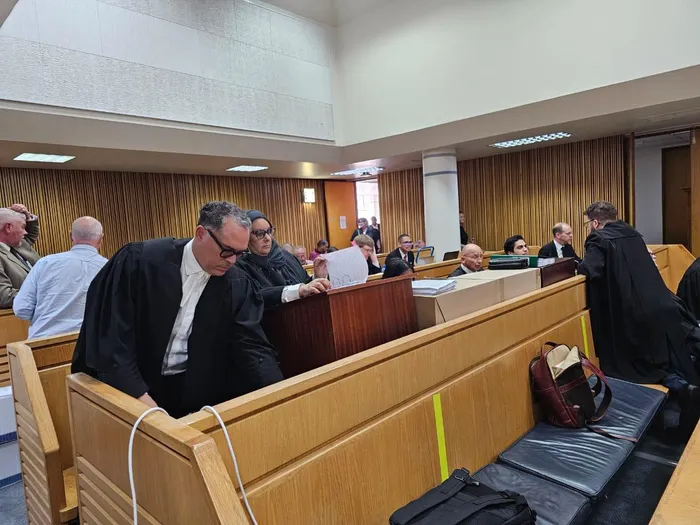
In its court application, SAPOA is asking for the city's three tariffs in the budget, namely the Cleaning Tariff, the Fixed Water Charge, and the Fixed Sanitation Charge be declared unconstitutional and invalid. Seen are the city's lawyers Advocate N Bawa SC (right), and Advocate N de Jager (left).
Image: Theolin Tembo
AfriForum, which launched its own challenge, argues that the city “does not have the power to use the value of a property to determine any fees, surcharges and tariffs other than a rate within the definition of and in terms the Local Government: Municipal Property Rates Act, 6 of 2004 (“the Rates Act”)”.
The city has maintained that its fixed charges are not rates but service charges.
Yesterday's proceedings began with SAPOA and AfriForum, using various case law judgments to substantiate their claim, arguing that as soon as a rate/charge is linked to a value of property, then it is a rate.
SAPOA’s lawyers argued that had the city followed all rules and ticked the boxes, then SAPOA wouldn’t have gone to court, and they argued that it makes a difference whether a levy is charged as a rate or as a service.
They said that their organisation has no difficulty in cross-subsidising the poor, but argued that there is a right way for the city to do that, which is through rates and not fixed service charges.
AfriForum, meanwhile, maintained that the case is about the legality of what the city is doing and what it wants to do.
“The core question in this matter is whether the city has exercised only those fiscal powers recognised by the Constitution and national legislation, or whether the impugned charges represent an overreach,” it said in court papers.
“You can still make the people who can pay, pay, (but) you must just do it lawfully.”
AfriForum argued that once the city substantially changes its tariff policy, it must amend the by-law.
Other amici and intervening parties in the matter include the GOOD Party, Cape Town Ratepayers Association, and SA First Forum.
The SA First Forum argued the matter of affordability, stating that tariff increases fail.
When the city had its turn, it argued that there is never going to be a policy in place that suits everybody.
It stated that research shows that there is a correlation between household income and property value, but stressed the point that they were referring to “household income, not personal income”.
It explained that there are specific rebates put into place (for pensioners and household income before R27,000), and that it caters for those affected by gentrification through rebates.
The city also stressed that there is nothing in the Constitution that says it can’t impose a fixed tariff. The court was a little stunned by the admission when the city stated that it had “wide powers and that there is no restriction to what it can impose”.
The matter continues.
Get your news on the go, click here to join the Cape Argus News WhatsApp channel.
Cape Argus