Safety concerns rise after second fatal paragliding crash in Cape Town


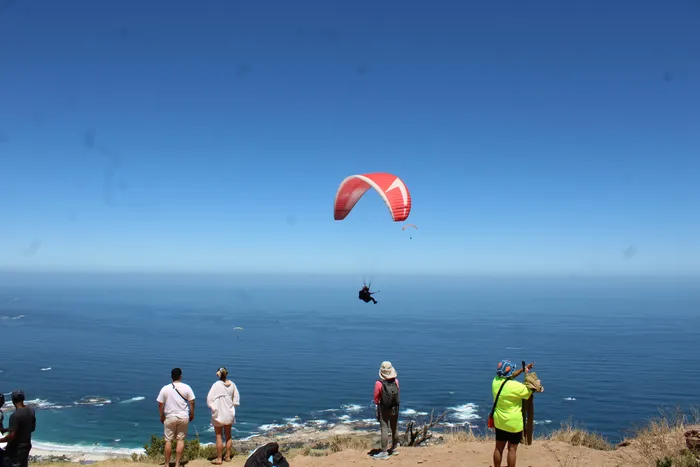
. People look on as a paraglider takes off from Lion’s Head. Ilustration.
Image: file
A 36-year-old South African pilot was killed in a paragliding accident on Lion's Head on Tuesday — the second fatal crash involving the same type of high-performance wing in just two years, prompting renewed scrutiny of safety protocols in Cape Town's soaring community.
The South African Hang Gliding and Paragliding Association (SAHPA) confirmed the man, a licensed member, was flying a Flare Moustache parakite when he fatally crashed on the mountain's steep western slope.
The specialised hybrid wing, designed for strong-wind coastal soaring, reacts far more aggressively than the larger wings used in standard paragliding. SAHPA chairperson Louis Stanford told the Cape Argus the victim was a "36-year-old South African male," but said no further details could yet be released. "We are still awaiting the official accident report and accounts from witnesses," he said.
Stanford noted this was the second fatal incident involving the Flare Moustache, after a similar crash in 2023.
A 36-year-old South African pilot has died in a paragliding accident on Lion's Head, Cape Town, marking the second fatal crash involving the same specialized 'Flare Moustache' wing in two years.
Image: Supplied
He added that the association had already begun reviewing flight protocols. "SAHPA is currently (even before the accident) reviewing launch and landing-site protocols and will be engaging with the community to firm up some of the conduct issues," he said.
He stressed that the review process was already underway before Tuesday's incident and would continue alongside the official investigation. The accident triggered a multi-agency response involving Wilderness Search and Rescue (WSAR), Western Cape EMS, SANParks rangers and other units, who battled fading light and hazardous terrain to reach the pilot.
Crews were deployed rapidly as daylight started to slip away, forcing rescuers to rely on specialised equipment. WSAR spokesperson David Nel said the teams faced difficult conditions on a near-vertical slope. "The incident occurred on a steep, technical slope and it took a team of at least 30 rescuers from various units, to complete the recovery," he said.
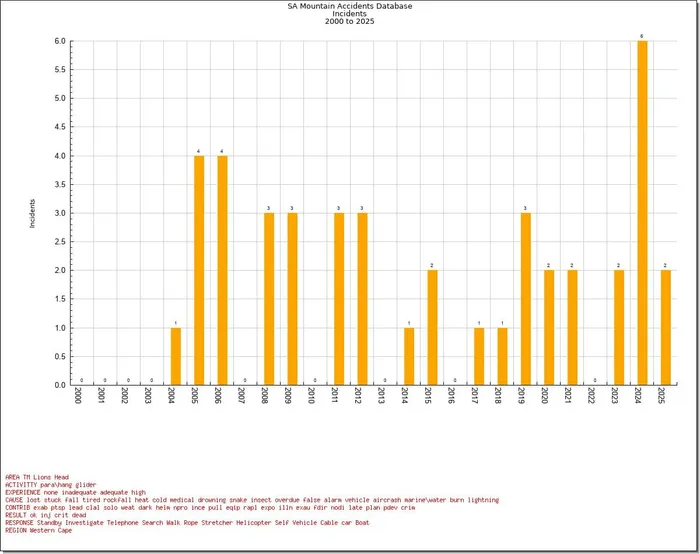
A drone was used to light up the mountain after dark. Nel said while such events were not frequent, they did appear regularly enough to be a concern. "Data shows that there have been 43 incidents over the course of the last 25 years, including approximately eight in the last 12 months," he said.
"We aren't exactly sure what led to this particular accident and while such incidents aren't that common, they are always tragic."SAHPA urged anyone with video, photographs or other evidence to submit it confidentially to SAHPA or the AIID, the aviation authority investigating the crash.
Get your news on the go, click here to join the Cape Argus News WhatsApp channel.
Cape Argus