Ramaphosa declares GBVF a national crisis, advocacy groups demand action beyond words


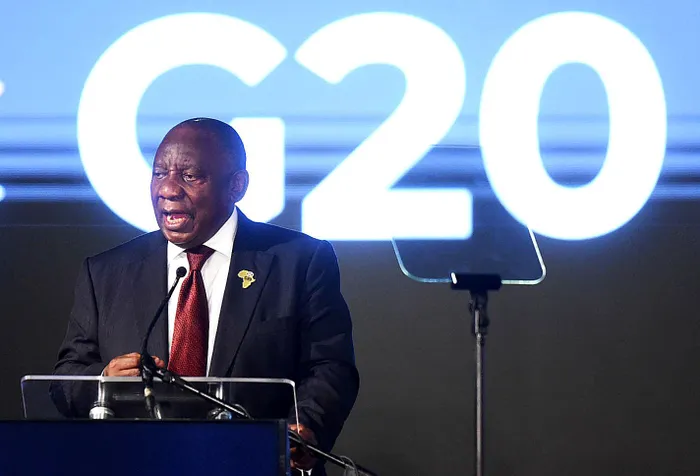
President Cyril Ramaphosa has heightened the fight against GBVF, saying the scourge needs to be a eradicated to ensure that nations thrive. Ramaphosa was speaking during the G20 Social Summit in Ekurhuleni on Thursday.
Image: Itumeleng English / Independent Newspapers
President Cyril Ramaphosa has declared gender-based violence and femicide (GBVF) both a national and global crisis that demands urgent intervention.
Speaking firmly on the matter, Ramaphosa stated that no nation can progress while its vulnerable citizens, especially women and children, continue to face abuse from those who should be their protectors.
This comes as various women's rights organisations have indicated that they will be picketing at various venues in parts of the country to highlight the scourge of GBVF in as part of planned G20 Summit-related protests.
In 2021, at the height of the Covid-19 pandemic, Ramaphosa had decried the increase in the number of domestic violence cases in the country.
On Thursday, Ramaphosa addressed the closing of the G20 Social Summit, where he said that the scourge of violence against women has now been further heightened.
"No society can thrive for as long as gender-based violence and femicide continue, and the agency of women is denied. The violence perpetrated by men against women erodes the social fabric of nations. Men and women are equal partners and must be actively involved to resolve power imbalances that normalise violence and silencing survivors," he said.
Ramaphosa stated that in South Africa, this process will be sped up as the government is at the centre of protecting its most vulnerable citizens.
"In South Africa, women need support and protection from the government and men. We are now going to classify GBVF as a global crisis to be addressed. We have agreed, among all our social partners, to take concerted efforts to end this crisis," he stated.
The three-day gathering hosted under the theme, “Solidarity, Equality and Sustainability,” reflects the nation’s strategic priorities of inclusive growth, poverty reduction, and the building of a capable, ethical, and developmental State.
Reacting to the tough stance on GBVF, Siya Monakali of Ilitha Labantu, an anti-GBVF advocacy group, said Ramaphosa's bold pronouncement, while important, falls short on urgency as GBVF has become embedded in the country's social fabric.
"Violence against women and children has long been embedded in our social fabric, perpetuated by systemic failures, weak institutional accountability, and an enduring lack of political will. While public declarations have become a recurring feature in our national discourse, particularly under the current administration, they have seldom translated into sustained implementation or measurable impact," he said.
He said to label GBVF a health crisis without fundamentally addressing the structural conditions that enable it risks reinforcing a cycle of symbolic recognition without transformation.
"This moment should therefore mark a departure from episodic dialogue towards comprehensive, properly resourced, survivor-centred intervention, reinforced by strong accountability mechanisms and coordinated action across all sectors of society. Anything less will merely repeat patterns of outrage without systemic change," Monakali stated.
For humanitarian aid worker and GBV, activist, Widaadh Williams, who is assisting the family of a 21-month-old boy who was allegedly raped by his own uncle and brutally attacked in Mitchells Plain, said promises meant seeing action: "The question is, what are they (presidency) going to do about it after they have now declared GBV to be a state of disaster. How are they going to assist our women and children in the communities, they should be providing additional policing and trauma centres."
Get your news on the go, click here to join the Cape Argus News WhatsApp channel.
Cape Argus